

Big shift in office trends in South Africa – including workspace ‘hoteling’


New property data shows that South Africa’s office and retail property markets continue to lag, reflecting not only the weak economic times in which South Africa still finds itself but also the key structural challenges in both sectors, says FNB.
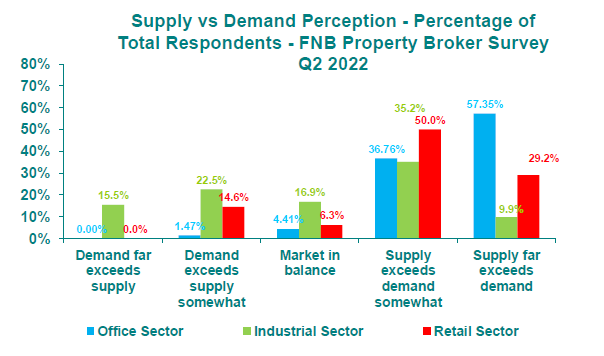
These issues are raised in the bank’s latest property broker report, which shows that while the country’s industrial property sector is seeing some growth, both retail and office sales are lagging.
“The former market is being challenged by greater online retail along with a financially constrained consumer, and the latter has the challenge of greater levels of remote work along with improved efficiency in the use of office space through hoteling of desk space,” the bank said.
In office ‘hoteling’, workspaces are reserved ahead of time — typically for longer durations of several days, a week, or a month — via a booking app or service.
FNB noted that South Africa’s office market has the most significant longer-term challenges, with weak employment growth numbers in key services sectors hampering its demand growth, and greater levels of remote working compared to pre-lockdown levels also constraining demand for space.
“At the strong end of the spectrum, industrial property benefits from a gearing up for greater online retail and all the warehousing and logistics requirements that this brings. However, even this sector’s strength must have limits at a time when the economy is coming under renewed pressure, which should imply inventory levels coming under pressure too, while the key manufacturing sector’s performance is likely to be mediocre at best,” it said.
FNB noted that the office and retail property markets also have the most respondents pointing to ‘supply exceeding demand’, either ‘somewhat’ or ‘far’, compared to those pointing to demand exceeding supply.
FNB has previously said that South Africa’s shift to remote and hybrid working is likely to have other knock-on effects on the property sector, including travel.
The bank has argued for a while that business travel not only battles from similar financial constraints following the 2020 recession impact on businesses, but the business sector has also successfully “Zoomified” much of its interaction during forced lockdowns.
This modern communication likely pushes it partially away from less efficient physical travel. Much of that costly physical business travel may therefore never return. Many hotels may have to be less dependent on domestic business travel on a more permanent basis, therefore.
Read: Airbnb enters deal with Cape Town to attract more remote workers
















 Loading ...