

How take-home pay has changed in South Africa


Recent BankservAfrica data shows a moderate increase in how much South Africans take home each month amid record high inflation.
The average nominal take-home pay for the month of June followed a downward trajectory from the beginning of the year at R15,570 to R14,600, reported BankservAfrica.
Shergeran Naidoo, head of stakeholder engagements at BankservAfrica, said it was the second consecutive month that nominal salaries have remained below the R15,000 mark and were 1.8% lower compared to a year ago.
According to Naidoo, the last time the nominal average take-home pay was this low was in July 2021. BankservAfrica further noted that in four of the past seven months, there had been negative year-on-year growth for nominal wages.
The graph below shows the trend of nominal take-home pay in South Africa over four years:

BankservAfrica’s monthly data reports show that over four years (Q2 2018 to Q2 2022), the nominal average take-home pay of South Africans has increased by roughly 1.19%.
The adverse effects of a steady decline in both the nominal and real take-home pay of South Africans have been compounded by record-high inflation.
StatsSA recently reported that inflation was at a 13-year record high in June of this year, with CPI jumping to 7.4% from 6.5% in May on the back of ever-increasing fuel and food prices.
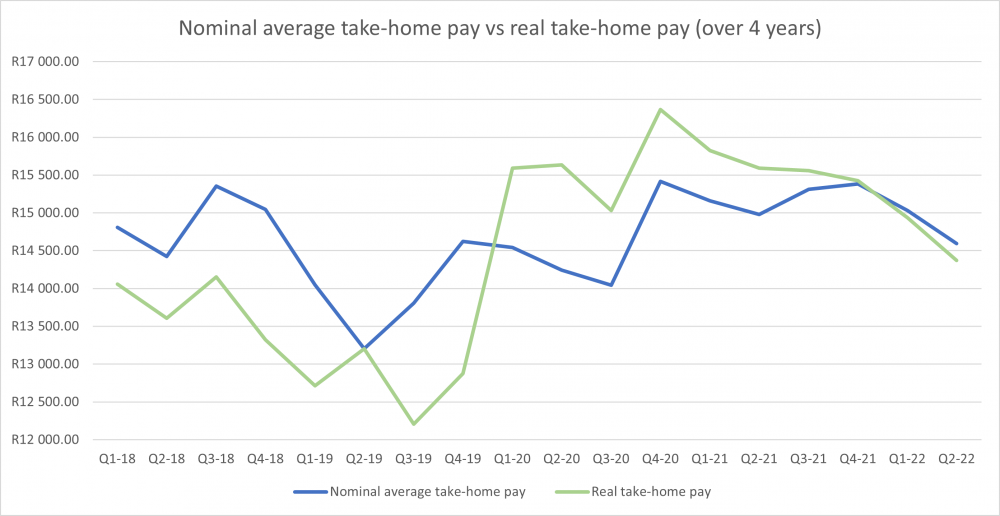
‘Real take-home pay’, referring to inflation-adjusted income, has also seen a decrease since the beginning of the year. Despite this, over four years, real take-home pay has seen a 5.62% increase, as seen below:

Real take-home pay peaked in the final quarter of 2020 however has dropped significantly to Q2 2022 (R14,374).
Real-take-home pay may continue to be shifted by inflation, with the latest Absa Quarterly Perspectives report predicting that CPI could peak around 7.9% in October, remaining above the upper 6% bound of the target range until mid-2023 and the 4.5% midpoint until 2024.
According to Reserve Bank Governor Lesetja Kganyago: “While economic growth is slowing globally, inflation continues to surprise to the upside. Sustained policy accommodation, supply shortages and other restrictions have sharply increased the prices of many goods, services and commodities.”
The graph below illustrates the difference between nominal average take-home pay and real take-home pay since 2018.


















 Loading ...