

New subjects set for schools in South Africa next year


South Africa’s Department of Basic Education (DBE) will introduce coding and robotics into the school curriculum for Grades R to 3 and Grade 7 in 2023, following a pilot project that began in the third term of 2021 for Grades R to 3 and Grade 7 students.
The pilot for Grades 4 to 6 and Grade 8 was implemented in 2022 and will be followed by a Grade 9 pilot in 2023. Full-scale implementation of coding and robotics into the school curriculum for Grades 4 to 6 and Grade 8 is planned for 2024, and the Grade 9s will follow suit in 2025.
The DBE said that the task team for the development of the coding and robotics curriculum met recently to finalise the process of strengthening the Curriculum Assessment Policy Statements (CAPS) for the subject.
A national CAPS is a single, comprehensive, and concise policy document introduced by the Department of Basic Education for all the subjects listed in the National Curriculum Statement for Grades R to 12. CAPS gives detailed guidance for teachers on what they should teach and how to assess.
For the independent school network, Curro, students in Grade R have already begun to learn robotics and coding. “Regardless of government requirements, Curro and Curro Academy have started implementing robotics from the foundation phase in some branches, including Protea Glen,” it said.
“Curro has become almost like a trendsetter in actually introducing that subject to our kids even before the government said that it’s compulsory,” said Swart Sibanyoni, head of the Primary School at Curro Protea Glen based in Soweto.
Curro Academy Protea Glen was established in 2019. “It’s always a struggle to start a school from the bottom,” said Sibanyoni. “But here, the school is so oversubscribed that we’ve got people who are already on waiting lists because the school is full.”
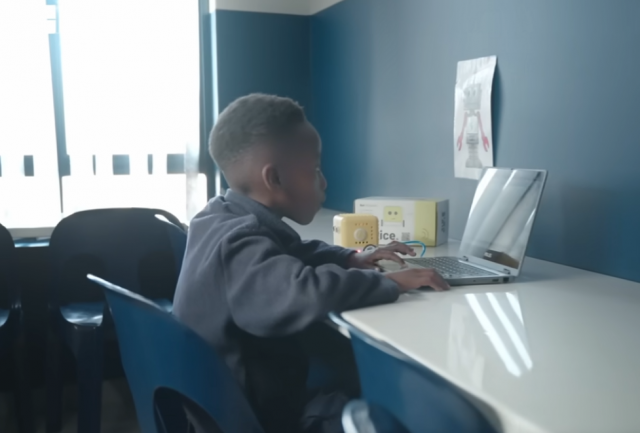
Learners at Protea Glen even benefit from being introduced to robotics through Duplo Lego robots using the ASUS BR1100 laptops.
“At Curro, robotics has its own curriculum. Curro came up with the curriculum so that it is not something that’s integrated into the learning, but it becomes a subject on its own. Because once it’s a subject on its own, it gives it that seriousness that the subject needs and deserves,” said Sibanyoni.
“We’ve all heard that we’re preparing children of today for jobs in the future that don’t exist yet. And it’s mostly true if you consider what they’re learning in schools now.”
At Protea Glen, learners can expect to learn how to code on laptops using small robots and the ASUS laptops from Grade R. The class is equipped with Windows-based laptops that are used to teach learners basic coding and a variety of other digital skills.
“This is done in a more practical environment, as it can be challenging to teach young children theory and programming, said Curro. “It’s not a subject that you can do in a theoretical manner,” said Sibanyoni. “If South Africa is going to prepare the technicians and scientists of the future, we better start by introducing children to the ideal IT infrastructure hardware from the start.”
Future careers require persons with digital skills that will equip and enable them to function effectively in a digital era, said the DBE. The teaching of coding and robotics will equip and expose learners to digital literacy, virtual reality, augmented reality, machine learning, artificial intelligence and the Internet of Things, it said.
“The future requires individuals who can build robots and other sophisticated machines and develop algorithms to code these machines. A code is an instruction given to a machine to follow that enables the machine to perform instructed functions. So, it is important to prepare our learners for this changing world.”
Read: Red flags over new subjects and curriculum changes for schools in South Africa












 Loading ...