

Rand doesn’t flinch at Ramaphosa’s promises


The rand and local bonds showed little movement in reaction to the State of the Nation Address (SONA) on Thursday night (9 February) after a period of weakness, says Momentum Investments.
According to the group, financial markets are expected to view the announcements as broadly positive.
“The success of these interventions relies heavily on government funding, and as such, the upcoming national budget plays a pivotal role in getting the ball rolling on implementing these announced plans,” said Momentum.
Before the SONA, the rand firmed in early trade on Thursday, with investors sitting in anticipation for a possible solution to the ever-worsening power crisis.
ETM Analytics told Reuters that the rand was solely focused on the contents of Ramaphosa’s speech with the ‘country’s future’ at stake.
The analytics firm added that investor perception would improve if a direct and honest assessment, with strict timelines and some accountability, were provided. It said investors were, however, poised for some disappointment.
During SONA, President Cyril Ramaphosa declared a national state of disaster regarding the electricity crisis in the country that has been plaguing economic growth for years.
“The state of disaster will enable us to provide practical measures that we need to take to support businesses in the food production, storage and retail supply chain, including for the rollout of generators, solar panels and uninterrupted power supply,” the president said.
Despite talk about the failing national power utility and a handful of developments being announced, no long-term plan was given by Ramaphosa. He said that government would double down on the energy plan announced in mid-2022 – which has seen little improvement to the crisis.
After SONA, the rand is still at the whim of US markets. Kim Silberman, a currency analyst from Rand Merchant Bank (RMB), told SAfm that despite the rand running away from the R18.00/$ mark, there had been a rally in the US currency amid a more hawkish fed – posing a threat to the rand.
Silberman added that foreign investors, specifically those in offshore bonds, are staying outside the South African market and waiting for a political and economically volatile February to pass before reconsidering.
The rand has undergone a period of weakness when compared to major currencies. The Achilles heel of the currency is shifting risk sentiments emanating from markets that are still seeing inflation risks in the US, said Investec chief economist Annabel Bishop.
The long-term outlook for the South African currency remains unclear, with severe volatility making it hard to predict.
Financial services firm PwC, in its latest economic outlook, said that the rand faces multiple risks internationally and at home. Therefore, local policy developments or the lack could be a key driver of movement in the rand.
On the international front, movements within the dollar and the ripple effect of decade highs of inflation could stoke disruption in the markets, added the firm.
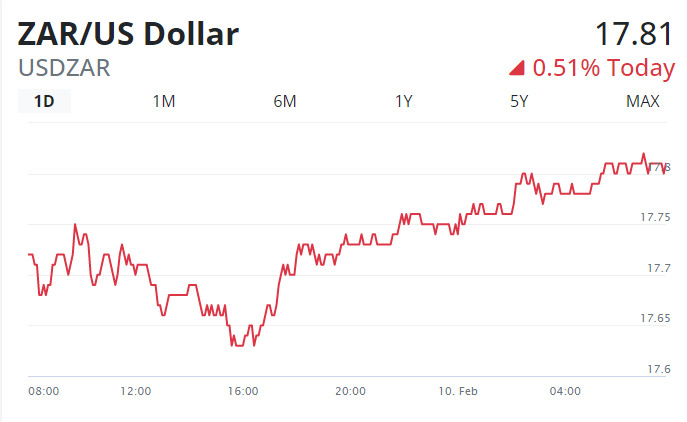
The rand is currently trading at:
- R17.81/$
- R19.07/€
- R21.52/£
Read: New state of disaster faces immediate backlash – and two legal challenges


















 Loading ...