

Rica – what is the point?


A new report questions the point of Rica, stating that the act is “fundamentally flawed” due to a lack of transparency within the system to detect or quantify abuses.
The Regulation of Interception of Communications and Provision of Communication-Related Information Act (Rica) is a law that makes it compulsory for everyone in South Africa to register their cellphone number.
The act came into force on 1 July 2009.
The Right2Know Campaign released its 2014 ‘Secret State of the Nation’ report, published earlier this week, and noted that, while NSA whistleblower Edward Snowden sparked a global debate about privacy and state abuses of surveillance, locally, very little information is available on the surveillance systems.
Rica, Right2Know pointed out, requires a judge’s warrant to monitor communications, and Parliament’s intelligence committee is supposed to release public oversight reports, but until April 2014 it had not released any for three years.
The information has subsequently been released, with the the report noting that it appeared that the number of authorisations to intercept users’ communications more than doubled between 2008 and 2011 before dropping off dramatically.
“However, these statistics do not give us a clear picture of the use of surveillance. They only measure how often the Rica judge issues a warrant to intercept someone’s communications,” the report said.
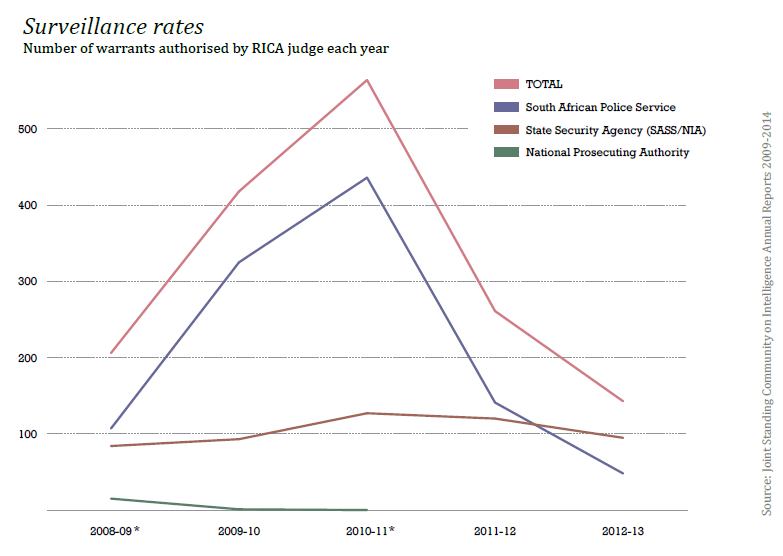
According to the report, the facility that actually ‘listens in’ to people’s communications reported to Parliament’s Joint Standing Committee on Intelligence (JSCI) in 2010 that it had made about three million interceptions over three years, during which time only 882 Rica warrants were authorised.
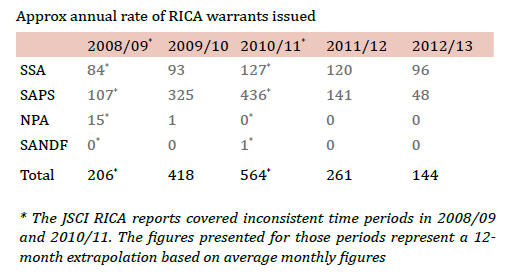
RICA warrants issues
“So each warrant may represent thousands of interceptions, or else surveillance is happening without a warrant,” Right2Know said.
“There is just not enough transparency in the system and too few safeguards to protect against abuses of surveillance. South Africa needs to kickstart a national dialogue about surveillance, Rica, and the right to privacy,” it added.
“There is no information about how many Rica interceptions lead to arrests or convictions, which would at least show Rica’s effectiveness in fighting crime,” the report concluded.
More on spying in SA
SA govt secrecy getting worse: report
Surprising number of South Africans okay with US spying














 Loading ...