

Over 1,000 businesses have shut down in South Africa in 2025 so far


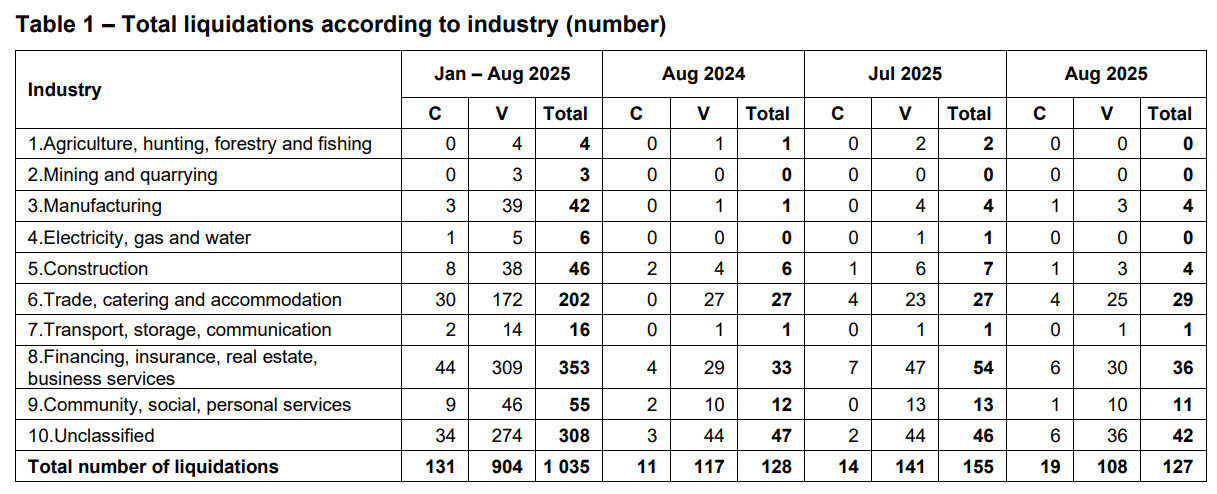
The latest liquidation statistics for South Africa show that the country has surpassed the 1,000 threshold in terms of business closures this year, with August contributing another 127 liquidations to the total.
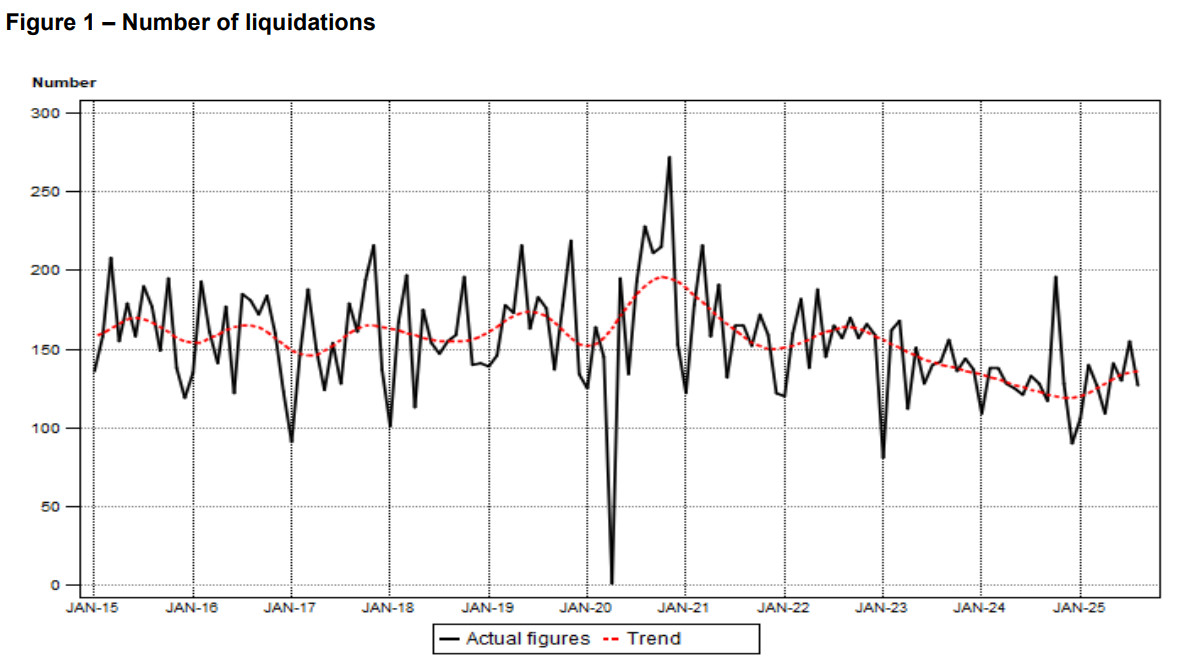
Stats SA recorded 127 more liquidations in August, which is down from 155 recorded in July and down 0.8% (difference of one) from 128 closures at the same time last year.
However, liquidations over the running three-month period (June to August) were 7.9% higher than over the same period in 2024.
Year-to-date (January to August) liquidations were also 1.5% higher than the same period last year.
Notably, the running total of liquidations in 2025 hit 1,035 at the end of August. Most liquidations were voluntary, and impacted the finance, insurance, real estate and business services sectors the hardest.
This was followed by the trade, catering and accommodation sectors.
To better contextualise the liquidations data, experts like Fluxmans business rescue and insolvency expert, Craig Blumenthal have noted that the distinction between voluntary and compulsory liquidations is important.
While liquidations are typically associated with solvency issues and more broadly reflective of the prevailing business environment, this may not necessarily be the case.
Voluntary liquidations, for example, are not necessarily due to insolvency, but could represent active business processes, where structures like special purpose vehicles or subsidiaries are liquidated to transact.
Compulsory liquidations, on the other hand, are typically court-ordered and usually reflect solvency issues.
The vast majority of liquidations in South Africa are voluntary, with around 88% of total liquidations in 2025 being in this category.
In August, 108 of the 127 liquidations were voluntary.
However, the 19 compulsory liquidations recorded in the month were up from the 14 in July, which were also up from June.
Notably, the 131 compulsory liquidations in the year-to-date are also 14% higher than the 115 recorded over the same period in 2024, which could indicate more businesses in distress in general this year.
According to Blumenthal, increasing compulsory liquidations are an indicator of economic downturn.
Strained environment
Looking at the wider trend in Stats SA’s data, liquidations have decreased each year since peaking in 2021.
While 2025 has started showing an upward turn in the trendline, this is still far off from the peaks.
Nevertheless, the prevailing business environment in 2025 has been difficult.
The latest Rand Merchant Bank (RMB)/Bureau for Economic Research (BER) Business Confidence Index showed that businesses are still feeling deflated.
The index fell deeper into depressed territory, well below the neutral 50 mark, at 39 in the third quarter, down from an already weak index reading of 40 in the second quarter.
Companies noted that the business climate deteriorated, as business activity worsened, notable in selling prices, purchasing prices, employment and inventories.
Despite the dampened business confidence, the South African economy has been resilient. Unfortunately, this resilience isn’t broad-based, with some sectors being hit harder than others.
For example, the imposition of 30% tariffs on South African exports has led to niche and specialised companies being voluntarily shut down. This also soured confidence.
However, it should be noted that these kinds of business closures are not necessarily liquidations and may not be reflected in the Stats SA data.
Liquidation proceedings are tallied in a different way than business closures or the outcomes of business rescue processes.
Even if wound down through a business rescue plan, these are not considered liquidated and are, in fact, a successful business rescue outcome.
This is because creditors and shareholders typically get more out of the process than through liquidation, and the brands and assets could even continue on in some form.
Data for liquidations are released by the Master’s Office, and those for business rescue are released by the Companies and Intellectual Property Commission (CIPC).
Both the categories and the information presented by the two offices also differ. However, there is some parity between the two.
















 Loading ...