

South Africa’s electricity prices vs the United States, Russia and China


South Africans already know that electricity prices in the country are unaffordable, with millions of households suffering under Eskom’s 800% hike in tariffs since 2007.
Price pressure is expected to continue mounting, with a 9% price hike pencilled in for 2026 and again for 2027, although this is not going unchallenged.
While South Africans know electricity is expensive, a new analysis shows that power pricing in South Africa is also more expensive than in major economies, and in some contexts, some of the highest in the world.
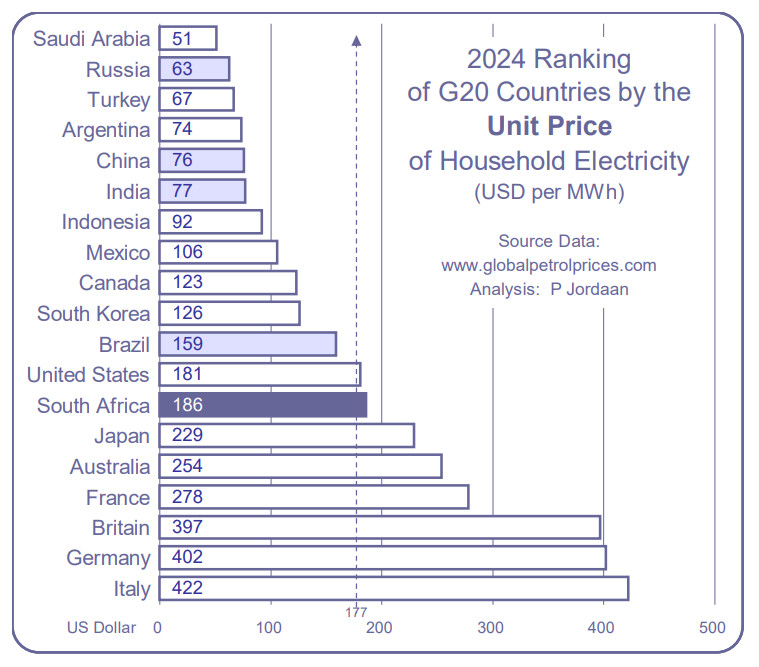
According to independent energy analyst Pieter Jordaan, on a direct pricing basis (converted to US$ for comparison), South Africa has the seventh most expensive electricity among G20 nations.
Here, South African households pay $186 per megawatt-hour (MWh) of electricity, sitting in the ranking between $181 in the United States and $229 in Japan.
The cheapest electricity among the G20 is in Saudi Arabia, where it costs $51 per MWh, while the most expensive electricity is in Italy at $422 per MWh.
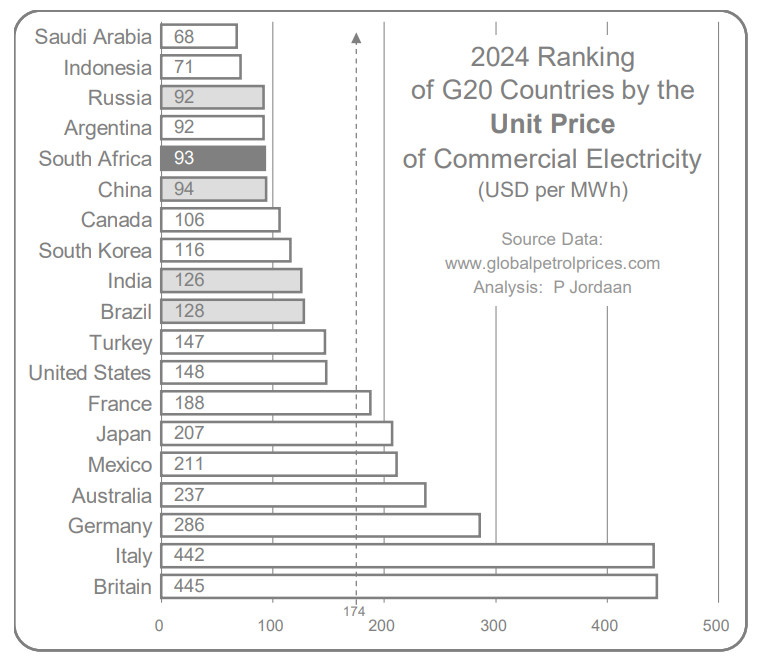
The picture changes for commercial electricity, however. Here, South Africa comes out as one of the more affordable countries among the G20, charging $93 per MWh.
This is the fifth-cheapest, just above Argentina and Russia ($93/MWh) and just below China ($94/MWh).
For commercial power users, Saudi Arabia is still the cheapest at $68/MWh, but Britain catapults to being the most expensive at $445/MWh.
South Africa stands out as one of a handful of countries that offer cheaper commercial electricity than household electricity, with most countries charging commercial users more.
One of the main arguments Eskom puts forward is that South Africans are underpaying for electricity, as pricing does not reflect the costs of producing power.
Unfortunately for South Africans, Eskom has significant control over these costs, including its bloated workforce, as well as what it pays for various procurement contracts.
This means that “reflective costs” include money spent on high average salaries for 42,000 workers, and widespread procurement corruption where the utility pays significantly inflated prices when buying simple things like mops, shoes or containers.
A different kind of Big Mac Index
However, a direct conversion of energy prices does not account for a slew of other economic indicators that impact affordability.
Factors like purchasing power and a country’s productivity, expressed as GDP per capita, can recontextualise the rates for a fairer comparison.
For example, while a country may have cheap electricity, if the population is generally poorer or does not have strong purchasing power, even cheaper electricity may be unaffordable for most.
The Economist’s Big Mac Index is published twice a year to give an indication of purchasing power parity across a basket of major currencies.
The index specifically uses the Big Mac because the McDonald’s burger is widely available across the world and is broadly the exact same product in all markets.
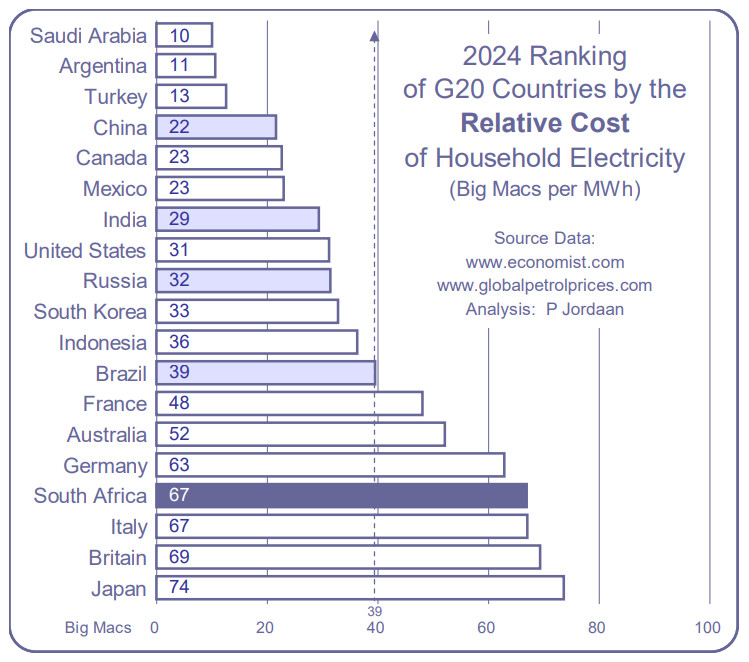
Building on this relatively stable base, Jordaan looked at electricity pricing in a similar way, calculating how many Big Macs a household could buy for the same cost as 1MWh of power.
Using this index, electricity affordability in South Africa is the fourth worst among the G20 nations, with a household getting 67 burgers for the same price of 1MWh of power.
Notably, this is the same level as Italy (67 burgers). This shows that the relative cost of electricity in South Africa is the same as the worst-ranked among the G20, despite being half the price in direct terms.
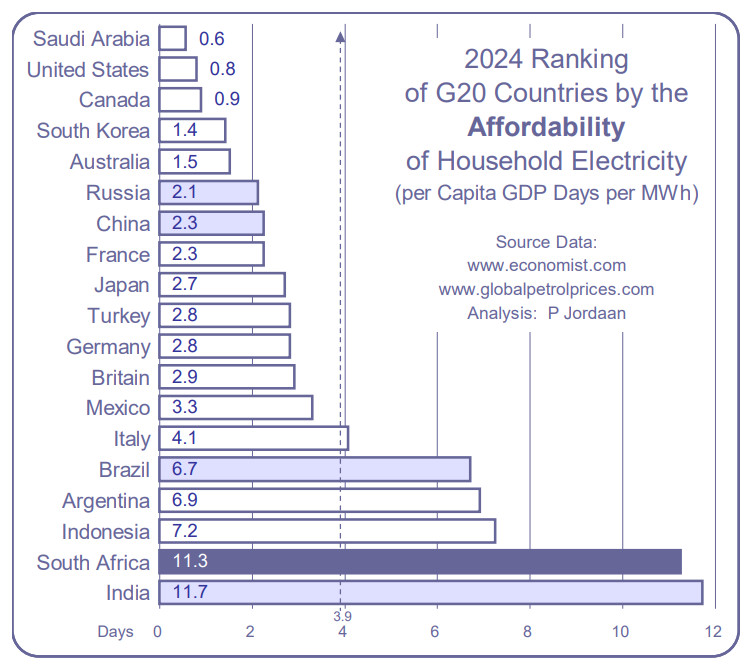
Looking at a different measure of affordability, Jordaan also analysed costs in terms of GDP per capita, counting the number of days an average citizen would have to work to procure 1MWh of power.
By this measure (capita GDP days per MWh), South African households fare far worse than other countries, having to work 11.3 days to pay for 1MWh.
Only India was worse in this metric, but not by much, at 11.7 days.
Conversely, Saudi Arabian households need to work only a little over half a day for the same power, while the United States (with the near-same direct cost) has to work 0.8 of a day.
1MWh is roughly the necessary stock to power a household for one to two months.
Looking at affordability metrics for commercial users, South Africa’s power is more affordable, ranking around the middle for the G20 countries, at 5.4 days.

















 Loading ...