

The one province in South Africa showing the best economic growth



Limpopo has seen the most economic growth in South Africa, while Gauteng comfortably remains the largest contributor to the economy.
A comparison from Stats SA has shown the economic growth rates among the nation’s provinces, which give insights into the current state of the nation’s regional economies.
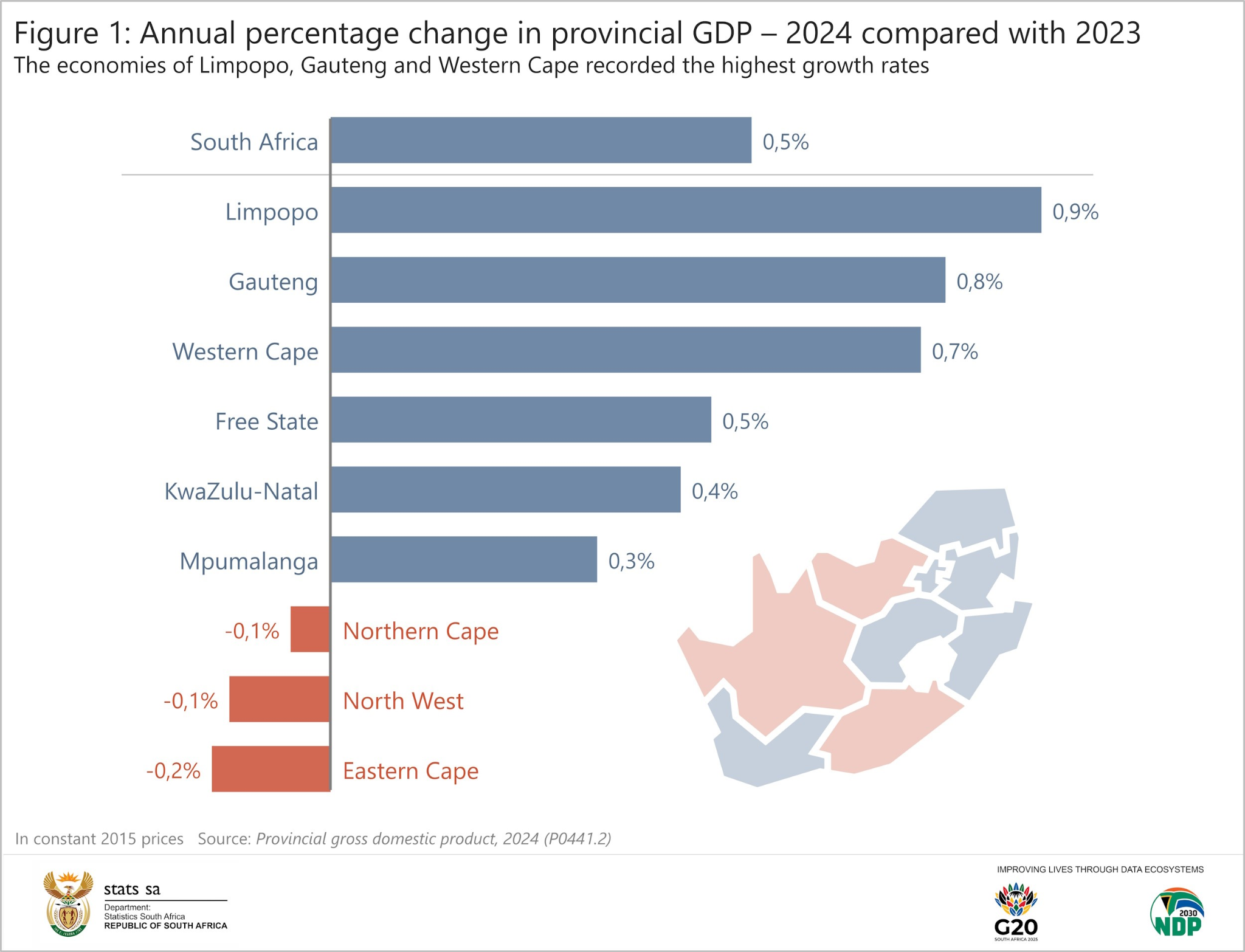
Of the nine provinces studied, six recorded economic activity growth in 2024 – the last full year of data.
Limpopo registered the highest growth rate of 0.9%, far higher than the national average of 0.5%.
Limpopo’s growth was driven by two industries: finance, which includes real estate and business services, and personal services.
Other industries in Limpopo that record gains include utilities, such as transport & communication, general government, manufacturing and trade.
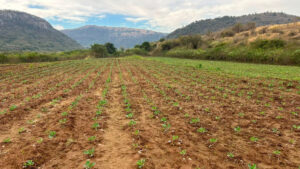
Although agriculture, construction and mining performed poorly, it was not enough to derail Limpopo’s positive showing.
Gauteng had the next highest growth at 0.8% in 2024, while the Western Cape was third at 0.7%.
Finance was also a major contributor to growth in Gauteng and the Western Cape, with notable support from personal services and utilities.
Finance was the main growth driver across Gauteng, Western Cape and Limpopo.
Other provinces that saw growth included Free State at 0.5%, KZN at 0.4% and Mpumalanga at 0.3%.
Three provinces recorded contractions, namely the Eastern Cape at 0.2%, and the North West and Northern Cape, with 0.1% declines.
Stats SA said that the Eastern Cape saw declines in seven of the 10 industries, with trade, manufacturing and agriculture being the most negative contributors.
North West also disappointed, pulled lower by trade, agriculture, transport, construction, manufacturing and mining.
The national statistics agency said that softer agricultural production was the Northern Cape’s most considerable drag on growth.
Although six of the nine provinces recorded growth, this growth is still not enough to solve many of the nation’s largest challenges.
As South Africa’s population grows at around 1.5% each year, any growth less than this will result in GDP per capita contractions, meaning that South Africans are getting poorer.
Top dog unchanged
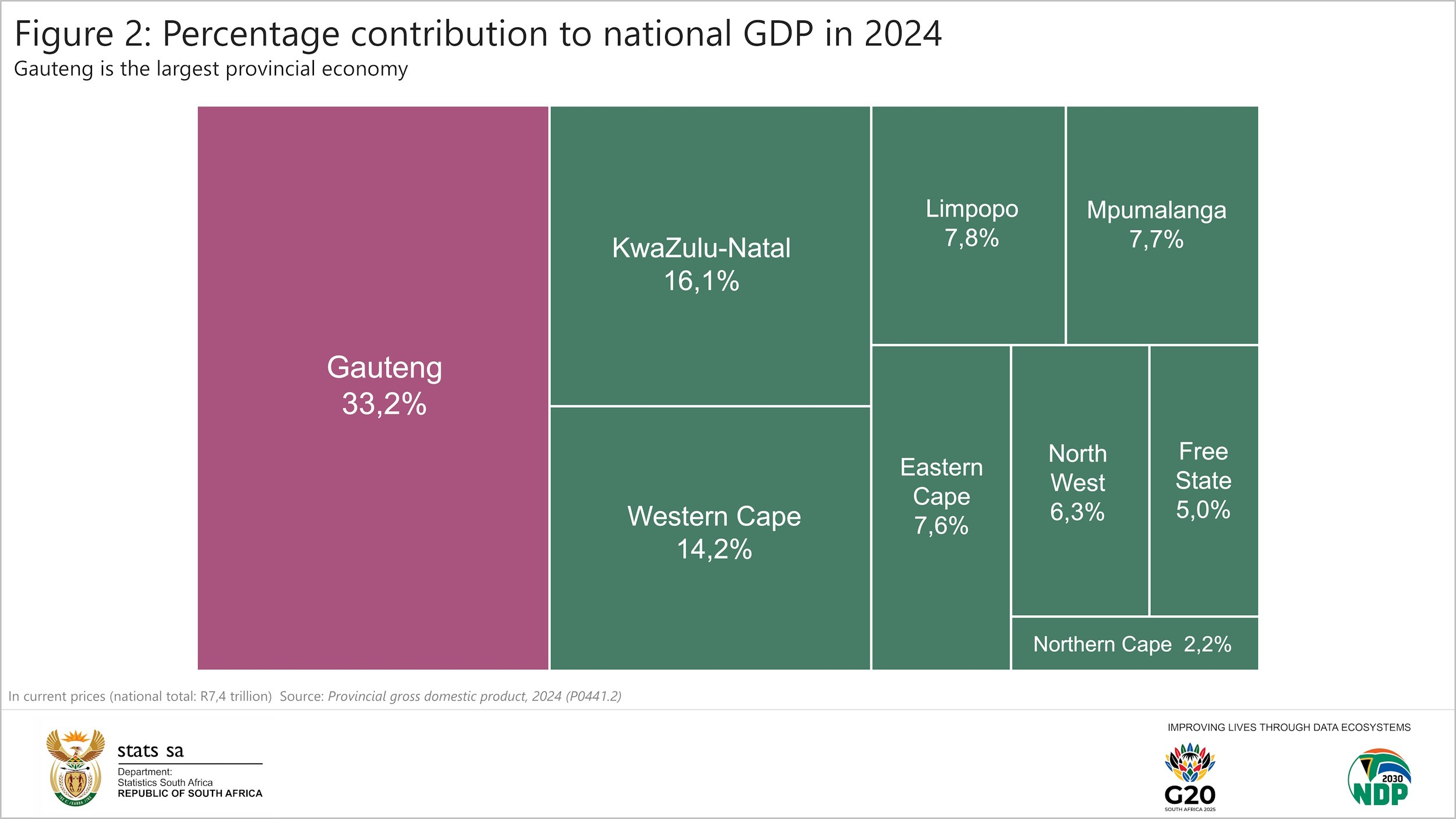
Although there are several ups and downs across the provinces, there was little change in provincial contributions to the South African economy in 2024.
Gauteng remains the largest, accounting for a third of national output. Even if the next two largest contributors, namely the Western Cape and KZN, were combined, their GDP impact would still be less than Gauteng.
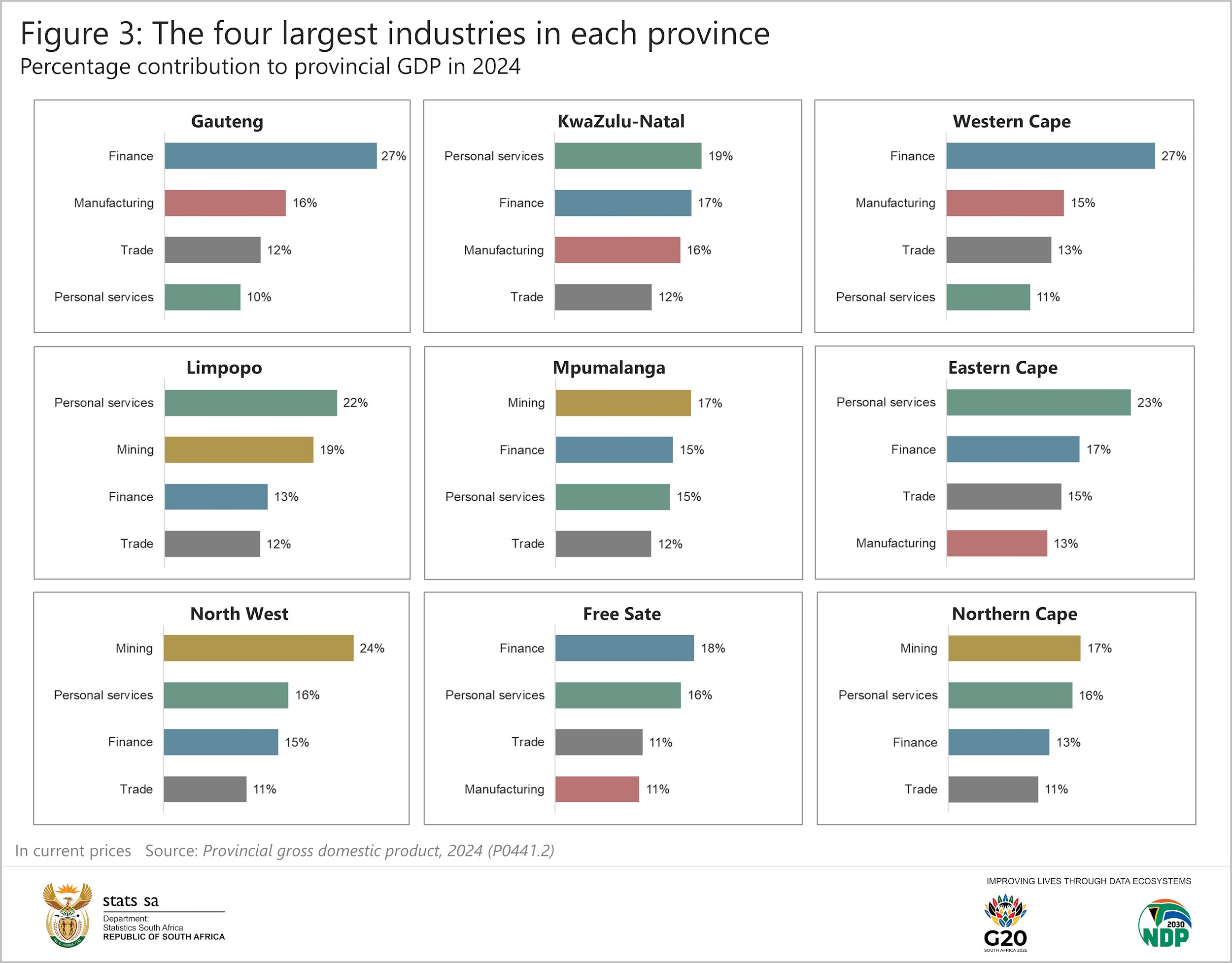
Stats SA also noted that the top four largest industries across the nation’s provinces include finance, personal services, mining, manufacturing and trade.
Mining was the main driver of economic activity in Mpumalanga, North West and Northern Cape, and the second largest in Limpopo,
Finance was the most influential industry in Gauteng, the Western Cape and the Free State.
Personal services, which include health and education, were the largest industry in KZN, Limpopo and the Eastern Cape.
Economic activity is not evenly distributed across the nation. For instance, agriculture is mainly concentrated in the Western Cape, KZN, and Free State. These provinces at 56% of the national agricultural production.
Mining mainly takes place in the North West, Limpopo and Mpumalanga, while Gauteng, KwaZulu-Natal and Western Cape are responsible for the bulk of South African manufacturing value added.















 Loading ...