

Over 1,500 businesses call it quits in South Africa


South Africa recorded over 1,500 business liquidations in 2025, most of which were voluntary.
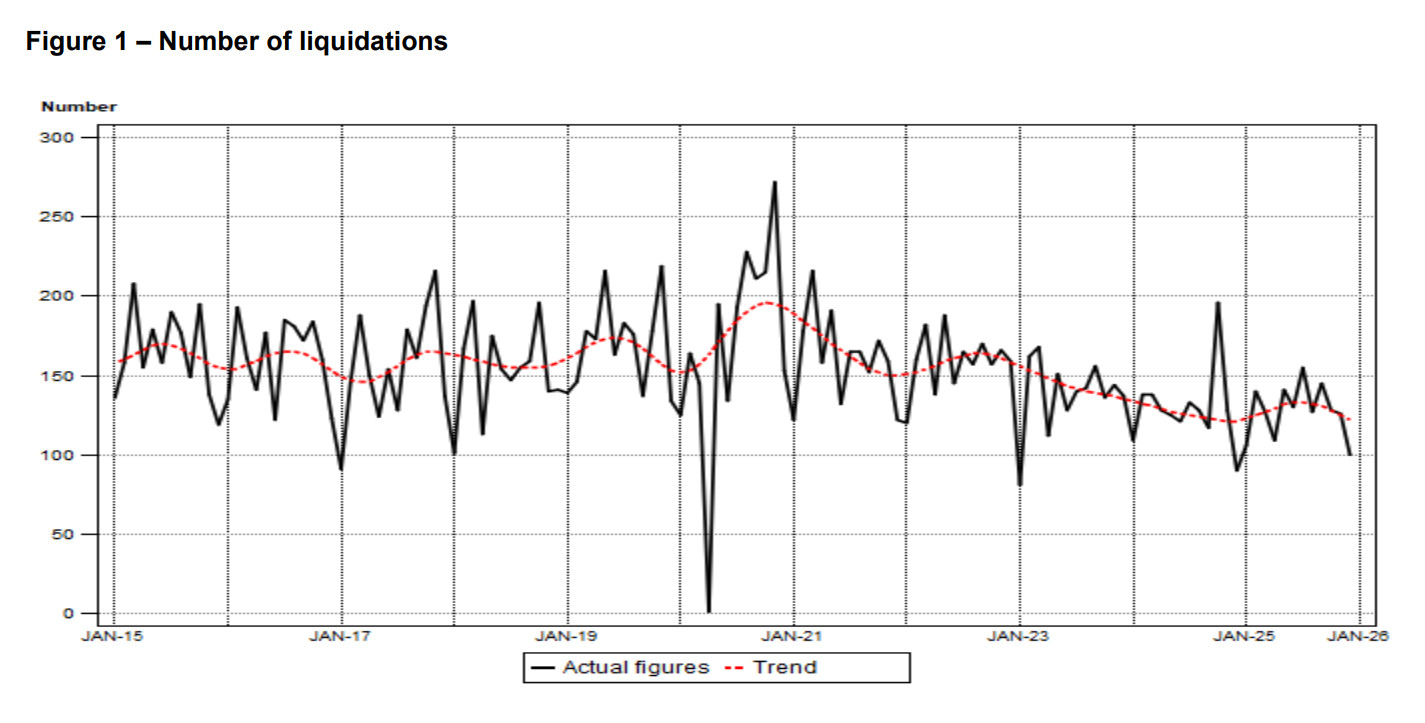
Stats SA published the latest liquidation statistics for December 2025, revealing that the country recorded another 100 business closures for the month, up 11.1% from December 2024.
While the number of liquidations in December where higher year-on-year, the figures were lower than in November 2025, and also lower on an annual basis.
Liquidations between October and December 2025 were lower than the same period in 2024, and the full-year figure of 1,534 closures in 2025 was down 1.1% from the 1,551 closures in 2024.
The vast majority of liquidations recorded in 2025 (87%) were voluntary, meaning they were initiated by the business owners themselves.
Voluntary business liquidations don’t necessarily indicate solvency issues or financial distress, as companies can be liquidated to free up cash for other business activity.
Therefore, a high number of voluntary liquidations could reflect increased business activity.
However, they could also point to deteriorating business conditions, where owners are left with no choice but to wind up operations.
According to business experts, a better gauge for business conditions is compulsory liquidations, which are typically court-ordered due to solvency issues.
For 2025, 193 businesses entered into compulsory liquidation (approximately 13% of the total).
Worryingly, while voluntary liquidations were lower compared to 2024, compulsory liquidations were up 5.5% from the year before, pointing to a strained business environment in the country.
Liquidations in South Africa have been decreasing since 2019; however, this has given rise to different interpretations of the numbers.
On the one hand, the lower numbers could point to an improved business environment following the COVID-19 pandemic. On the other hand, it may simply indicate that there are fewer businesses around.
Notably, the number of compulsory liquidations has remained fairly consistent, averaging 214 forced closures over the past seven years.
The country experienced a spike in compulsory liquidations in 2020 and 2023, tied to the Covid-19 pandemic and hard lockdowns.
| Year | Voluntary Liquidations | Compulsory Liquidations | Total Liquidations |
|---|---|---|---|
| 2019 | 1,784 | 258 | 2,042 |
| 2020 | 1,773 | 262 | 2,035 |
| 2021 | 1,762 | 170 | 1,932 |
| 2022 | 1,677 | 230 | 1,907 |
| 2023 | 1,457 | 200 | 1,657 |
| 2024 | 1,368 | 183 | 1,551 |
| 2025 | 1,341 | 193 | 1,534 |
Business hit in December
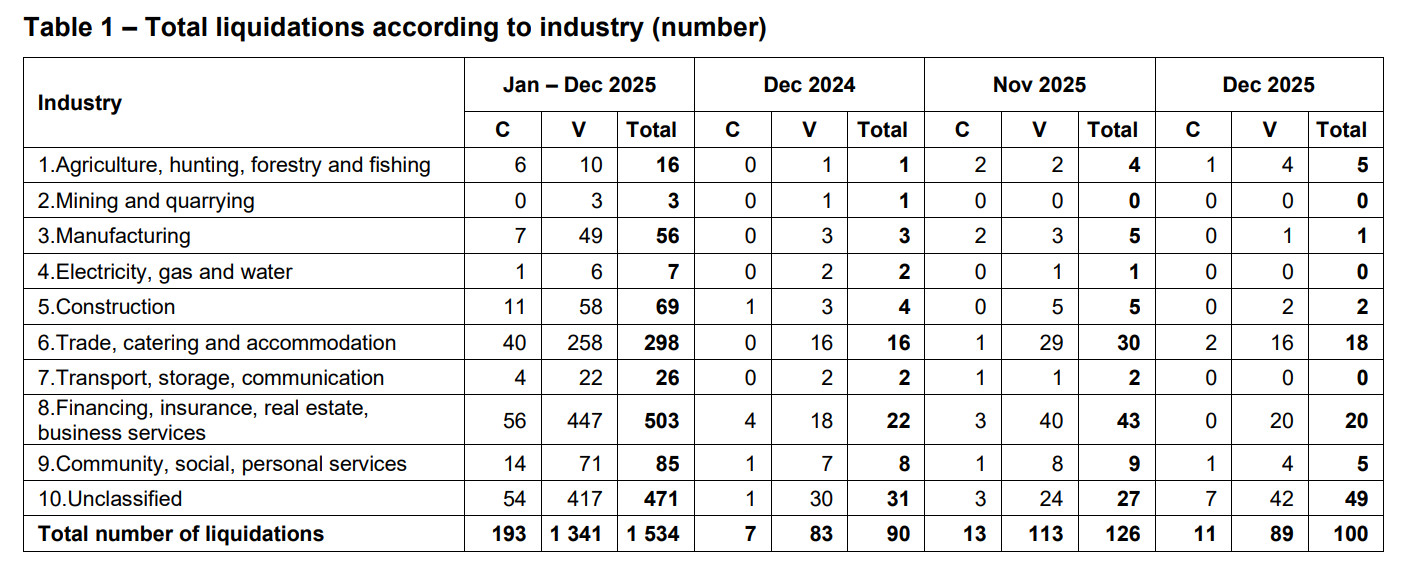
Looking at the December data, the month followed the established trend in the country where businesses in the finance, insurance, real estate and business services sector were hardest hit.
This was followed by the trade, catering and accommodation sector.
These sectors took the biggest overall blow in 2025, accounting for 503 and 298 of all liquidations during the year, respectively. The trend was consistent across voluntary and compulsory liquidations.
Despite the turn in sentiment in South Africa in the last few months of 2025, analysts noted that it would take time for any positive shift to filter through to an operational reality for businesses.
In truth, the year was tumultuous and volatile for most businesses, which were battered by a “toxic mix” of factors affecting trading conditions.
This included years of high interest rates, weak consumer demand, and rising operational costs.
Logistical bottlenecks and escalating transport costs further squeeze margins, while global trade tensions and regulatory burdens compound the issue.
For 2026, signals are more optimistic, with the economy expected to stick to a growth trajectory. However, weak fundamentals, including high levels of unemployment and stunted investment, remain.
















 Loading ...