

Most expensive province to buy groceries in South Africa at the start of 2026


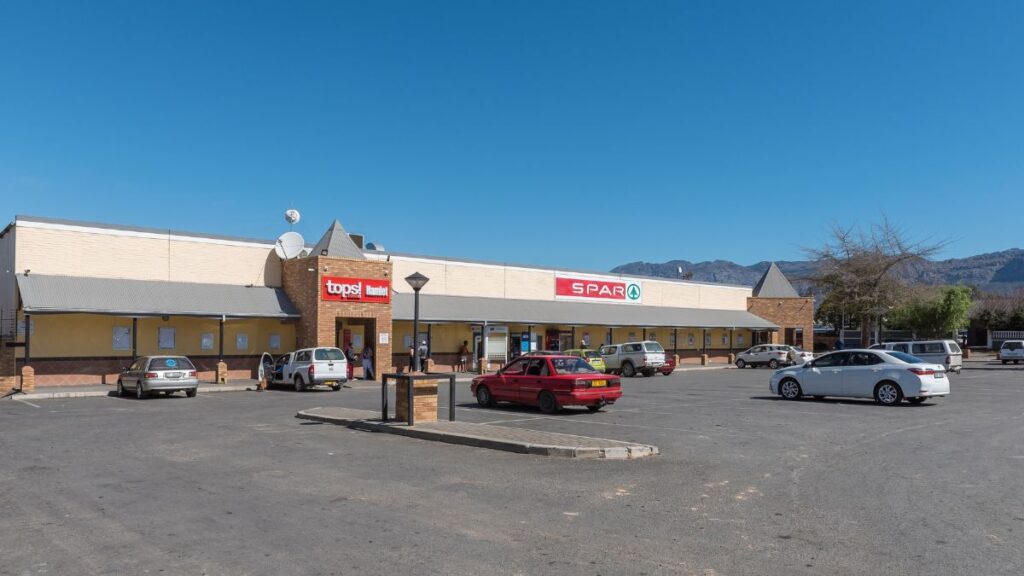
In January 2026, Johannesburg continues to be the most expensive city among South Africa’s three major metros for groceries for seven consecutive months, followed by Cape Town and then Durban.
This is according to data from the Pietermaritzburg Economic Justice and Dignity (PMBEJD) group, which tracks the cost of a household food basket across the three major provinces.
The PMBEJD report found that while 22 of the 44 tracked food items became cheaper or saw no increases year-on-year, the other 22 experienced price hikes, with six items seeing double-digit inflation.
Annual consumer price inflation ticked marginally higher in December to end the year at 3.6%, up from 3.5% in November, with the month-on-month change in the consumer price index (CPI) at 0.2%.
Stats SA said that the average inflation rate for 2025 was 3.2%, which is the lowest rate since 2004’s 1.4%.
Looking at the specifics of the December figure, the annual rate for food and non-alcoholic beverages (NAB) remained stable at 4.4%.
Meat inflation, however, continued its upward trajectory, rising 12.6% in December from 12.2% in November.
Beef inflation remains at high levels amid a major foot-and-mouth disease outbreak. For instance, beef steak recorded an annual price change of 29.4% in December.
Inflation for cereal products rose from 1.7% in November to 2.1% in December, with several key items experiencing faster price increases.
This includes brown bread (accelerating from 0.5% to 1.0%), white bread (1.3% to 1.7%) and spaghetti (1.7% to 3.1%).
The milk, other dairy products & eggs category remained in deflationary territory at -1.1%, which was primarily led by cheaper milk products.
Cheese, however, bucked the trend, with cheddar prices rising by 9.0% in the 12 months to December, higher than the 4.9% rise recorded in November.
The annual rate for oil & fats slowed to 4.6%, with sunflower oil softening to 6.2% from November’s 6.6%. Olive oil is also 8.0% cheaper than it was a year ago.
Prices for non-alcoholic beverages rose by 4.2% in the year to December, which was higher than November’s rate of 3,7%. Inflation for cold beverages increased from 1.4% in November to 2.2% in December.
Most expensive city for groceries
As of January 2026, the average cost of a household food basket in South Africa, comprising 44 essential items that reflect typical purchasing patterns, reached R5,401.44.
This is a marginal 0.6% annual decrease of R32.26 compared to January 2025. Month-on-month, however, the basket price increased by a notable R69.99 compared to December 2025.
However, a breakdown of costs in each city shows that the change in food prices is greater in some areas than others.
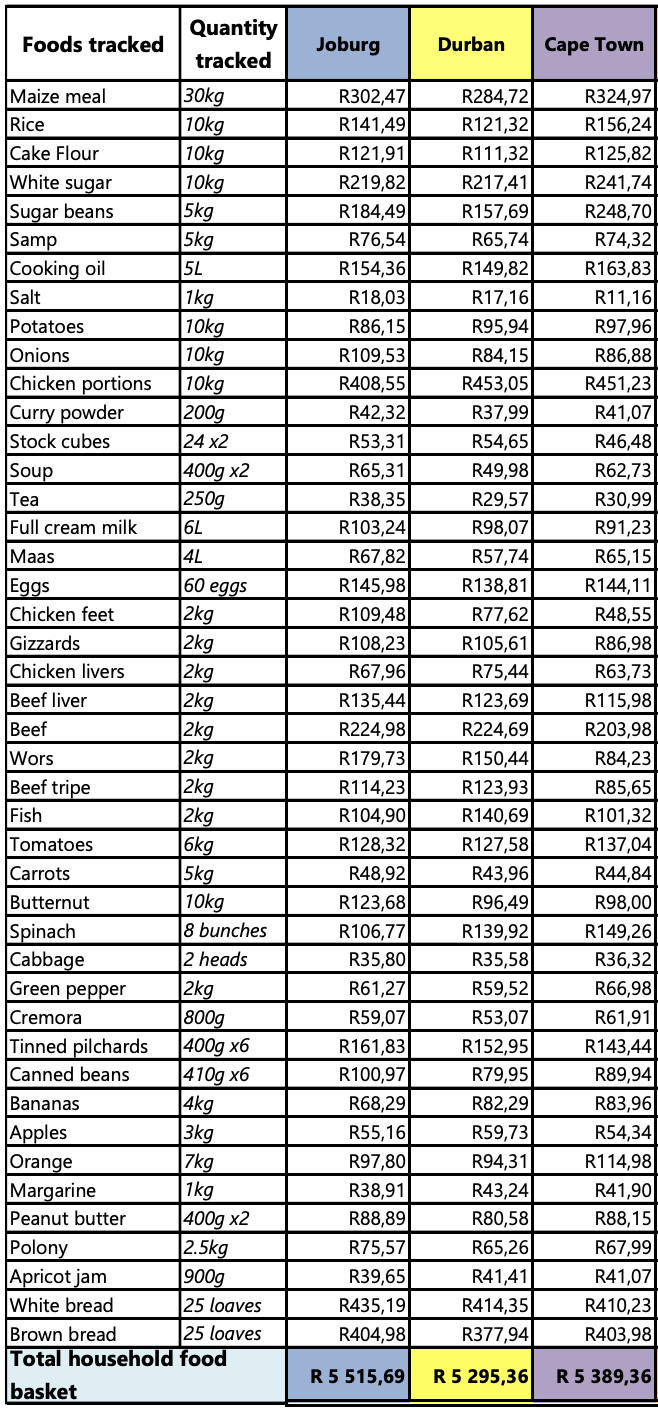
In January 2026, the household food basket cost R5,515.69 in Johannesburg, a 0.2% increase of R8.31 from the previous year. However, this is also R22.73 less than the basket price of R5,554.41 in December.
Despite the decrease, Joburg’s basket price surpassed the national average by R114.25, making Johannesburg the most expensive metro for groceries.
In comparison, Durban maintained its position ahead of Cape Town as the cheapest city for groceries, recording further decreases compared to last month and the year before.
Cape Town’s food basket, recorded at R5,389.36, increased by R204.09 (3.9%) from R5,185.27 in January 2025.
The city also saw an annual increase of 0.4%, or R20.77, from R5,368.58 in December. Despite the increase, it is still R126.33 less expensive than Johannesburg.
Durban’s food basket decreased by R11.11 (-0.2%) from R5,306.47 in December 2025 to R5,295.36 in January 2026.
Additionally, year-on-year, the Durban household food basket decreased by R155.71 (-2.9%) from R5,451.07 in January 2025 to R5,295.36 in January 2026.
Basket comparison January 2026

















 Loading ...