

It’s a bad time to braai in South Africa


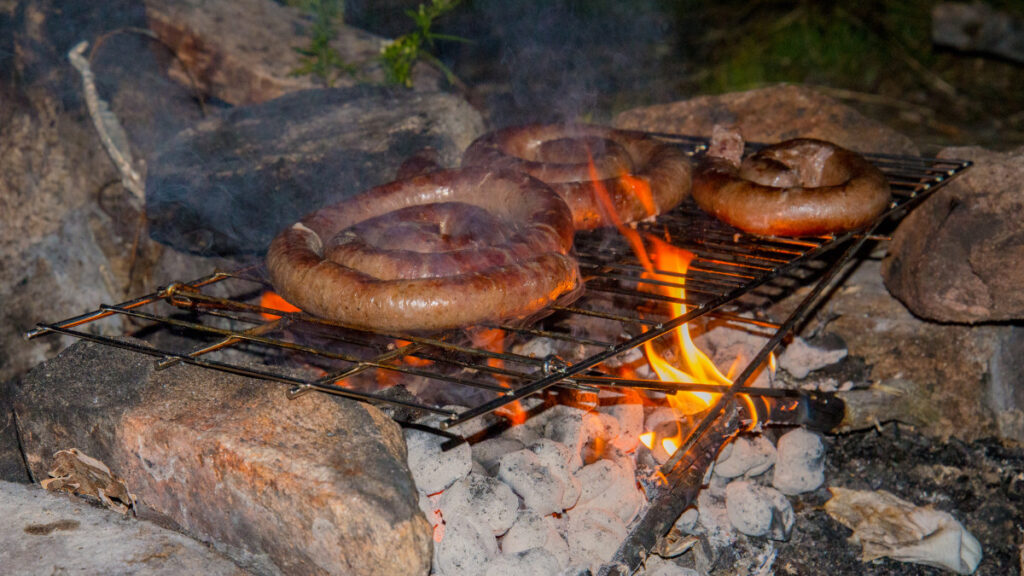
The latest Braai Index for January 2026 shows both a month-on-month and year-on-year increase in the cost of hosting a braai, with economists warning that meat prices are set to keep climbing.
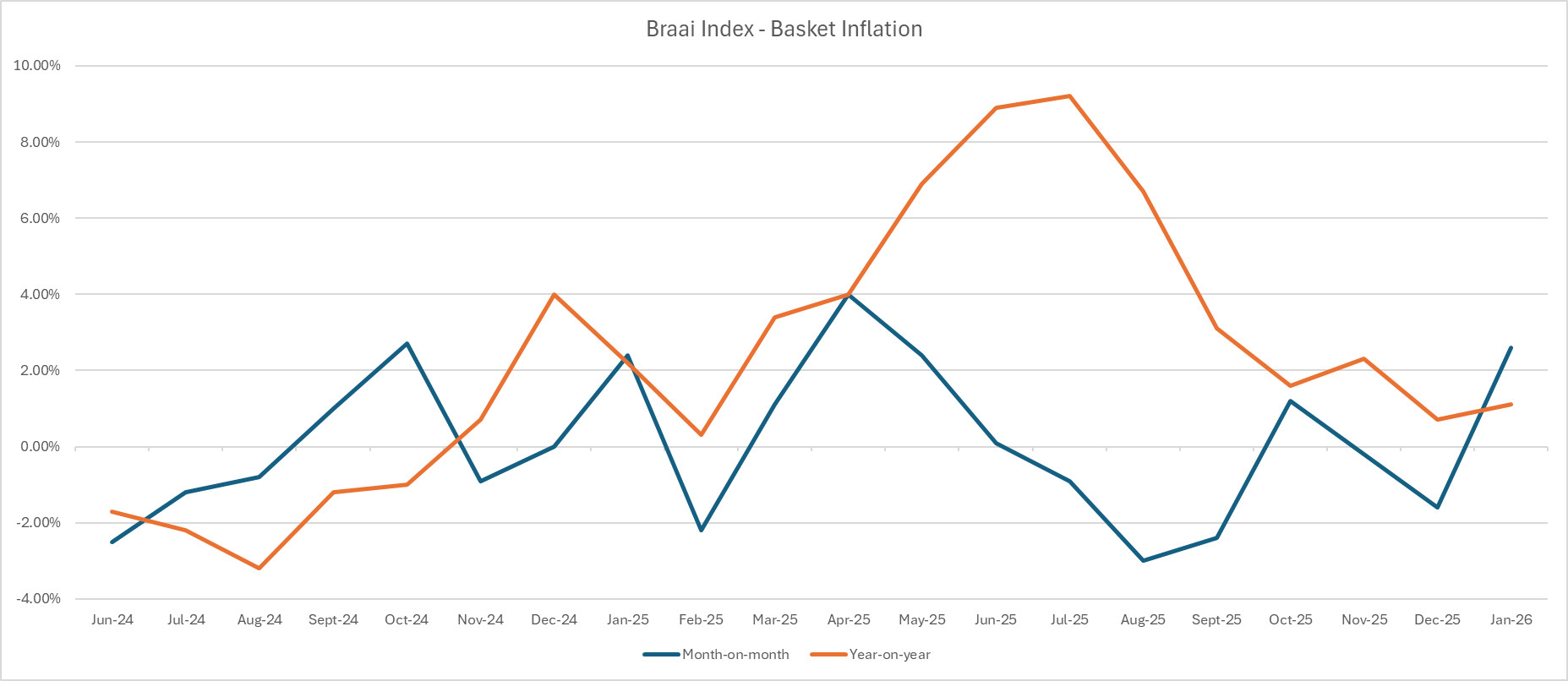
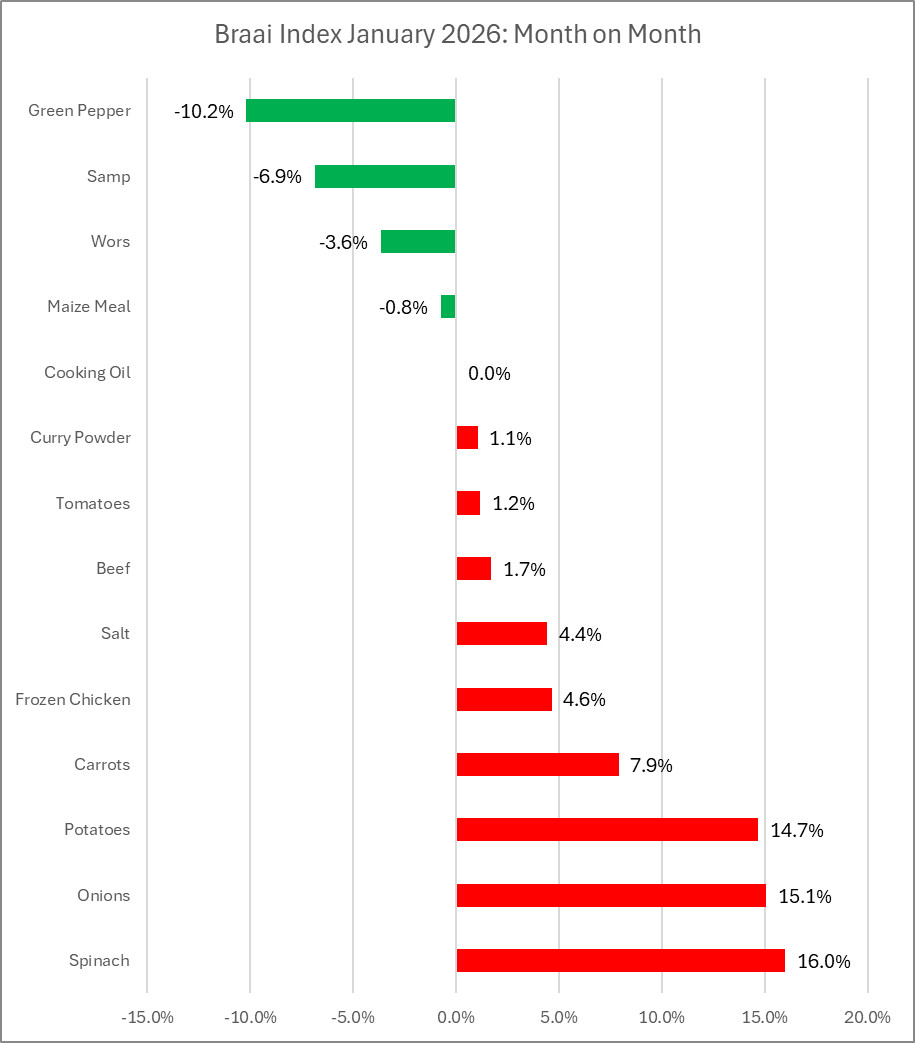
The index shows that the South African braai basket has increased 2.6% month-on-month, driven by increases for both the meat (beef and chicken) and veggie components.
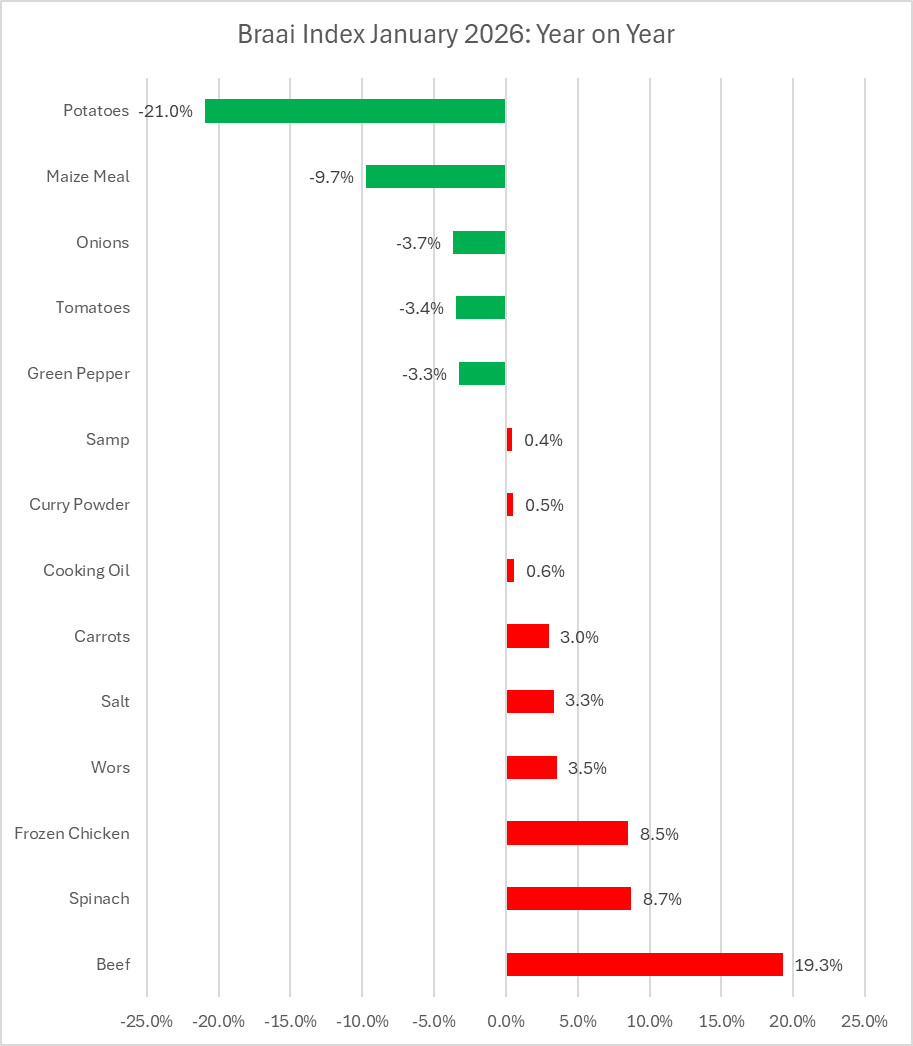
Year-on-year, basket inflation is more muted, but still up 1.1%, primarily driven by a massive 19% increase in beef prices.
The Braai Index is compiled monthly by BusinessTech using pricing data from the Pietermaritzburg Equity Justice and Dignity (PMBEJD) group.
The PMBEJD’s data reflects real “on the ground” pricing across South Africa’s major provinces and includes the items found in the shopping baskets of the majority of South African households.
The index, in turn, tracks the prices of a selection of essential items typically used for a South African braai, offering a more focused view of inflation at the grill.
The index includes meat (beef, wors, chicken portions), vegetables (spinach, carrots, tomatoes, potatoes, onions, green pepper) and others (samp, maize, curry powder, salt).
Between December and January, prices generally rose, with a sharp increase in the price of spinach, onions, potatoes and carrots.
This was partially offset by decreases in the prices of green peppers and samp.
Year-on-year, the basket’s pricing saw beef prices shoot up 19.3%, with spinach and chicken also climbing around 8%-9%.
This follows a steep 21% y/y increase in beef prices the month before, continuing the rising trend seen since the outbreak of Foot and Mouth Disease in April and May 2025.
Month-on-month [+2.6%]
Year-on-Year [+1.1%]
Meat price madness
The Braai Index broadly aligns with wider annual inflation data for food & non-alcoholic beverages. In December 2025, Food NAB remained stable at a rate of 4.4% y/y.
Headline inflation is expected to remain fairly stable this year, but economists have flagged meat as a major risk factor.
In December, meat inflation continued its upward trajectory in Stats SA’s basket, rising to 12.6% from 12.2% in November.
Economists at Nedbank warned that the ongoing outbreak of Foot and Mouth Disease in South Africa would keep pushing up meat prices for the months to come.
They warned that, on top of the past six months or so of large increases, consumers can expect double-digit meat price inflation to last until roughly April 2026.
Because of this anomaly, or ‘black swan event’ in the red meat industry, the weighting of the index tilts to higher basket inflation.
The Braai Index is heavily influenced by two proteins: beef and chicken.
Other proteins, such as pork and lamb, are not tracked in the PMBEJD basket and thus do not feature on the index.
Producers of these proteins have criticised the data presented in the index, noting that braai affordability could differ greatly if consumers choose alternative proteins.
One such producer, Eskort, has directly appealed to have pork products included in the index, noting that pork offers a cheaper alternative to beef.
Data from the IDC, citing food producers, notes that poultry is by far the most widely consumed protein in South Africa, followed by beef.
This explains the prominence of these proteins in the PMBEJD’s basket tracking.
According to the data, 49% of animal protein consumed per person in South Africa is poultry, 26% is beef, 13% is eggs, 7% is pork, and 5% is mutton and goat.
The group noted that consumption of poultry is increasing while red meat consumption is decreasing.
Overall, the Braai Index remains a broad indicator of food inflation, tracking the most widely consumed food products, as tracked by the PMBEJD.
Costs and affordability will vary depending on what you actually eat.

















 Loading ...