

Cheapest bank accounts in South Africa – Absa vs Capitec vs FNB vs Nedbank vs Standard Bank


The Solidarity Research Institute recently published its Banking Charges Report for 2026, which examined South Africa’s major banks and compared their banking fees, ranking Capitec Bank as the most affordable option for “middle-class” consumers.
“The banks are becoming increasingly competitive in terms of their bank charges, and they are also expanding their value proposition beyond just basic financial services,” said Solidarity Research Institute economic researcher Theuns Du Buisson.
The Solidarity report analyses only “ordinary transaction profiles”, which are accounts that are available to any member of the public, which excludes youth, student, elderly, faith groups, and private bank accounts.
The banks listed in Solidarity’s report are South Africa’s main banks: Absa, Capitec Bank, FNB, Nedbank, and Standard Bank, as well as TymeBank and Bank Zero.
To determine the true cost of banking, Solidarity adopts a “basket of transactions” approach instead of merely comparing basic monthly administration fees.
They developed various user profiles based on the number of transactions someone typically makes each month, focusing on bundles of 12, 14, 17, 25, and 30 transactions.
The 12 and 17 transaction comparisons reflect consumers with low incomes and fairly basic banking needs.
The 14-transactions category, which represents consumers with online-only banking needs, assumes all banking is completed digitally.
The 25-transaction comparison reflects middle-class income consumers with “sophisticated” banking needs, while the 30-transaction comparison reflects higher middle-class incomes and highly sophisticated banking needs.
The cheapest options per category

Low-income
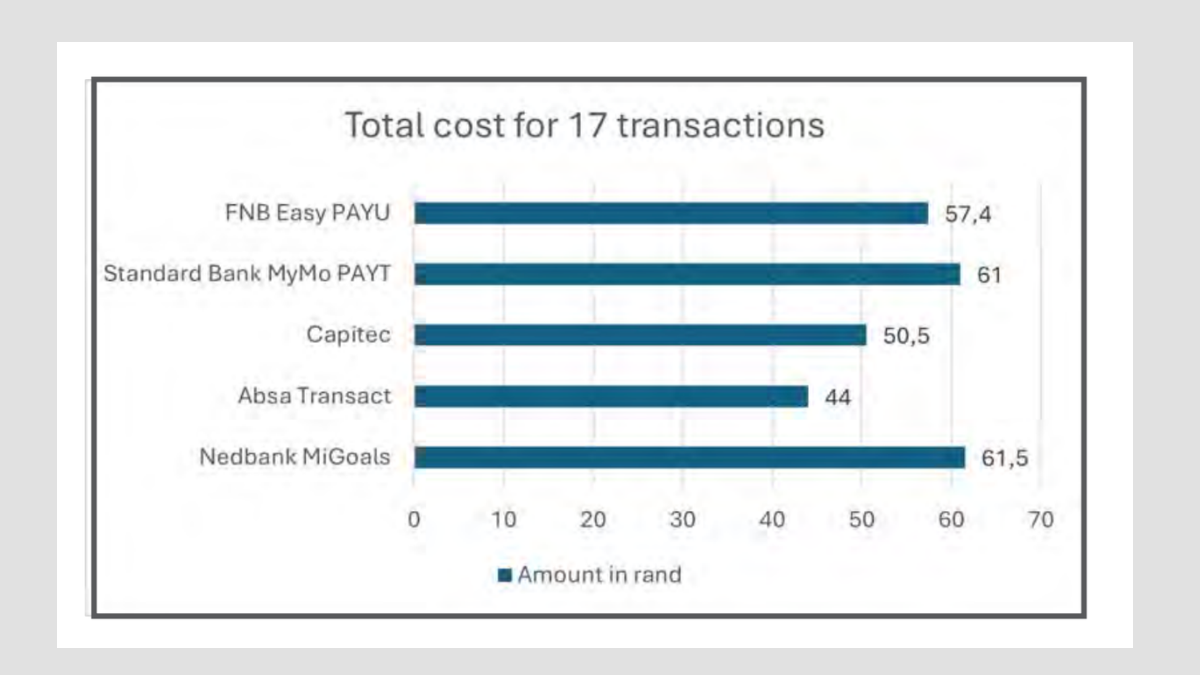
Absa’s Transact account is the cheapest option for the low-income and fairly basic banking needs (12 and 17 transactions) category, with Capitec as the second cheapest in the category.
“However, when transaction volumes increase, the competition between Absa and Capitec is getting stiffer, with Absa still being slightly cheaper at approximately R44 compared to Capitec’s R50.50,” said Du Buisson.
Online-only banking
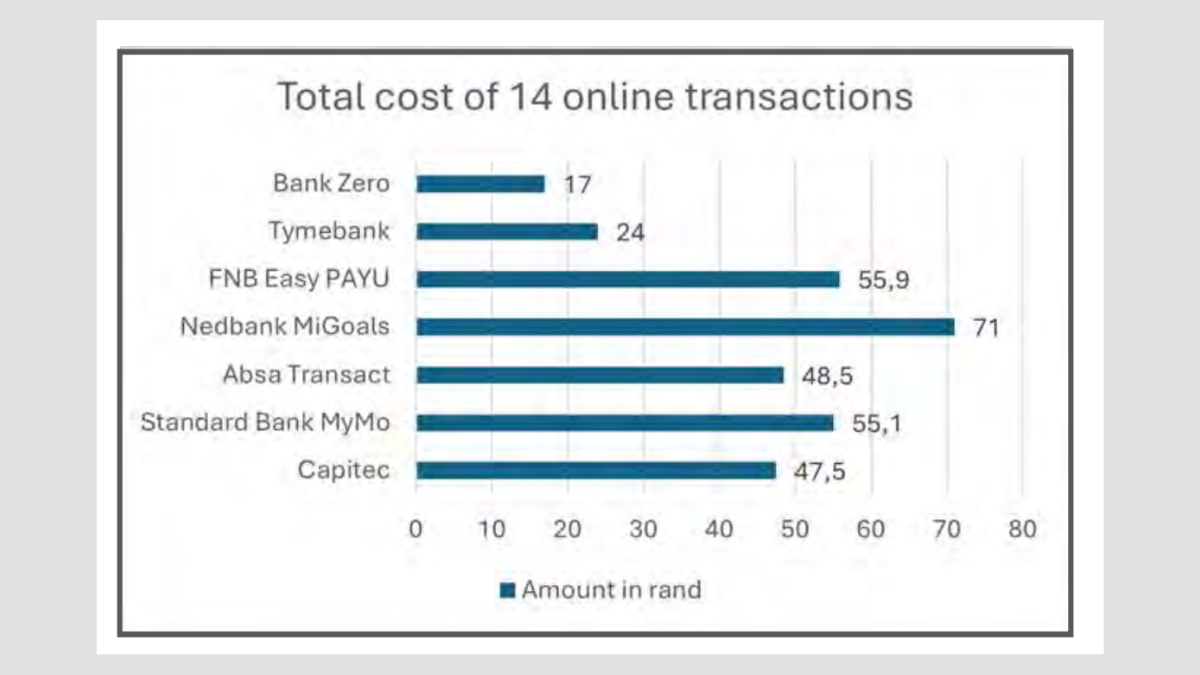
For the online-only banking needs category (14 Transactions), Bank Zero is the cheapest option, significantly cheaper than the rest of the banking market. TymeBank ranks second in this category for affordability.
Middle-class
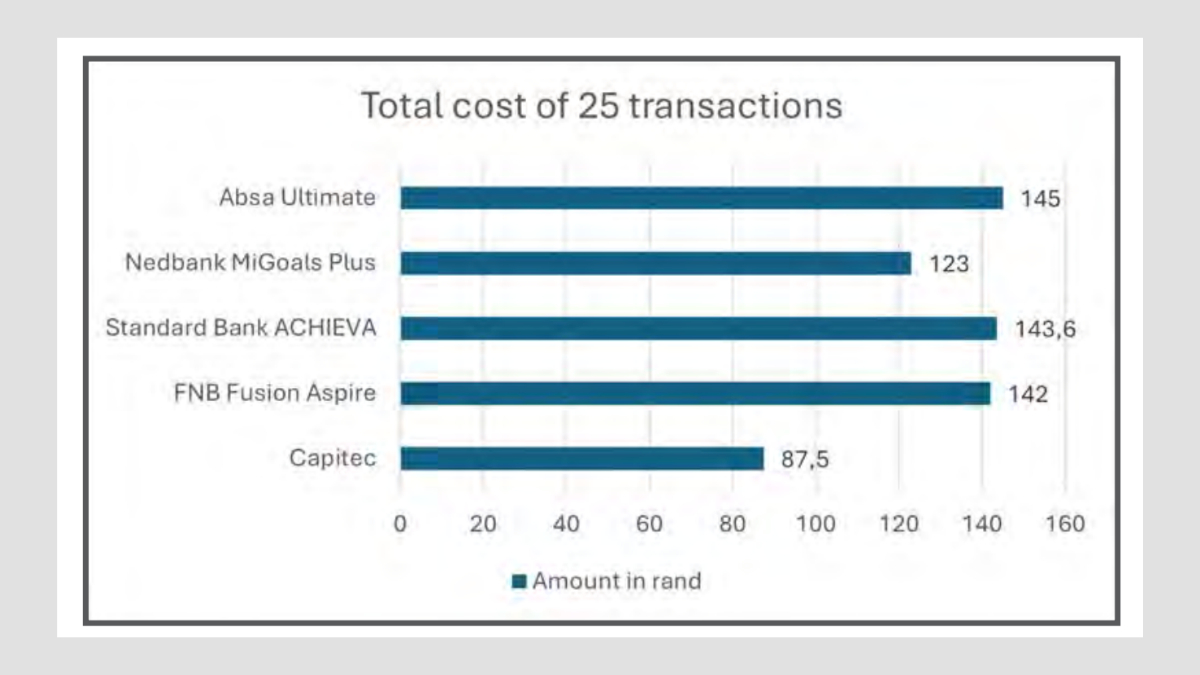
In the 25-transactions category, reflecting the middle-class incomes with sophisticated banking needs, Capitec is the most affordable option; however, Solidarity noted that when considering bundle accounts that offer substantial added value and rewards, Nedbank’s MiGoals Plus account is the cheapest.
“Middle-class consumers will pay the least at Capitec, but if the benefits of other banks’ rewards programmes are of value to such consumers, then Nedbank’s MiGoals account, at a total cost of approximately R123 for our basket of transactions, could be the cheapest,” said Du Buisson.
Higher middle-class
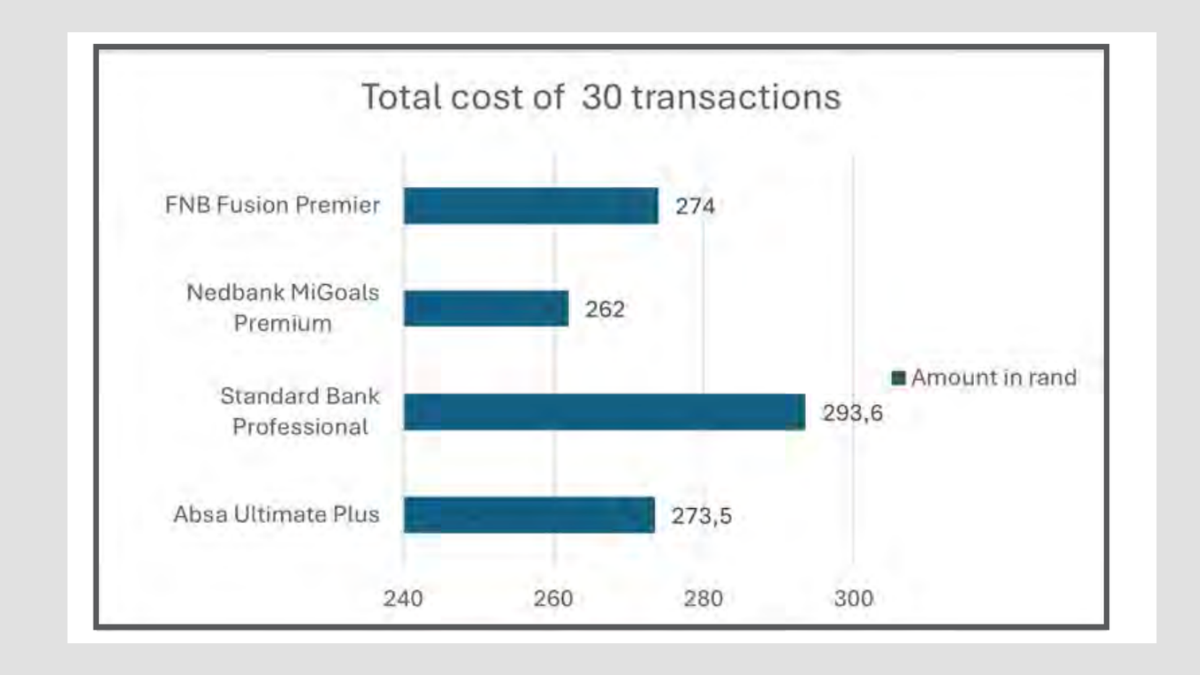
For higher middle-class income and sophisticated banking needs (30 transactions), Nedbank’s MiGoals Premium account is the cheapest option, while Absa’s Ultimate Plus account comes second in this category.
Du Buisson said that this year’s analysis also concentrated on the added value proposition banks provide to customers, especially the benefits accessible to all account holders that are not contingent on the level of a rewards programme.
“In the cheaper category, it is difficult to determine which of the two accounts, Absa’s Transact or FNB’s Easy PAYU, offers most value to customers,” Du Buisson said.
“For example, Absa includes life cover of R5 000 in its monthly administration fee of R7,50. FNB’s Easy PAYU, also at R7,50, again offers four loaves of bread at 99c per month and a relatively simple way of accessing a R25 voucher at Pick n Pay every month.”
According to Du Buisson, banks’ offerings in the middle-class and premium categories are quite similar, although some benefits clearly stand out.


















 Loading ...