

SARS is coming after taxpayers for R3 petrol price relief in South Africa


South African Revenue Service (SARS) Commissioner-designate Dr Ngobani Johnstone Makhubu says that the R3 per litre fuel tax relief offered to consumers in April will have to be repaid in one way or another.
Speaking at an introductory briefing on his appointment as the new SARS head, Makhubu noted that the revenue service has been given a challenging collection target for 2026/27.
The commissioner-designate said that, following SARS’ record R2 trillion haul in 2025/26, the revenue service has been tasked with collecting R2.13 trillion in 2026/27.
This task will be challenged by “the headwinds that are already starting to bloom,” he said, referring to the chaos caused by the United States’s war in Iran.
The war has triggered a global energy crisis, sending fuel prices skyrocketing as shipments through the Strait of Hormuz were blocked.
Because of the crisis, fuel prices were expected to shoot up by over R6 a litre for petrol and over R10 a litre for diesel in April.
However, Finance Minister Enoch Godongwana announced last-minute relief for fuel users, granting a R3 per litre cut to fuel taxes.
Outgoing SARS commissioner Edward Kieswetter said the key caveat is that the National Treasury’s fuel levy relief is only valid for a month.
The levy cut was not intended to be a long-term solution, but a pause for the government and local finance authorities to assess the situation.
“The month is really to give us time to understand [the length], the severity and the magnitude of this crisis,” Kieswetter said.
He said that fuel has a knock-on effect on everything else, because it is central to the production, logistics and flow of goods and services.
“Invariably, fuel will have an impact on the cost of living…[the relief] buys the minister some time to understand what exactly is happening,” he said.
However, the SARS leads warned that the relief does not come without a price.
Fuel levy losses must be paid
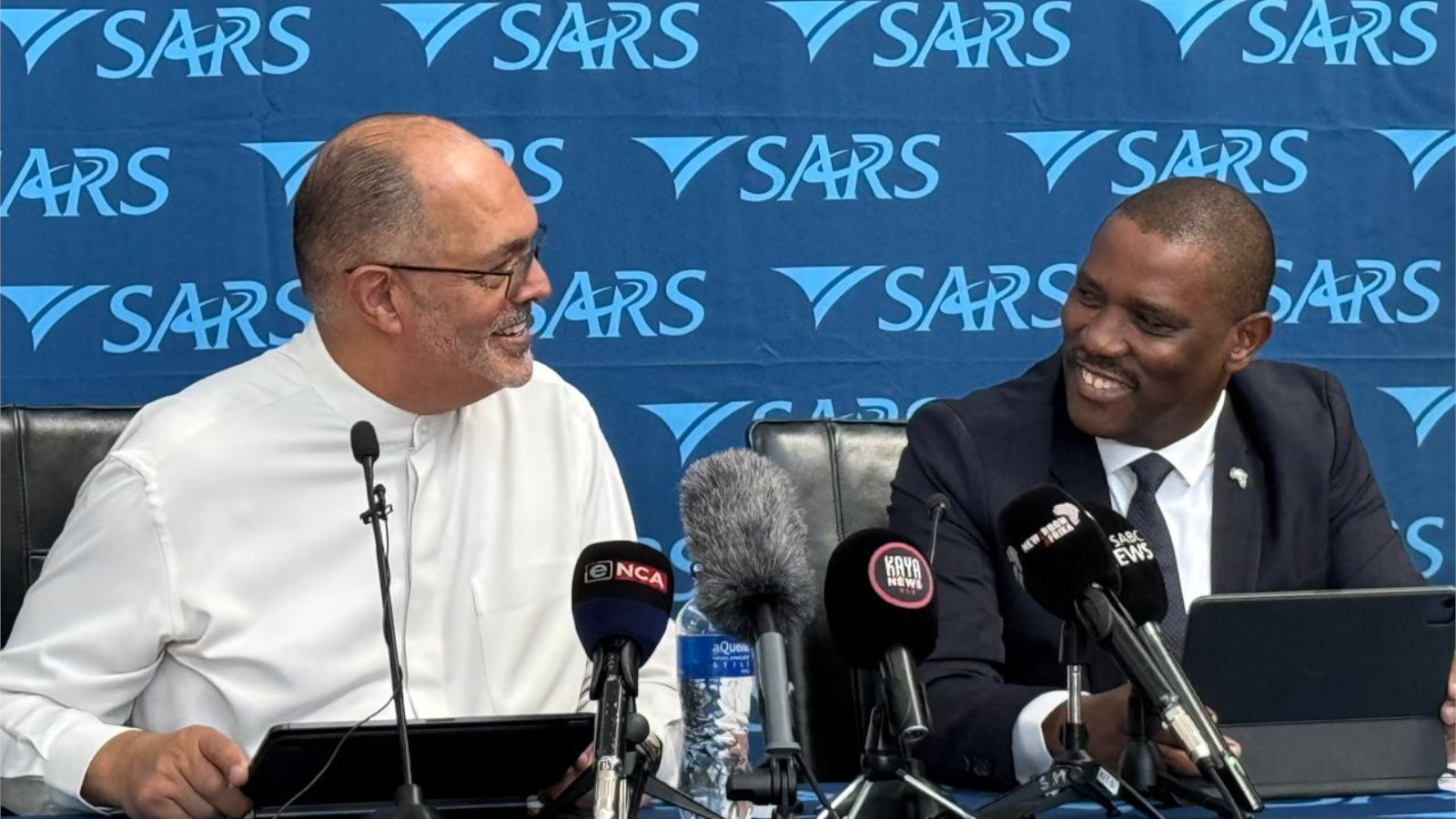
Speaking on the cost of the relief, commissioner-designate Makhubu said that the bill for the fuel levy relief is coming, and that taxpayers will have to foot it, one way or another.
“Fuel levies are pencilled in at R104 billion for this financial year in terms of total collections. The [fuel levy] relief is going to cost around R6 billion,” Makhubu said.
“It is expected to be cost-neutral—this suggests that the R6 billion will have to come from somewhere. We do expect that we may be asked to work extra hard to get that.”
Makhubu and the team at SARS will now be under pressure to ensure these collections happen.
The commissioner-designate will formally assume the top position at SARS from 1 May 2026, after the one-month relief has ended.
The National Treasury has not yet announced how the relief process will terminate.
The Treasury previously offered relief for fuel prices in 2022, following Russia’s invasion of Ukraine.
During this time, R1.50 was cut from fuel levies for three months (April-June), before being added back over two months (75c at a time), terminating in August.
As it currently stands, the R3 fuel levy relief is just expected to simply terminate on 6 May 2026, at which point it will presumably be added back into the fuel price.
Current fuel price recoveries point to another R5 per litre hike building for petrol prices in May (R15 per litre for diesel). Adding R3 to the mix would push prices to another record hike.
Meanwhile, Treasury and the Department of Petroleum and Mineral Resources have noted that the tax cut was only “phase one” of a two-phase intervention.
Further measures are expected for May and June. These are expected to be broader and longer-term interventions.
The second phase of the support will be a broader review of fuel pricing over the medium term, the Treasury said.











 Loading ...