

Calls for law change that affects property rates in South Africa



There are calls to amend the Municipal Property Rates Act of 2004 to cap the rate that municipalities can charge for property rates in South Africa.
Property rates in South Africa are calculated by multiplying a property’s municipal valuation by a cent amount in the rand set annually by local municipalities.
Durban businessman and Queensmead industrial property owner Roy Tilley has raised concerns about South Africa’s municipal property rates system.
Speaking in an interview with BizNews, he argued that the way rates are calculated is fundamentally flawed and increasingly unaffordable for property owners.
Tilley said the issue is in the formula used to determine rates, which he believes allows municipalities unchecked power to increase charges.
“It affects all types of property, residential, commercial, and industrial, and what it boils down to is that it’s a blank cheque for any municipality to take as much as they want from your building in terms of rates.”
He stressed that property rates differ from other municipal services because they cannot be avoided.
“Rates, unlike water or electricity, you can’t switch them off. You can’t say, ‘I’ve had enough’ and find an alternative. With rates, you can’t escape it,” he said.
According to Tilley, the system allows municipalities to continuously increase the percentage applied to a property’s value, which is known as the randage or cent amount in the rand.
“We’ve got a formula that ever increases the percentage applied to the actual value of the property. The percentage applied is mathematically infinite in terms of the current formula,” he said.
Tilley stressed that while ratepayers can object to valuations, the process does not address the underlying issue.
“The objection process is only focused on the municipal value, which is not the problem. It’s the formula that is applied to that value. You’re fighting with your hands tied behind your back,” he said.
Law change needed

Tilley added that the compounding effect of rate increases on property makes the system particularly unsustainable.
“You can’t apply an ever-increasing percentage to an ever-increasing number. Eventually, no matter what you do, you won’t be able to service that,” he said.
He also highlighted the broader economic impact, especially on small businesses. His Queensmead property hosts multiple small tenants, many in spaces under 100 square metres.
“We are like an incubator for small businesses. If this thing eventually closes down, all these small businesses would have no place to go,” he said.
The knock-on effects extend to employment. “We’ve got guys who’ve been working for us for over 30 years, and now they’re going to have to be on short time because we can’t keep absorbing these rate increases,” he said.
Tilley further argued that municipalities are not delivering value in return for the rising costs. “We’re getting zero value,” he said.
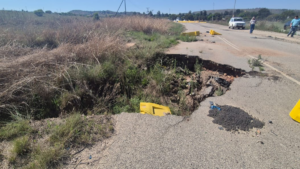
Tilley cited poor road conditions, unmaintained verges, and ongoing service delivery failures in industrial areas as examples of the lack of return on the increased rates.
He also pointed to a widening gap between property value increases and rate hikes. “In eight years, our property was up-valued 33%, but the rates went up 115%,” he said.
Tilley warned that the problem is not limited to industrial property owners. “Older people will ultimately be forced out of their homes because they won’t be able to afford the rates,” he said.
This is because their incomes largely remain static while these property costs continue to increase. He described the system as effectively giving municipalities a stake in private property.
“By applying a percentage to the municipal value, they become a shareholder in your property—but they never paid for it, they don’t maintain it, and they still get a comfortable yield,” he said.
“This has to go to Parliament. They have to amend the Municipal Property Rates Act of 2004. We need to put a cap on the maximum percentage that can be applied to any property,” he said.

















 Loading ...