

Top American bank expects interest rate hike in South Africa next month


Bank of America expects the South African Reserve Bank (SARB) to hike interest rates in May, with inflation expected to pick up after the Iran War.
Following the US and Israel’s attacks on Iran, the Persian nation targeted energy resources in the Middle East, leading to a rapid rise in oil prices. While a ceasefire was reached, tensions remain high.
The conflict led to massive fuel price increases in South Africa, with petrol increasing by R3 per litre and diesel by R7 per litre despite the government lowering the fuel levy by R3.
Regarding inflation, the CPI rose to 3.0% in February and 3.1% in March. However, this data did not reflect the increases at the pumps, which only started on 1 April.
Bank of America thus expects inflation to reach 3.7% in April, a slight decline from its previous estimate of 4% due to government fuel relief.
Bank of America added that a further 10% spike in fuel prices in May would cause CPI to reach 4.1%. This would go beyond the one percentage point tolerance band of the SARB’s 3% target.
“Higher fuel prices will probably translate into higher transport expenses more broadly, which act as input costs for production, leading to higher food prices, among other second-round effects,” it said.
“Our primary changes to the inflation outlook are due to higher oil prices as a result of geopolitical tensions, which transmit through a weaker ZAR and higher domestic transport and food costs.”
Even if the current tension eased quickly, Bank of America said South Africa would still need to adjust to higher oil prices, implying a more persistent inflationary impact rather than a transitory shock.
The bank added that higher food and fertiliser prices remain a risk, with fuel a major input to transport and food, creating high pass-through risk.
Food prices are crucial for interest rates, as they have the largest impact on inflation expectations.
“Firms can absorb small price moves, but large, persistent shocks increase pass-through. South Africa relies on imports for about 80% of its fertiliser needs,” said Bank of America.
“Fuel and fertilisers together make up about 50% of grain production input costs. Prices of both have risen by 15-20% since early March.”
However, Bank of America noted that fertiliser demand should peak only when the planting season resumes in October 2026.
Current price increases are driven more by fears of potential scarcity than by actual shortages, the bank said.
“If the conflict ends by June, fertiliser prices may moderate before procurement intensifies,” it said.
“If not, elevated prices could spill into grain production and later food inflation. For now, food prices remain contained.”
A May hike is likely
An interest rate hike in May remains Bank of America’s base case, with the bank predicting that the 4% upper target will be breached in Q2 2026.
The bank said that inflation is likely to remain around the 4% target for the remainder of 2026, peak at 4.4% in Q1 2027, and then fall again. This would call for one near-term hike, according to the bank.
“To anchor inflation expectations around the target, the SARB would likely hike in May to push up the policy rate to 7%,” said Bank of America.
“The rationale would be to keep real rates close to 3% near term. Thereafter, the focus could be to move towards 2.75% once CPI is on a firm downward trajectory towards 3%.”
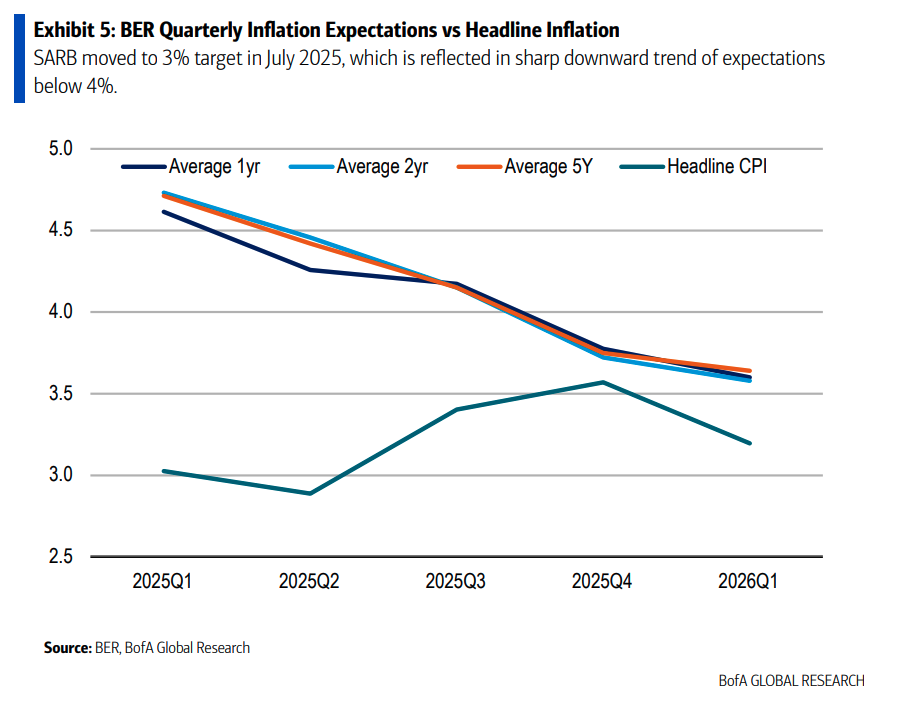
The bank said that a scenario where the SARB were to hike more than once would involve actual inflation prints jumping far above 4% and inflation expectations rising, reversing the current declining trend.
Rising inflation expectations would cause difficult decisions for the central bank. The next BER inflation expectations survey will be released in June 2026 and will incorporate the energy shock.
| Metric | 2024 | 2025e | 2026f | 2027f |
| Real GDP growth (%yoy) | 0.5 | 1.1 | 1.3 | 1.6 |
| CPI (%yoy) | 4.4 | 3.2 | 3.8 | 3.5 |
| Policy rate (%) | 7.8 | 6.8 | 7.0 | 6.3 |
| Fiscal Bal (% of GDP) | -4.3 | -4.1 | -3.7 | -3.6 |
| Primary Bal (% of GDP) | 0.9 | 1.3 | 1.8 | 2.0 |
| Debt (% of GDP) | 77.0 | 79.5 | 77.1 | 73.8 |
| Current Account Deficit % of GDP | -0.7 | -0.5 | 0.3 | 0.0 |
| Exchange rate (USD/ZAR end period) | 18.7 | 16.6 | 16.0 | 16.0 |














 Loading ...