

Rand hits the sweet spot


South Africa’s rand continued its winning streak on Thursday, strengthening further against the US dollar, and landing in the ‘fair value’ range set by markets.
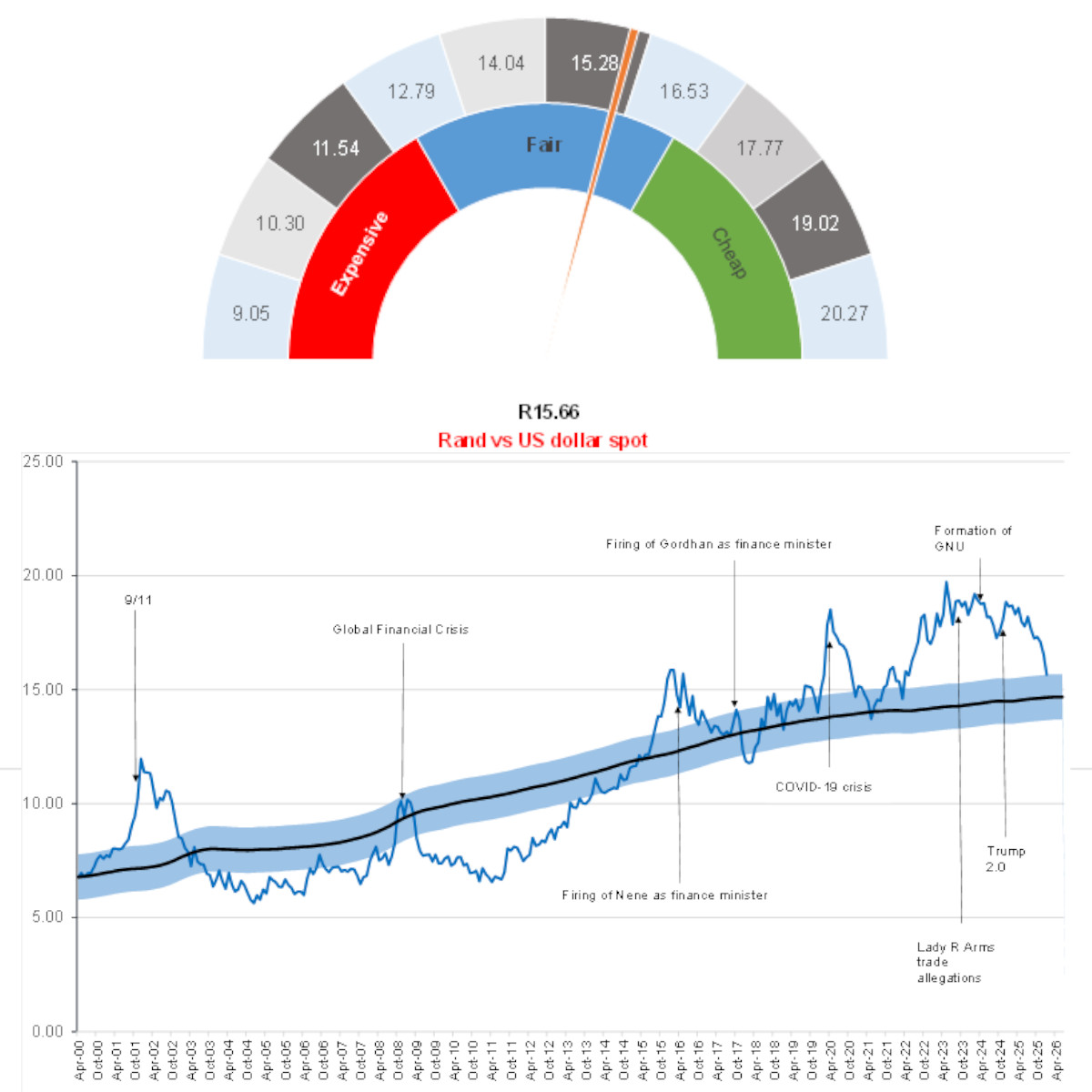
Analysis by boutique wealth management group Anchor shows that at around R15.70 against the US dollar, the rand has entered into the modelled fair value range of R13.73 to R15.73.
The fair value range is where the rand is seen as reflecting its true value, rather than being over- or undervalued due to market sentiment tied to its risk premium.
It is also seen as the value reflective of purchasing power parity, which measures the purchasing power of currencies when buying a similar basket of goods.
The Big Mac Index is a simple and familiar measure of PPP, but various measures are used in modelling across different banks, analytics groups and finance groups.
Like Anchor;s modelling, the “fair value” of the rand has been pegged at between R13/$ (Big Mac Index) and around R16/$ (Investec’s modelling)—and the rand’s current levels put it neatly in range.
The rand broke through the psychological R15.70/$ level on Wednesday, and traded as low as R15.65/$ on Thursday ahead of the Reserve Bank’s interest rate decision.
Anchor noted that the rand has strengthened by around 5.5% against the dollar this year so far and could settle and sustain in the fair-value band.
The currency’s appreciation has been driven primarily by broad-based US dollar weakness, supported by surging commodity prices—notably gold and platinum, up 22.1% and 28.3% YTD, respectively.
To a lesser extent, but not discounted, the improving investor sentiment towards South Africa has helped things along.
“Record gold and platinum prices, heightened US policy uncertainty, and growing expectations of further US Federal Reserve rate cuts have weighed on the US currency,” Anchor said.
The US Fed held rates on Wednesday, in line with market expectations; however, the longer-term view is that cuts will happen, just slowly.
Similar sentiments have been expressed around the South African Reserve Bank and its cutting trajectory, with economists anticipating a rate cut either today or at the next meeting in March.
The broader view is that South Africa will see 50bps of cuts in 2026—though there is no consensus on the pace.
Dollar weakness in the driving seat
The US Dollar Index, which tracks the value of the greenback against a basket of six major global currencies, has declined by ~11% YoY to 28 January 2026 and was down 9.4% in 2025.
This comes as markets and investors reassess the sustainability of US growth, the inflationary implications of the Trump regime’s on-again, off-again tariffs, Trump’s erratic behaviour on the global stage, and the likelihood that US interest rates have peaked, it said.
Markets have taken note of Trump’s aggression towards allies, including a strange fixation on acquiring Greenland.
“Trump’s cognitive functions and health have also been a source of concern, and an incoherent, rambling speech at the World Economic Forum in Davos was widely ridiculed,” Anchor said.
More worrying, however, has been the Trump administration’s targeting of the Fed, with the “startling revelation” that Fed Chair Jerome Powell is facing a criminal investigation.
This has amplified an increasingly hostile administration towards the Fed.
“Some commentators have described this as an effort to undermine the central bank’s independence,” Anchor said.
In addition to these misgivings, civil unrest, sparked by two highly publicised fatal shootings by US federal agents, has added to perceptions of policy unpredictability.
“Against this backdrop, investors have increasingly sought alternative safe havens, pushing gold prices to record highs,” Anchor said.
While the dollar has been a key driver of the stronger rand, Anchor said that domestic developments have also become increasingly supportive.
Lower oil prices (-18.5% in 2025) and elevated gold and platinum exports have materially improved SA’s terms of trade, boosting the fiscus.
SA’s November trade surplus rose to R37.7 billion, the largest since March 2022, reflecting a strong export performance.
Improved electricity supply, better logistics outcomes—improved rail performance, increased container volumes, and stronger public-private collaboration—and the resilience of the Government of National Unity (GNU) have also helped lift business confidence.
The positive news is that the conditions are likely to continue, with the caveat that the swings might not be as pronounced.
“While the recent moves in the currency have been sharp, we believe that the underlying trend may well continue during 2026, albeit at a more measured pace,” Anchor said
“With the rand trading closer to its fair value, it has also become more vulnerable to adverse shocks, which are inherently difficult to predict.”
The group warned that US trade and foreign-policy developments under the Trump administration, along with South Africa’s 2026 Local Government Elections, remain potential sources of volatility.
“Any negative surprises on these fronts could have a more pronounced impact on the local currency,” it said.

















 Loading ...