

Good news for interest rate cuts in South Africa – but there’s a big catch


Inflation expectations in South Africa have declined to a record low, but the war in the Middle East continues to cast doubt over the path of inflation and interest rates.
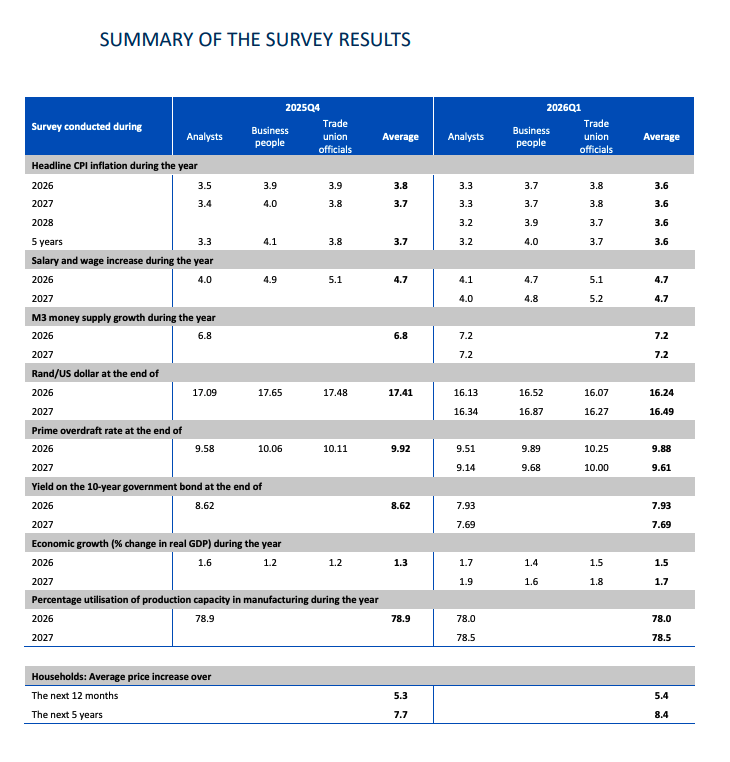
The latest inflation expectations survey conducted by the Bureau for Economic Research (BER) showed that inflation is expected to decline over the next five years.
The drop in inflation expectations was marginal from 3.7% to 3.6%, but it nonetheless represents a record low, the BER said.
All three professional groups in the survey, analysts, business people and trade union officials, made downward revisions of 0.1 percentage points compared to the prior quarter.
On the lower end, analysts expect inflation to average 3.2% over the next five years, while business managers forecast 4.0%.
The three professional groups in the survey expect inflation to be very stable over the next five years, with headline inflation at 3.6%, on average, this year, next year and in 2028.
Finance Minister Enoch Godongwana recently introduced a new inflation target of 3.0% in 2025, with the latest inflation expectations falling within the 1 percentage point leeway provided by the new target.
The South African Reserve Bank (SARB) commissions the BER to conduct a quarterly survey on inflation expectations.
The results of the inflation expectations survey are among the many factors the Monetary Policy Committee (MPC) of the SARB considers when deciding on the interest rate.
The MPC will be concerned if inflation expectations are well above the 3% inflation target and other inflation indicators deteriorate.
To prevent higher expectations from becoming a reality, the MOC may be forced to raise interest rates. The opposite happens if inflation expectations and other indicators decline.
The latest expectations point to inflation being close to the current target range, which would give the MPC room to cut interest rates.
However, the latest survey of financial analysts, business executives and representatives of the trade union movement was conducted between 16 February and 5 March 2026.
Thus, many respondents were questioned before the USA and Israel launched attacks in Iran on 28 February. Iran has responded by launching attacks across Arabia and has shut down the Strait of Hormuz.
This has led to a sharp increase in oil prices to over $100 per barrel, with many still unsure when the conflict will end, as the US’s rationale for starting the war remains unknown.
On top of the surge in oil prices, global risk-off sentiment could impact South African assets and weaken the rand.
Given the uncertainty over the war, the future path of interest rates remains unknown. The Reserve Bank was widely expected to cut interest rates twice this year, but this prediction has become less certain.
Household expectations

While the three professional groups expect inflation of 3.6% this year, household inflation expectations for the next 12 months ticked up to 5.4% in Q1 2026, up from 5.3% previously.
“The downward trend seems to have bottomed out now; this is the same level that it was in the second quarter of 2025,” said the BER.
The three professional groups, on average, expected that wages would increase by 4.7% over the next year, with the forecast unchanged from the previous quarter despite inflation expectations dropping.
All three professional groups have also become slightly more optimistic regarding optimistic growth. On average, they expect GDP growth of 1.5% in 2026, up by 0.2% points from Q4 2025.
They also expect a small acceleration in GDP growth to 1.7% next year.















 Loading ...