

South Africa has hit a jobs wall – and it could be around for a while


South Africa’s latest unemployment figures are largely in line with expectations, but there are concerns around the country’s slowing absorption and participation rates, say Nedbank economists.
While the economy has gained traction in the past months, the momentum has come from increased global demand and the rally in commodity prices. Domestically, however, high-frequency data suggests that demand remains subdued and businesses will take time to recover from the shock of level 5 lockdown.
“Meaningful job creation will probably only resume once corporate profitability has been restored and balance sheets have been strengthened,” Nedbank said in a research note following the latest Quarterly Labour Force Survey (QFLS).
“Government can best boost labour market prospects by speeding up vaccination rates, which would go a long way in helping to improve the conditions in labour-intensive industries such as hospitality and tourism.”
Worryingly, however, the absorption and labour force participation rates have been on a declining trend for the past two quarters, it said.
The labour force participation rate is the proportion of the working-age population that is either employed or unemployed. The absorption rate is the proportion of the working age population that is employed.
“Added to this, the number of unemployed and discouraged work-seekers remains high – so even if employment were to increase, the unemployment rate is likely to remain structurally high over the medium term.”

Hardest hit sectors
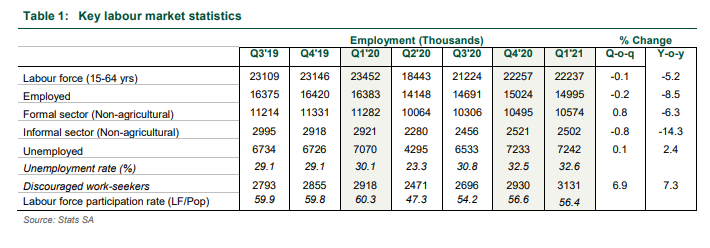
The QLFS showed that the official unemployment rate increased by 0.1 of a percentage point from 32.5% in the fourth quarter of 2020 to 32.6% in the first quarter of 2021 – the highest since the start of the survey in 2008.
Despite the first quarter generally being positive in light of school-leavers and graduates entering the labour market, the total number of people employed declined by 0.2% (-28,000) over the quarter, with the jobs created in the formal sector (+79 000) outweighed by jobs lost in the informal sector (-19,000), agriculture (-18,000) and private households (-70,000).
The picture looks even bleaker annually Nedbank said, with total employment down 8.5% (or by 1.39 million). There were significant job losses across sectors, with most jobs shed in the formal sector (-707,000), followed by the informal sector (-419,000), private households (- 189,000) and agriculture (-72,000).
The industry breakdown highlighted that of the 28 000 total jobs shed, construction (-87,000) and trade (-84,000) reduced employment the most, followed by private households (-70,000), transport (-40,000) and agriculture (-18,000).
By comparison, the finance sector recovered an exceptional 215,000 jobs. Job creation also occurred in mining, manufacturing, utilities and community and social services. On a year-on-year basis, all sector recorded job losses, except the finance sector (+10,000).
Long-term problem
The full picture of the crisis of unemployment in South Africa lies in the number of unemployable, not just unemployed, people whose proportion can be partially gauged by the long-term unemployment figures.
In an analysis of the data, the DA’s Gwen Ngwenya said that:
- The likelihood of remaining unemployed is greater for the long-term unemployed.
- People who have been unemployed for longer than a year become discouraged and stop looking for work. On average the long term unemployed give up looking for work and join the ranks of the economically inactive in greater numbers than they reintegrate back into the job market.
- Long-term unemployment strongly and negatively effects psychological well-being, increases social exclusion and propensity to crime. Furthermore, when reemployed those returning after a long period of unemployment tend to earn less than in their previous jobs and are demoted from their past career paths.
Unfortunately, the long-term unemployed are not a tiny subset of the unemployed in South Africa, they are a significant majority, Ngwenya said.
“People who have been unemployed for longer than a year make up 75.3% of the unemployed population according to the latest results released by Stats SA for the first quarter of 2021.
“Many of them have been unemployed for a great deal longer than a year – 60% of unemployed South Africans have been out of work for longer than five years, and at least one in three have never worked before.”
Read: South Africa’s unemployment rate hits new all-time high

















 Loading ...