

Eskom reports R16 billion in profit


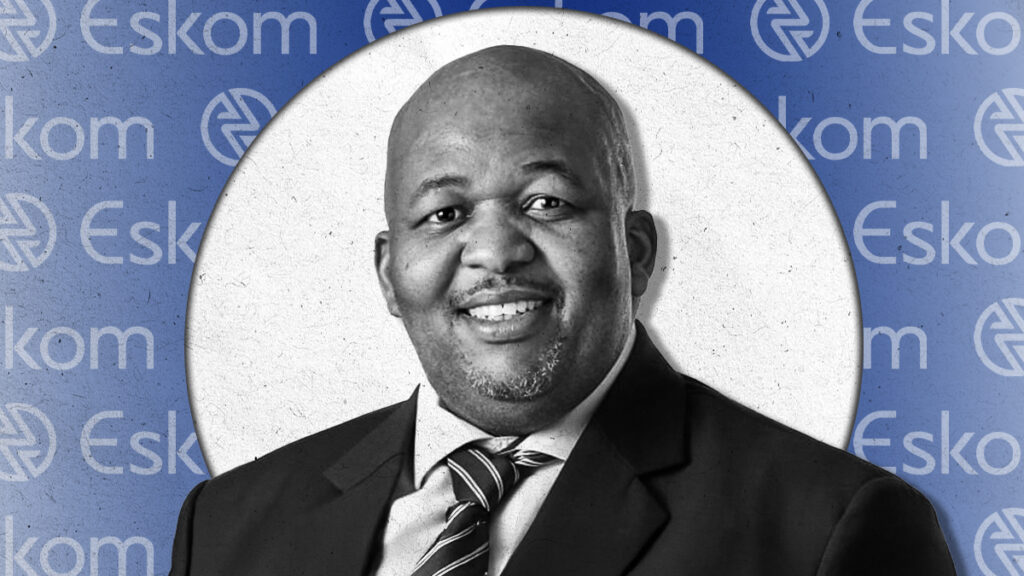
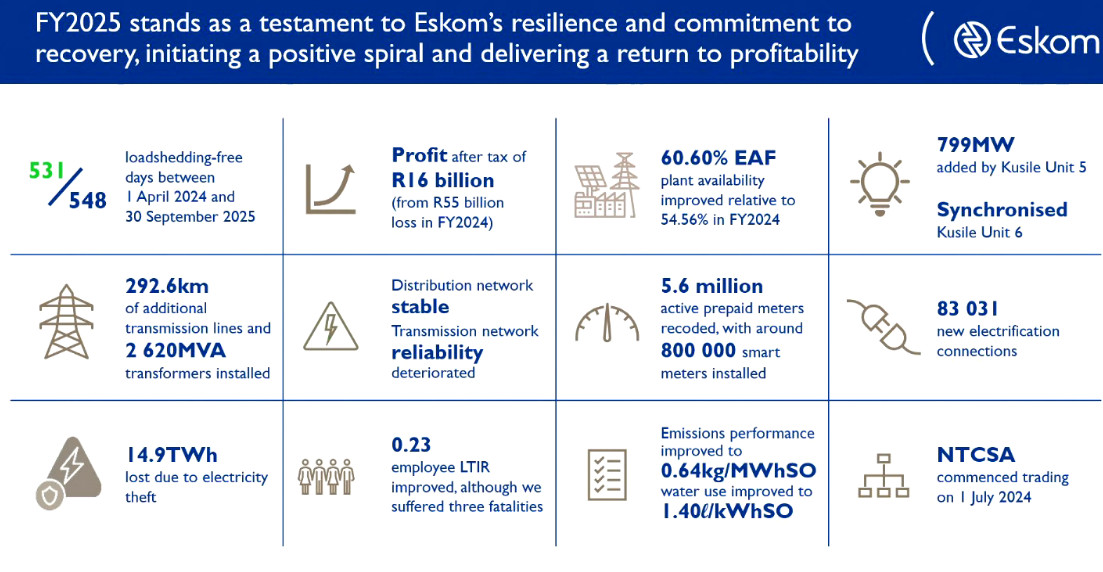
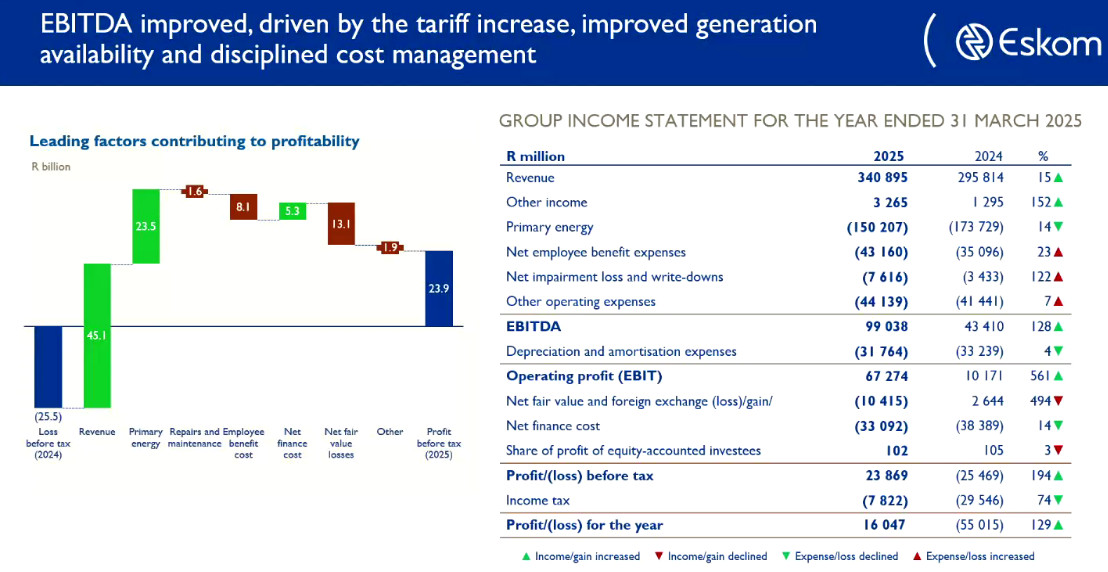
Power utility Eskom has announced a profit after tax of R16 billion for the full year ending March 2025, up from a massive R55 billion loss recorded in the previous year.
The utility noted that the profit was driven by significant cost reductions in its primary generation costs, and reduced spending on open-cycle gas turbines.
The group recorded a profit before tax of R23.9 billion (2024: loss of R25.5 billion), marking the first return to profitability since FY2017.
It said that this was underpinned by a stronger EBITDA margin of 29.05% (2024: 14.67%), supported by a 12.74% standard tariff increase and a 14% reduction in primary energy costs.
Energy not supplied as a result of load shedding declined significantly to below 0.4TWh (2024:13.2TWh). This corresponds to a total load shedding duration of 175 hours (2024: 6,367 hours) and a decrease in the number of load shedding days to 13 (2024: 329 days).
“Consequently, Eskom was able to supply electricity on 96% of the days in the reporting period, compared to 9% in 2024,” it said.
“Recovery of previously disallowed fuel levy rebates from SARS provided a further boost to earnings and liquidity. After adjusting for this once-off recovery, Eskom recorded a normalised profit before tax of R11.9 billion.”
According to a report by the Council for Scientific and Industrial Research (CSIR), the South African economy lost up to R2.8 trillion due to load shedding in the 2023 calendar year.
In 2024, that figure was reduced by 83% to R481 billion. This shows Eskom’s turnaround strategy is working, the group said, and highlights the importance of getting the company’s operations right.
“Eskom’s stability and performance are vital to South Africa’s growth and development, through sustained economic growth and job creation,” said Eskom Chief Executive, Dan Marokane.
The CEO said that the company is working to reinvest its profits back into national assets, and plans to invest over R320 billion over the next five years to expand its infrastructure to the benefit of the country.
Municipal debt mounting
Notably, Eskom pointed out that it has not yet met stakeholder expectations, but the performance shows significant progress on doing so, hitting 90% of all external audit findings raised since FY2021 to FY2024.
Eskom received a qualified external audit opinion for FY2025 due to incomplete or inaccurately maintained records in terms of the Public Finance Management Act (PFMA).
These records did not comply with legislative requirements relating to irregular expenditure and losses due to criminal conduct.
Issues raised in the prior year’s audit qualification were not adequately addressed and continued into 2025. Several internal control deficiencies were also highlighted.
Furthermore, there is material uncertainty regarding Eskom’s going concern status, driven by dependence on government support, uncertainties related to operational assumptions and regulated revenue by NERSA, as well as growing municipal arrear debt and energy losses.
The group said it established various programmes and initiatives to address these issues, including cleaning up its internal controls, setting up investigation and security units and hiring additional finance professionals.
Eskom also flagged a major problem that continues to sit on its books, that being municipal arrear debt, which stood at R94.6 billion as of 31 March 2025.
This marks a 27% increase from the previous year (2024: R74.4 billion).
“Despite the implementation of the National Treasury’s municipal debt relief programme, the growth has not slowed,” Eskom said.
“Most participating municipalities are failing to meet the basic requirement of paying their current accounts on time and in full. This situation poses a serious risk to the viability of Eskom’s standalone Distribution company and threatens progress in the broader legal separation process.”
The group said that it continues to engage with the government to explore alternative interventions, including prepaid supply models and other “proactive interventions”.
This includes implementing distribution agency agreements to capacitate municipalities and improve both revenue collection and service delivery.
“In a break from the past, we are accelerating the review and restructuring of our cost base,” Marokane said.
“This is being done within the framework of the expected future single-digit tariff increases allowed by NERSA, as we drive efficiencies and take control of the factors within our control to address the affordability of electricity.”

















 Loading ...