

Another gut-punch for SPAR


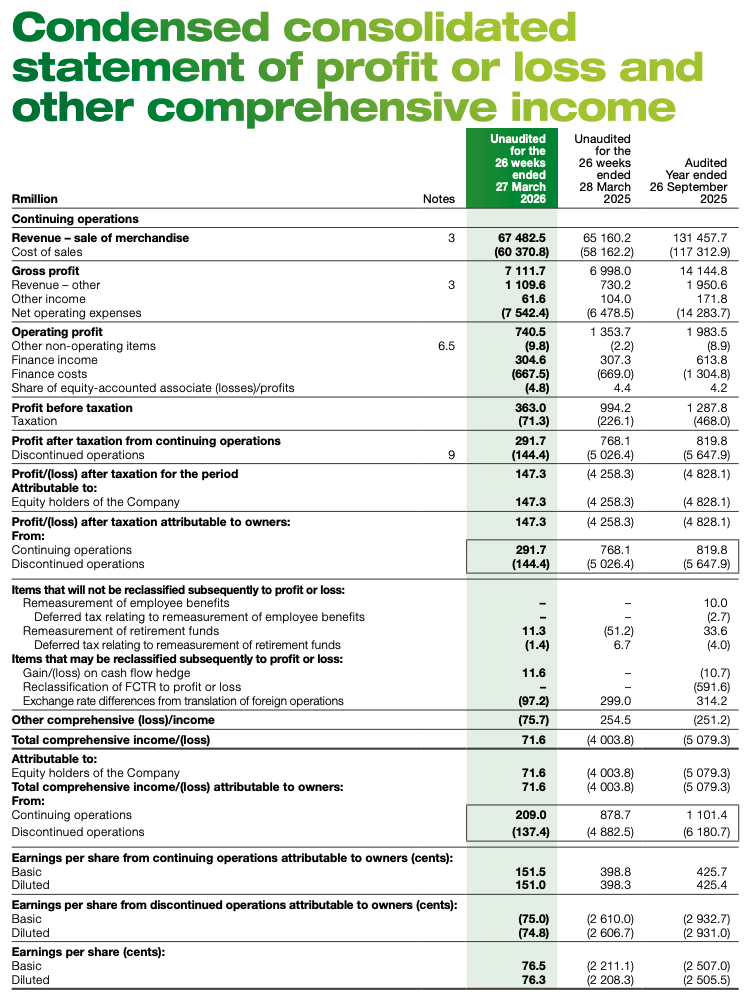
The SPAR Group’s latest financial results have been weak despite the group swinging from a R4.2 billion loss to a R147.3 million profit.
In its interim results for the six months ended 27 March 2026, the group said that it faced significant pressure.
This included three main challenges: underperformance in KwaZulu-Natal, an ineffective Black Friday campaign that failed to deliver a return on investment, and residual balance sheet clean-ups.
Although the performance for the period demonstrated the scale of the challenge facing the group, it also provided a clear baseline against which progress and recovery can be measured.
“These are not market problems; they are execution problems, and they are fixable,” said new Group CEO Reeza Isaacs.
“We allowed our cost base to outgrow revenue for too long. We also failed to treat retailer profitability as our primary metric.”
From the group’s continuing operations, group revenue increased by 3.6% to R67.5 billion. However, profit from continuing operations declined from R768.1 million in H1 2025 to R291.7 million.
The group’s Poland, Switzerland and United Kingdom operations have also been classified as discontinued operations, with the first two already sold and the UK business in the sale process.
The group’s discontinued operations recorded massive write-downs of over R4 billion in the prior period, resulting in losses of over R5 billion.
The latest results show the loss from discontinued operations declining to R144.4 million.
When including continuing and discontinued operations, the group’s total profit attributable to owners improved from a loss of R4.2 billion to a profit of R147.3 million.
On a basic earnings per share level, the group saw an improvement from a loss of 2,610.0 cents to a profit of 76.5 cents.
However, headline earnings per share, which ignore once-off items and non-operational matters, declined by 53.9% to 123.6 cents per share.
Recovery plans

Isaacs, a former executive at Woolworths, will lead the group’s recovery strategy, which prioritises improving retailer outcomes first.
The group has thus intensified engagement with independent retailers and the National Guild to ensure retailer concerns are heard and resolved more quickly. It has five pillars of execution.
This includes stronger procurement, improving brand and marketing effectiveness, modernising retail systems and processes, and helping retailers improve profitability.
The group also plans to reposition SPAR2U, which it said should allow for a more personalised retail experience, supported by investment in a new platform and the continued growth of digital partnerships.
In KZN, a structured stabilisation programme has restored three straight months of operating profit to close the half, with out-of-stock rates materially improved.
The group’s new local perishables model has also improved availability and driven revenue growth. New leadership is in place across Merchandise, Finance and Retail Operations.
While the group has exited three international markets, the group is keeping its Irish business (BWG). BWG Foods saw a solid performance with sales up 2.2% to €855.7 million, and gross margins improved.
The business continues to provide a strong example of how independent retailers can outperform when supported by the right wholesale infrastructure, operating disciplines and customer proposition.
Early indicators also suggest that corrective actions are underway. Gross-profit growth turned positive in February and March, with KZN service levels improving and SPAR health up 26%.
SPAR Rewards’ sales increased 9.3% year-on-year, with the SPAR Rewards programme now having 12.8 million registered cards, and members spending 74% more per basket than non-members.
“Recovery will not be defined by a single reporting period. It will be defined by consistent operational improvement, stronger retailer outcomes and visible progress over time,” said Isaacs.
“We believe in the independent retail model because it offers local relevance that other retail chains cannot match.”

















 Loading ...