

Another warning sign for South Africa’s economy


South Africa’s economy continues to struggle, with the PayInc Economic Index the latest indicator of challenges facing South African households.
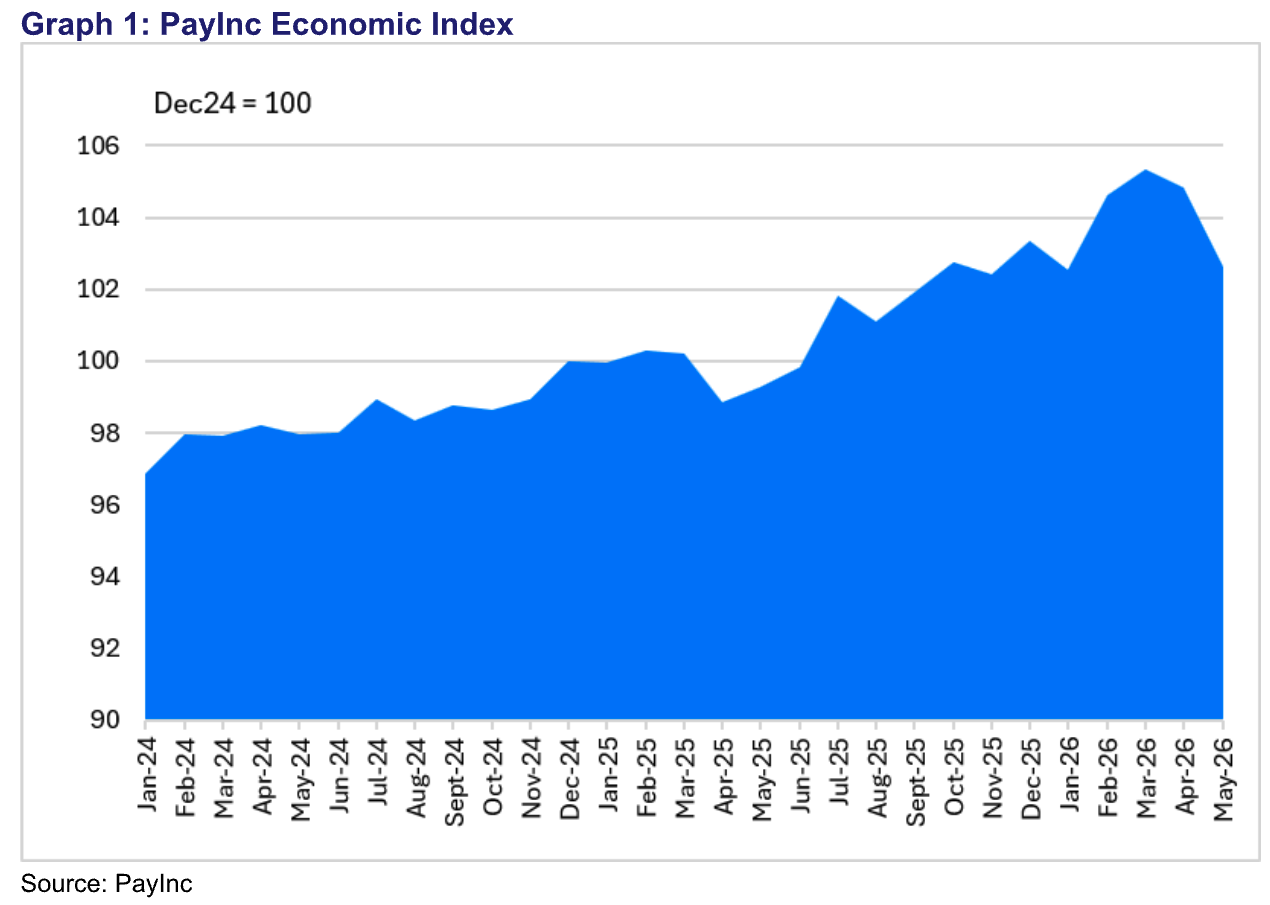
The PayInc Economic Index, which tracks the monthly value of electronic transactions cleared via PayInc, declined sharply in May 2026 amid rising costs and global tensions, taking a toll on households.
“The index declined by 2.1% month-on-month to 102.6 in May 2026, marking the lowest level since November 2025,” said Shergeran Naidoo, Head of Stakeholder Engagement at PayInc.
“Despite remaining 4.0% higher than a year ago, the latest data signals a moderation in economic activity over the past two months.”
The index showed that both transaction volume and value remained largely unchanged in May.
PayInc’s primary contributors to the weaker outcome were higher inflation forecasts, with consumer price and producer price indices rising significantly, alongside a slight tapering in cash demand.
“Households and businesses have faced mounting pressure due to consecutive fuel price increases and a 25-basis-point interest rate hike announced in late May,” said Elize Kruger, Independent Economist.
“Combined with declining consumer and business confidence, these factors are expected to weigh on economic activity in the months ahead.”
Other indicators have also highlighted the pain in the sector. The S&P Global South Africa Purchasing Managers’ Index (PMI) fell to 49.6 in May from 51.6 in April.
This indicates a return to contraction in private-sector activity, as new orders fell at their fastest pace this year, while cost pressures intensified amid higher fuel prices.
The Absa PMI remained above the neutral 50-point mark for a second straight month at 50.8, down from 52.6 in April. While higher than Q1’s average of 48.3, the survey showed a deterioration in conditions.
The exception remains the new-vehicle market, where total vehicle sales increased by 12.8% year-on-year in May, and new-car sales rose by 16.3%.
Problems ahead

Kruger said that the ongoing geopolitical conflict in the Middle East has already influenced energy costs, with petrol and diesel prices up by approximately R8 and R10 per litre, respectively, in June.
Estimates from the Bureau for Economic Research showed that higher fuel prices could add about R45 billion to the economy’s costs in Q2.
PayInc said that the likelihood that businesses can fully absorb these increases is low, raising the prospect of broader inflationary pressures across the economy.
This has already led to a more cautious approach to monetary policy from the South African Reserve Bank (SARB), adding further pressure on growth.
The SARB’s Monetary Policy Committee (MPC) increased the repo rate by 25 basis points at the end of May 2026, bringing it to 7.0%.
The Reserve Bank also warned that three further interest rate increases may be required amid heightened inflation.
The latest CPI print was 4.0%, at the upper end of the SARB’s new tolerance band, with the SARB looking to bring inflation back to its new 3% target.
While the economy faces challenges, the recent Q1 2026 GDP figures exceeded average economists’ expectations by 0.5%.
“While the economy remains resilient, the latest PayInc Economic Index points to emerging pressures that could weigh on growth in the months ahead,” ends Kruger.

















 Loading ...