

Eskom hits 5-year milestone


Eskom has reached 100 consecutive days without load shedding, with the state-owned entity patting itself on the back for returning to 2020 levels of unplanned breakdowns.
The state-owned utility said that the latest accomplishment builds on the momentum of 2024, as it delivered 352 loadshedding-free days.
It is also a significant improvement from the 36 days recorded in FY2023/24, its lowest performance in recent years.
The group said that the progress stems from the Generation Recovery Plan that was implemented in March 2023 as a way to stabilise and strengthen the national grid.
In the current FY2025/26 financial year, Eskom has recorded 26 hours of loadshedding and delivered 144 days of reliable electricity.
“The resilience of our generation fleet continues to improve, with unplanned losses due to breakdowns now at 6,035 MW—well below the 7,000 MW threshold,” said the state-owned utility.
“The last time Eskom recorded unplanned losses below this level was on 27 September 2020, when the figure stood at 6,829 MW.”
It said that the operational gains are stepping stones towards the larger goal, which is ending load shedding for good.
“Eskom remains fully committed to supporting South Africa’s electricity reform agenda and accelerating the transition to a competitive, sustainable energy future.”
“Our focus is not only on maintaining operational excellence, but also on enabling the structural reforms that will shape the future of the energy industry, for the benefit of all South Africans.”
Not so fast

Despite Eskom’s praise of its performance, the Nedbank Group Economic Unit’s latest energy tracker shows that the uptick in renewable energy sources primarily drives South Africa’s power supply improvements.
Its analysis showed that power demand in South Africa far outstrips available supply by as much as 24% versus the 2019-2021 average.
This has forced Eskom to turn to load reductions, Open Cycle Gas Turbine usage and international imports to stop load shedding.
Although Eskom’s dependence on this “compensatory load” has eased dramatically since peaking in 2023, this isn’t necessarily due to Eskom’s performance.
Nedbank’s economists said that the reduced pressure on Eskom was made possible by improvements in excess demand, or South Africans moving away from the national utility.
“Demand for energy continues to decline, signifying a structural break from reliance on Eskom. Only modest improvements have been made on the supply front,” the bank said.
The economists pointed to a sharp uptick in renewable and alternative energy investment post-2022, when the government scrapped licensing requirements for private generation.
This led to a surge in renewable investment, including solar PV and batteries. 2025 has seen another resurgence, followed by investment stalls in 2023 and 2024, with around 7,000 MW of renewable energy installed on the grid.
Nevertheless, Nedbank noted that South Africa’s energy security remains compromised.
This is evident in that Eskom still relies on compensatory measures to meet South Africa’s needs.
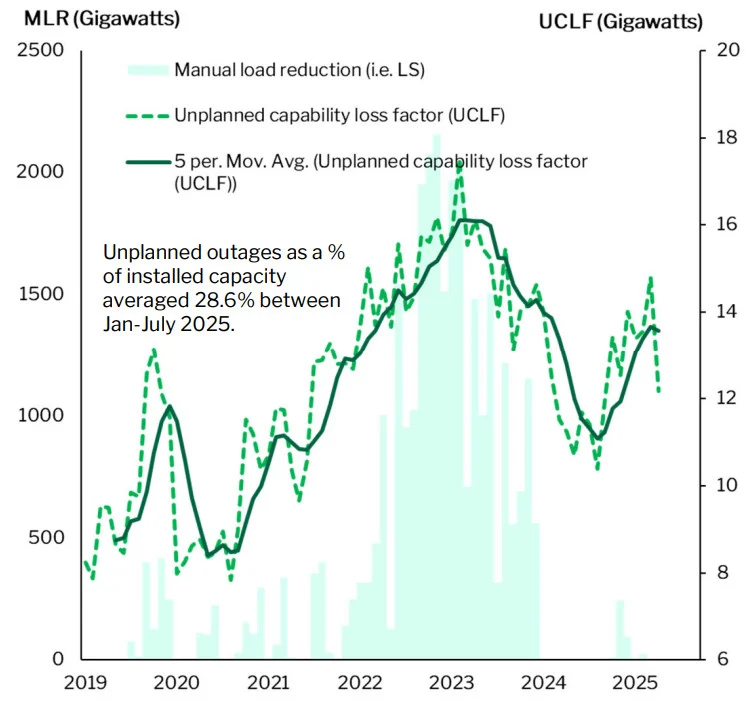
While Eskom has noted an improved energy availability factor (EAF) and reduced breakdowns to under 13,000MW, the reality is that these levels are still far off previous levels.
A plotted timeline shows recent breakdown levels are as bad as in 2022. Eskom’s latest data shows a positive move in this direction, but outages still remain around 10,000 MW when looking at a broader picture.
















 Loading ...