

Where South African investors are putting their money


The Association for savings and investments in South Africa (ASISA) has published new data detailing which funds, asset classes and managers South African investors are entrusting their money to.
The SA unit trust industry’s 2016 statistics highlight some interesting long-term investor trends and also knee-jerk reactions to current markets.
Carl Roothman, head of Retail at Sanlam Investments, highlights some of the trends observed.
Unit trusts have become an investor magnet
“With their flexibility, daily liquidity, low minimum investment amounts and high levels of transparency it is no surprise that unit trusts have blossomed into the darling of both retail and institutional investors,” said Roothman.
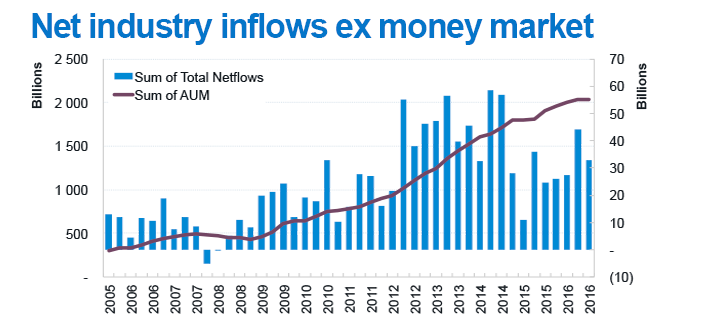
“During 2015 the local industry reported net inflows of R101 billion. In 2016 this figured ballooned to R166 billion, pushing total assets under management beyond the R2 trillion notch. These numbers include net flows into institutional unit trust funds, retail unit trust funds and funds of funds.”
However he noted that when money market funds are not included, the total net flows didn’t fare quite that well against former years, particularly compared to 2013 and 2014.
Investors gravitate towards multi asset solutions
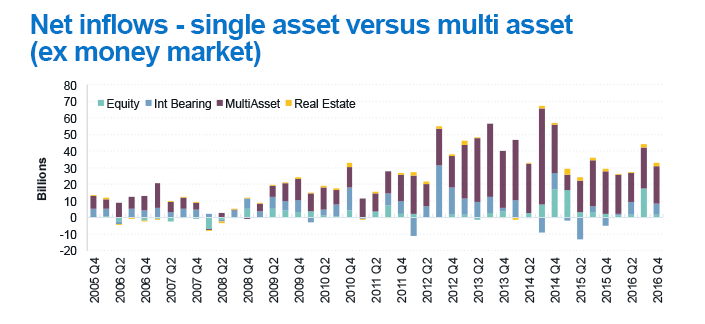
Multi-asset may combine traditional securities, like stocks and bonds, with alternative approaches, like real estate or commodities.
The SA Multi Asset categories offer a simple solution for those investors looking for a well diversified portfolio but who do not want to make their own strategic and tactical asset class allocations, noted Roothman.
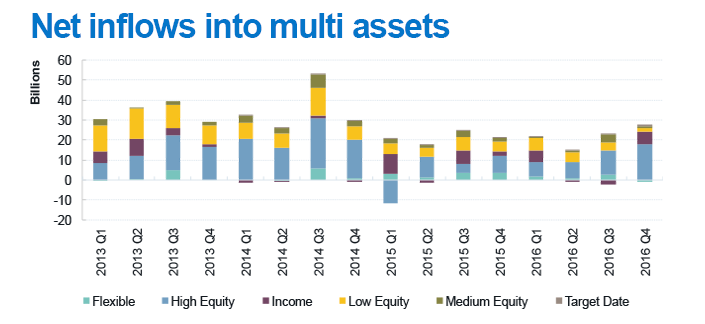
“They also offer advisers the convenience of outsourcing asset allocation for three types of investor risk profiles: SA Multi Asset Low Equity for the more cautious; SA Multi Asset Medium Equity for those who can stomach a moderate amount of risk; and SA Multi Asset High Equity for the more aggressive among their clients.”
Cash-hugging behaviour
“Another trend spotted is the attractiveness of interest bearing assets when the outlook for most asset classes look uncertain,” said Roothman
“Taking money market funds out of the equation, other interest bearing funds received a meaningful R17 billion in net inflows during 2016. This is not an annual phenomenon – in 2015 this category experienced large net outflows.”
However Roothman noted that the data does not show us why investors choose the funds they do.
“They could favour fixed interest funds because of the current sideways trend of the equity market, but another possibility could be that investors are chasing past returns. Local equity markets are not looking cheap and delivered only 2.6% in total last year.”
“In comparison the bond market returned a stellar 15.5% for the calendar year. Whether past performance or pessimism about equity’s immediate growth potential is the main driver of asset allocation, both drivers would be worrying.”
Which individual category attracts the most assets?
The SA Multi Asset High Equity category received the biggest chunk of all net inflows consistently over all four quarters of 2016.
For investors within retirement fund structures, this would be the most aggressive asset allocation fund category available under Regulation 28, noted
The SA Multi Asset Low Equity category has also been very popular over the past four years and it’s in this category that SIM offers a star performer in terms of consistency and downside protection, the SIM Inflation Plus Fund. This fund has attracted the largest net inflows of all SIM funds, namely R4.8 billion for 2016, Roothman concluded.
Read: Rand gets even stronger as investors warm up to South Africa


















 Loading ...