

Great surprise for South Africa


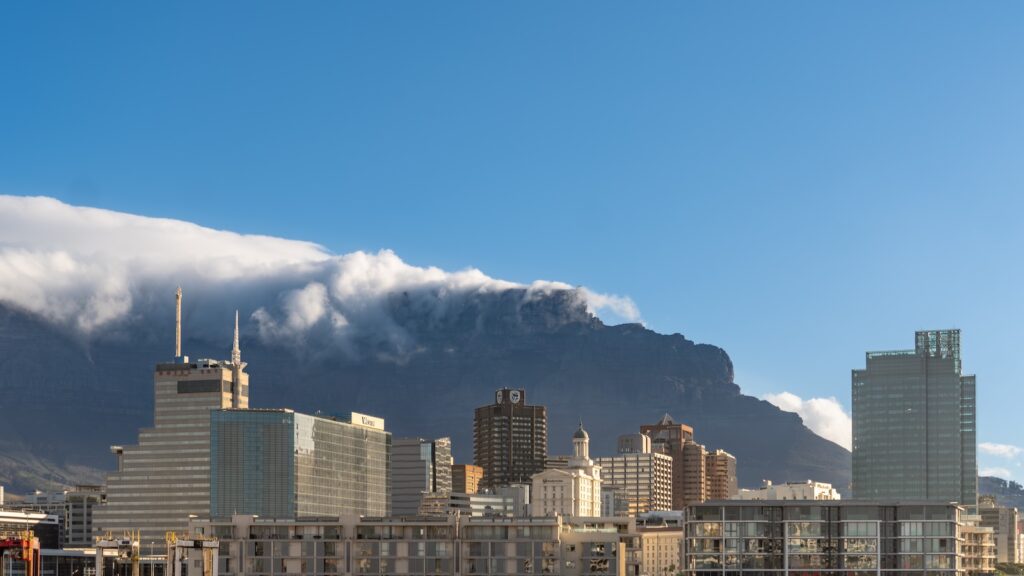
South Africa’s economy grew by 0.5% in the first three months of 2026, despite the turbulent end to the quarter, comfortably beating market expectations.
The latest figure beat the 0.3% median estimate of 15 economists in a Bloomberg survey.
Stats SA noted that the conflict in the Middle East began towards the end of February, more than halfway through the first quarter.
The impact of the conflict was felt in the sharp fuel price increases in April, which may be reflected in the second-quarter GDP estimates.
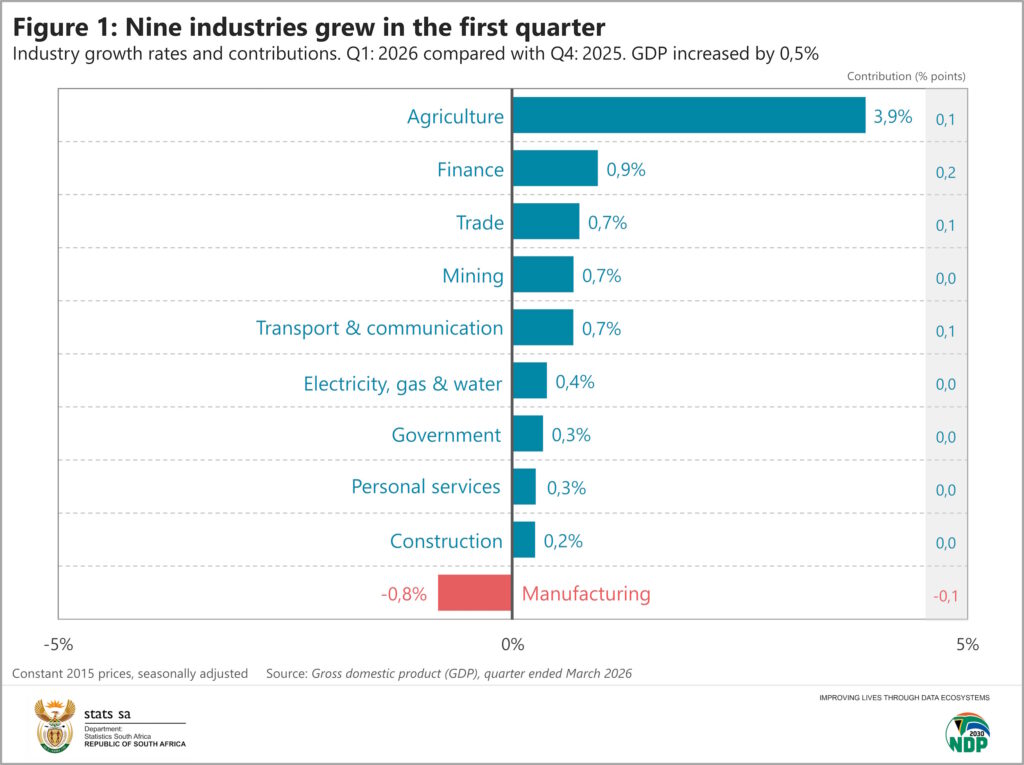
Stats SA said that finance, agriculture, trade and transport did the heavy lifting on the production (supply) side of the economy.
The expenditure (demand) side was supported by declines in imports and by rises in household consumption, government consumption, and exports.
Nine industries were stronger overall, with the finance industry the main positive contributor to production, expanding 0.9% and adding 0.2 of a percentage point to GDP growth.
Agriculture, trade, and transport & communication also made notable contributions, expanding by 3.9%. Field crops and horticulture products, mainly fruit, underpinned the industry’s stronger performance.
The trade industry also extended its gains for a sixth consecutive quarter, supported by stronger wholesale trade, motor trade, food & beverages and accommodation.
While transport and mining were up, manufacturing misfired over the quarter, weakening by 0.8% – the second straight decline, with a drag including petroleum & chemicals, iron & steel, and wood, paper & publishing divisions.
While glass & non-metallic mineral products, motor vehicles & transport equipment, electrical machinery and textiles & clothing were stronger, it was not enough to lift manufacturing into positive territory.
Expenditure side
Stats SA said that the expenditure side of the economy was lifted by weaker imports, as well as a rise in household consumption, government consumption and exports.
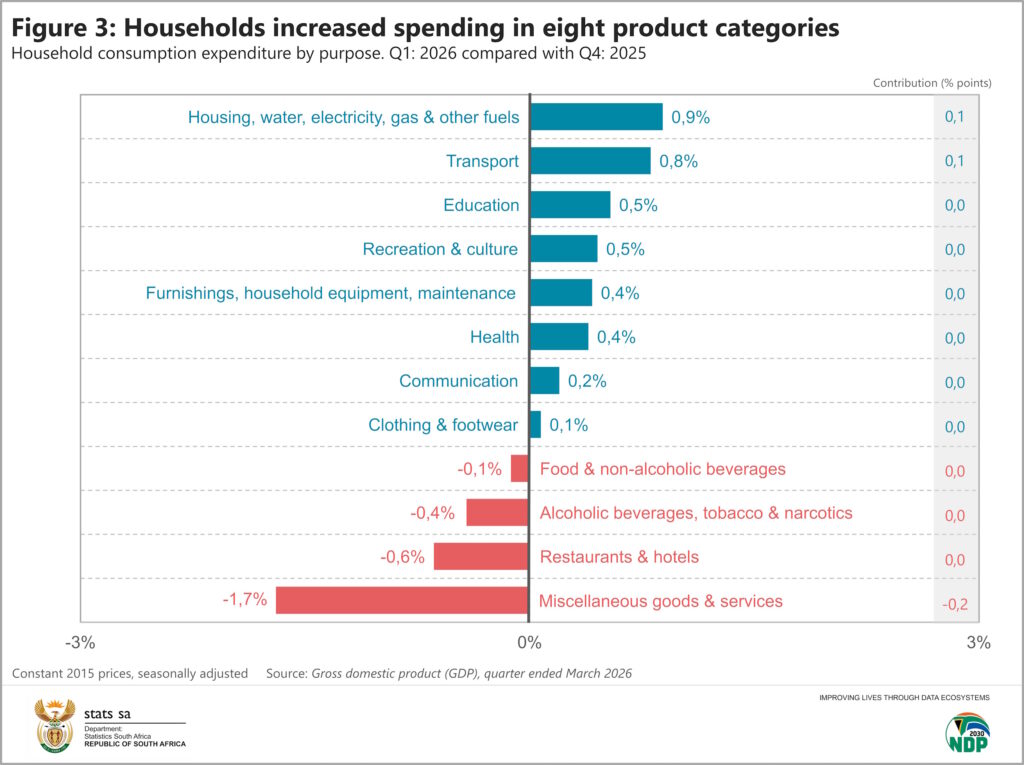
Household consumption rose by a marginal 0.1%, the lowest growth rate in eight quarters. Household utilities, such as water and electricity, and transport were the largest positive contributors.
Consumers spent less on food & non-alcoholic beverages and on alcoholic beverages, tobacco & narcotics, consistent with 0% growth in retail sales on the production side of the economy.
Spending on restaurants & hotels was also down. The miscellaneous goods & services category was the most significant negative contributor, reflecting a decline in insurance expenditure.
Stats SA added the slowdown in imports was driven by weaker trade in precious metals, mineral products, machinery & electrical equipment, textiles & textile articles, and animal & vegetable fats and oils.
Exports rose by 0.5%, driven by increases in trade in mineral products, vegetable products, prepared foodstuffs, beverages & tobacco.
The manufacturing, trade and mining industries thus drew into their stockpiles to meet demand, resulting in an annualised R22.4 billion drawdown in inventories.

















 Loading ...