

South Africans are in the danger zone


Many South Africans spend almost half of their disposable income paying off debts, which finance experts say is unsustainable—and even more are in the “danger zone.”
According to DebtBusters’ latest Money Stress Tracker for 2025, South African households are feeling less pressure on their finances this year, but still carry unsustainably high debt levels.
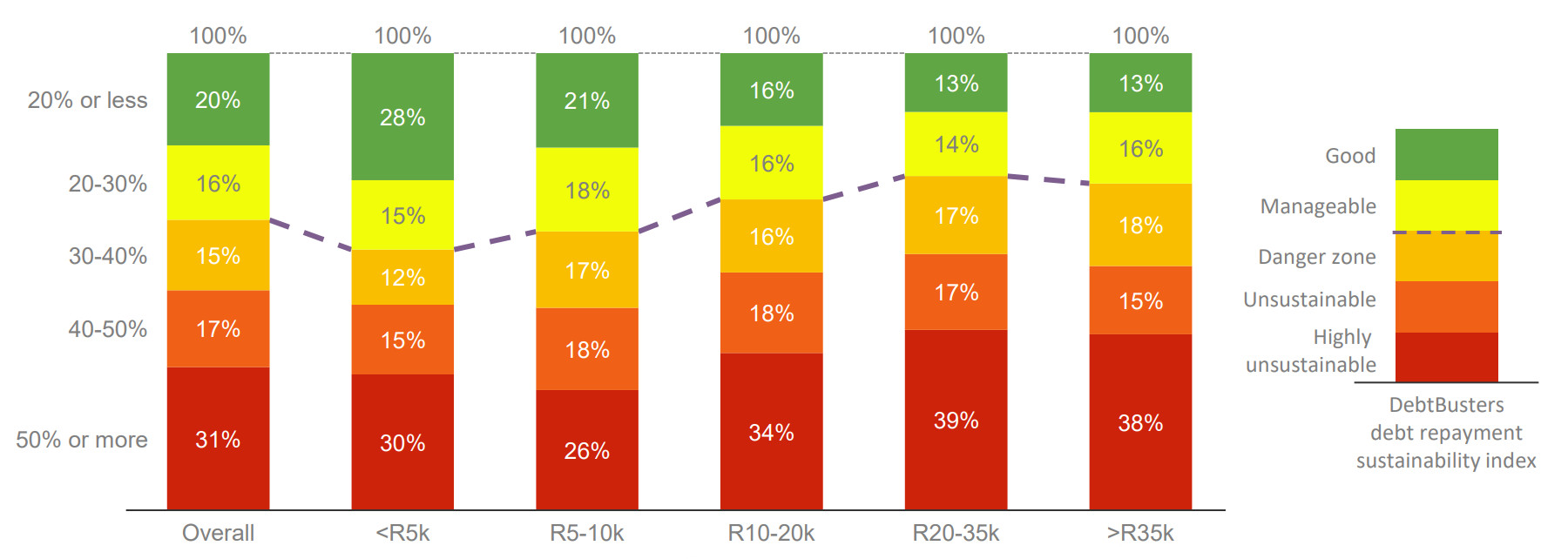
The group said it generally advises customers not to spend more than 30% of their take-home pay on debt repayments—40% at most.
However, its survey found that, on average, 48% of households spent more than 40% of their disposable income on debt.
“Anything beyond 40% is unsustainable,” the group said, adding that spending more than 50% was critically unsustainable and that the 30% to 40 % range is the “danger zone.”
By its metrics, 63% of South African households are in the danger zone.
The Money Stress Tracker is based on a survey of over 27,000 respondents, making it one of the largest surveys conducted in South Africa. It measures household finances and consumer stress.
The report tracks stress and financial health levels across income groups, locations, ages, and genders, showing which groups are most at risk of losing control of their finances.
An encouraging finding in the survey is that South Africans are generally less stressed about running out of money, with the number of respondents flagging this concern declining since 2022.
However, the struggle to repay off monthly debt is very real, with almost 40% of respondents indicating they are impacted by this, up from 36% in 2022.
This is most prevalent among 25 to 44 year olds in lower income brackets, evenly reflected across all provinces in the country.
Generally, however, those living in the Western Cape are more concerned about their finances than other provinces, taking over from Gauteng in 2024.
The more populous provinces (GP, WC and KZN) have higher stress levels overall.
South Africans feeling stuck
DebtBusters noted that while 48% of South Africans are paying more than 40% of their take-home pay on debt, and 39% are struggling to pay off the debts they owe each month, most people don’t think they’re in crisis.
About two-thirds of people feel their debt levels are about the same or less than their peers, and the group said this is driving a ‘desensitisation’ to debt, where people accept it as the norm.
This is driving a broader trend of being ‘stun-locked’ into debt.
The survey data revealed this through significant declines in households taking action to relieve their financial stress.
There has been a 10% decline in households trying to prevent financial losses through controlling their expenses by cutting back monthly spending or sticking to a budget.
There has also been a 13% decline in households trying to increase income by finding a higher paying job, asking family for help, taking out a loan or selling personal items.
While the number of people trying these methods is still higher than in 2022, DebtBusters said there is generally less enthusiasm to take action.
Just under a third of respondents simply said that they feel stuck, and feel there are no viable options to gain control of their finances.
The positive slant on the data is that most South Africans are still trying to do something to deal with the financial stresses of 2025.
“In 2022 and 2023, people tended to seek better jobs or start a side hustle, while in 2024, debt counselling was the preferred way to relieve financial stress,” DebtBusters said.
“Now, there is a growing emphasis on entrepreneurial efforts, multiple income streams and financial independence, reflecting a move towards self-reliance and creating diverse sources of income.”


















 Loading ...