

These are the deadliest areas in South Africa


The South African Police Service (SAPS) has recorded a 4.9% decrease in reported serious crimes in the country, including a sizeable 11.5% drop in murders—but some of the most violent areas are still getting worse.
Presenting the much-delayed crime statistics for the second quarter of the year, covering July through September 2025, the SAPS showed that crime levels in the country are easing.
This includes a 3.1% drop in contact crimes, a 15.5% drop in trio crimes (Carjacking and residential and non-residential burglary), and a 10.2% drop in property-related crimes.
The police also recorded a significant increase in crimes detected as a result of SAPS action, up 19.2% year-on-year, pointing to greater enforcement.
Overall, the 17 community-reported crimes dropped by 4.9%, with 361,560 cases reported over the quarter.
Across the various categories and sub-categories, however, seven crimes tracked higher.
This includes contact sexual offences, which surged 12.4% and attempted sexual offences, which rose 8.8%.
Kidnappings are also on the rise, up 3.1% to over 4,770 cases opened over the three-month period. Commercial crime, attempted murder, common assault and sexual offences in general were also higher.
According to acting Police Minister, Firoz Cachalia, while the decline in overall numbers is a positive for the country, he acknowledged categories that remain “Stubbornly high”.
Specifically, he pointed to sexual offences, gender-based violence and commercial crimes, which are trending up, while gangsterism, syndicates and mafias are also major sticking points.
“Many people turn to crime where there is a lack of opportunity, excessive alcohol consumption and exposure to dangerous drugs sold by gangs who recruit our youth into a life of crime,” he said.
“Combating gang violence requires effective, no-compromise policing, effective investigation and prosecution.”
He said that criminal networks fuel violence in the country, and organised crime in particular undermines job creation, investment and growth.
“We must follow the money and hit the criminals where it hurts, in their pockets. We need fast, effective prosecutions and strong witness protection to turn investigations into convictions,” he said.
South Africa’s murder capitals

While South Africa’s murder numbers declined in the quarter, there were still 5,794 murders recorded over the three months, equating to 63 people being killed every day.
This still reflects a monumental problem for the country, which struggles with exceptionally high levels of violent crime.
South Africa’s murder rate, based on the latest available full-year data, is 45 people per 100,000 people, which is more than ten times higher than the average murder rate of other G20 countries.
The rate is much higher than that of any other G20 country, including Mexico and Brazil, and is higher than in some active war zones, including Gaza.
Murder in South Africa is concentrated in the country’s most populous provinces, though when looking at murder rates, the picture changes.
Gauteng has the highest number of murders, with 1,443 cases recorded over the quarter; however, given its large population, the murder rate in the province is 9.0 per 100,000—below the national average.
The actual murder capital of South Africa is the Western Cape, which carries a murder rate of 15.2 per 100,000 in the second quarter.
Notably, the Western Cape and the Northern Cape were the only provinces to see murder levels increase over the period, with all other provinces recording a drop.
The Eastern Cape, which has had the highest murder rate in the past few reporting periods, tracks close behind at 14.6 per 100,000 people.
Quarterly Murder Rates by Province
| Province | Murders | Population* | Murder rate | Murder change |
|---|---|---|---|---|
| Western Cape | 1,160 | 7,627,688 | 15.2 | +9.1% |
| Eastern Cape | 1,032 | 7,090,788 | 14.6 | -21.5% |
| KwaZulu Natal | 1,189 | 12,232,247 | 9.7 | -16.7% |
| South Africa | 5,794 | 63,100,945 | 9.2 | -11.5% |
| Gauteng | 1,443 | 16,104,933 | 9.0 | -8.6% |
| Free State | 188 | 3,039,834 | 6.2 | -12.6% |
| North-West | 249 | 4,183,947 | 6.0 | -16.2% |
| Mpumalanga | 267 | 5,076,133 | 5.3 | -20.1% |
| Northern Cape | 72 | 1,379,183 | 5.2 | +1 count |
| Limpopo | 194 | 6,366,192 | 3.0 | -20.2% |
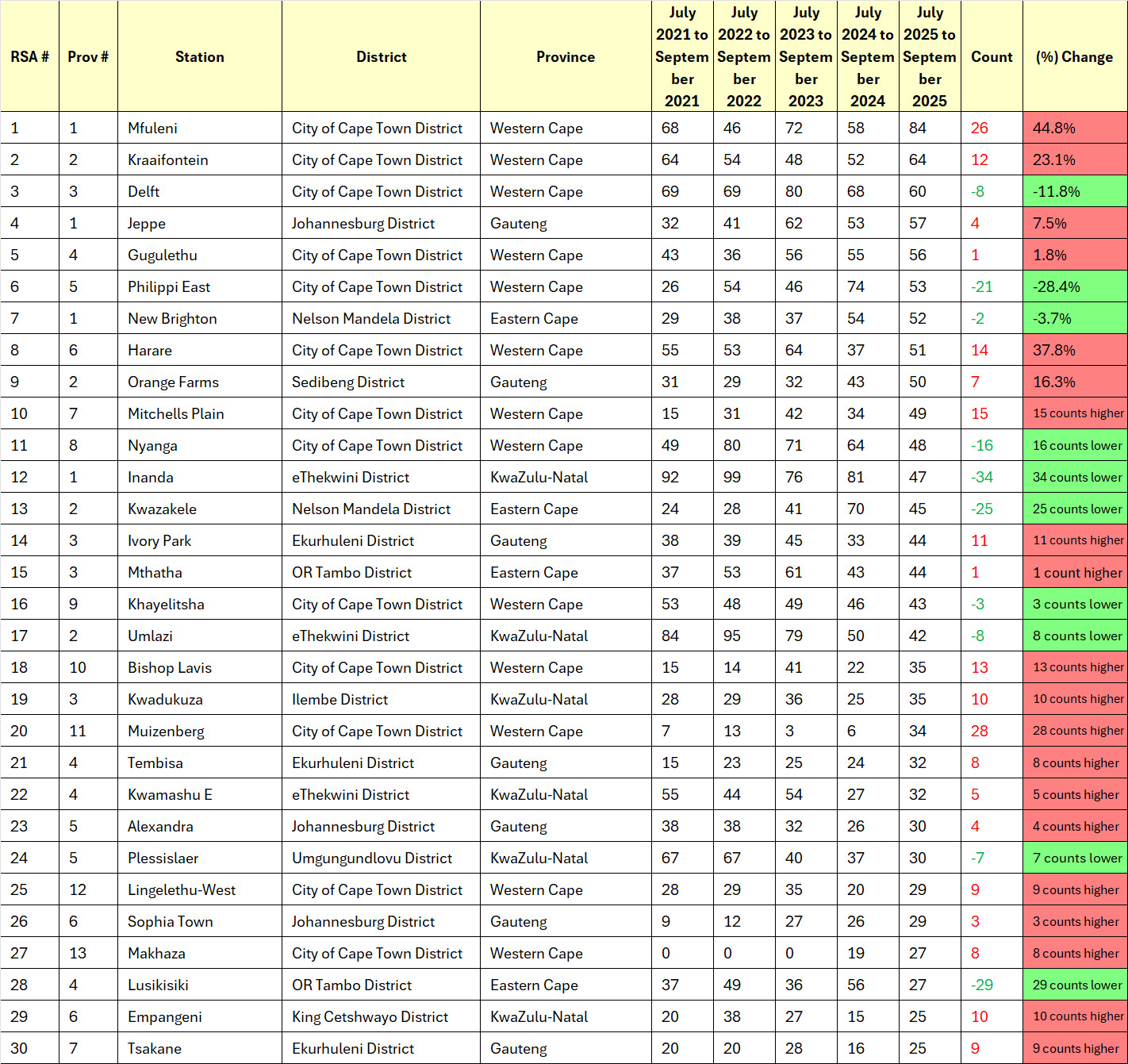
Narrowing the data even further to a district level, it’s clear to see that the City of Cape Town dominates the highest-murder precincts, accounting for four of the top five, and seven of the top 10 districts.
The Democratic Alliance, whose political leaders run the city, placed the blame at the feet of the SAPS, saying the numbers reflect the national government’s ongoing failure to properly resource and capacitate policing in the Western Cape.
“The latest crime statistics reveal a province under siege, where communities are left to fend for themselves while the national government looks away,” it said.
The party has been fighting for years for the national government to devolve policing powers to the provinces. However, these measures have been repeatedly rejected.
The party said the rising violent crime levels in the province are “the direct outcome of a SAPS that is under-resourced, mismanaged, and centrally controlled”.
It called on the Minister of Police to take immediate and decisive action to initiate a full review of SAPS leadership in the Western Cape, including the performance of the Provincial Commissioner.
It also repeated the call to devolve investigative policing powers to the provincial government and the City of Cape Town to allow the province to strengthen investigations, deploy specialised units, and intervene where SAPS has failed.
















 Loading ...