

Ramaphosa announces 5,500 new police officers for South Africa


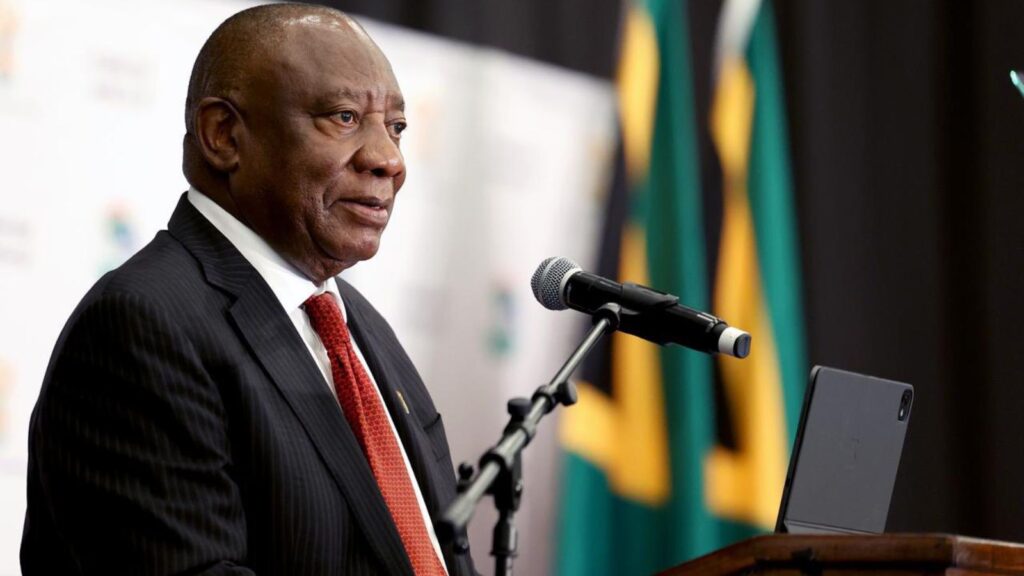
President Cyril Ramaphosa says that 5,500 new officers will soon enter training academies as part of the government’s initiative to add 11,000 new constables to the force.
In his weekly letter to the nation, the president focused on the transformation of the South African Police Service (SAPS) and the challenges the department faces in rebuilding public trust.
This is in light of the Madlanga Commission, which has exposed the deep roots of corruption and political interference in South Africa’s criminal justice system.
Ramaphosa stressed that South Africa has a large SAPS force, comprising over 180,000 members and 3,000 reservists.
He said that the majority of these officers serve with honour and integrity, and that the actions of a corrupt few should not define the thousands who serve with honesty and courage.
“For most people, the SAPS is the first they turn to when their safety is threatened, when there is an emergency or when they need to report a crime,” said Ramaphosa.
“When our people call the police, often at a moment of great distress or danger, they expect that someone will answer. They expect that help will come. They expect that the law will protect them.”
He said that for every incompetent or corrupt member, there are many thousands more who are honourable.
Despite his defence of honest officers, Ramaphosa openly acknowledges a major “challenge of confidence” in the police.
Ramaphosa said that the allegations of criminal infiltration, corruption, and political interference in parts of the criminal justice system are deeply disturbing.
He said that the Madlanga Commission must be allowed to do its work thoroughly and without fear, favour or interference.
“South Africans are entitled to know the truth. They are entitled to know that those entrusted with fighting crime are not themselves working with criminals.”
“Where wrongdoing is established, there must be consequences. Where crimes have been committed, the law must take its course,” he said.
However, he urged South Africans and communities to support and work with the police to act against criminality.
“The task before us is clear. We must be relentless in pursuing criminals. And we must be equally relentless in ensuring that criminality and corruption have no place in the institutions meant to protect us,” he said.
South Africans do not trust the police

Stats SA recently published its Governance, Public Safety, and Justice Survey for 2025/26, highlighting a significant lack of trust and faith in the country’s police services.
The survey is a nationwide, household-based initiative that aims to address the gap between official crime statistics reported by the SAPS (South African Police Service) and households’ experiences with crime in the country.
While the SAPS crime data reflects the number of crimes processed by police across all precincts, it is limited to those crimes that are officially reported or discovered through investigations.
The Victim of Crime survey offers a different perspective, focusing on statistics on crimes experienced by households.
It includes data on unreported crimes and explores why households and individuals choose not to report them.
The survey revealed significant gaps in crime reporting, with more than half of incidents often going unreported. The level of non-reporting tends to be influenced by the severity of the crime.
For instance, in cases of personal property theft, nearly two-thirds of these crimes go unreported. However, when it comes to violent crimes like murder, almost all incidents are reported.
Alarmingly, even in situations where South Africans’ lives are endangered, such as being mugged on the street, more than half of these crimes remain unreported to the police.
Across the survey, the reasoning for this lack of reporting is fairly consistent: respondents believe that the police would simply not do anything about it.
The second most common response was that the police were unable to take action, typically because there was insufficient evidence of the crime.
Referring to the survey’s findings, Ramaphosa said that the government must take this sentiment seriously and work to change these perceptions.
“The Constitution makes the SAPS responsible for law enforcement. Although the private security industry provides some complementary services, the responsibility for keeping the public safe ultimately rests with the state.”
“Private security may protect those who can afford it, but public safety must be available to all.”
As part of the push to restore faith in the police, the government is moving to capacitate it with fresh faces.
Through the SAPS Project 11,000, the president said that the upcoming intake of 5,500 constables will soon begin training at the academies.















 Loading ...