

South Africans without salaries are buying more homes in South Africa



South Africa’s first-time homebuyer market is undergoing a massive shift, with rising participation from self‑employed individuals.
Standard Bank’s data showed that the first-time homebuyer market is getting younger, more female, increasingly moving into sectional titles, and seeing rising participation from self‑employed individuals.
In 2025, the average first-time homebuyer with Standard Bank was 38, which is 3 years younger than in 2020.
While first-time homebuyers are getting younger, home prices are not getting cheaper. The average purchase price for bank-financed first-home transactions exceeded R1 million in 2025.
Affluent suburbs such as Rosebank (Johannesburg) and Tyger Manor (Cape Town) saw average first-time purchase prices rise to R1,369,817 and R1,685,339, respectively.
More affordable areas, such as Khayelitsha, reflected an average of R821,633. This reflects an overall increase of roughly 5.5% in the past two years.
One growing group reshaping the market is the self-employed first-time buyer. The group was historically underrepresented among home buyers due to income variability.
This lack of stable income led to barriers to traditional lending. However, new loan registrations in the segment grew by 33% in 2025.
Toni Anderson, Head of Home Services at Standard Bank, said the increase indicates the industry’s commitment to developing products for non-salaried applicants.
“The shifting dynamics among first-time buyers reflect the evolving aspirations and realities of South African consumers,” said Anderson.
Gauteng’s lead is getting bigger
Provincial differences are also starting to grow among Standard Bank’s first-time homebuyer transactions.
While Gauteng has always seen the most first-time homebuyer transactions, data shows that it is expanding its lead over the Western Cape and KwaZulu-Natal.
Gauteng accounted for around 47% of these purchases in 2025, a 5-percentage-point increase from 2024.
On the other hand, the Western Cape contributed 19%, down four percentage points. It remains the second-largest market for first-time property buyers.
KwaZulu-Natal also saw a 2% decline, reflecting softening activity in 2025, with the data highlighting Gauteng’s growing economic pull for new entrants to the property market.
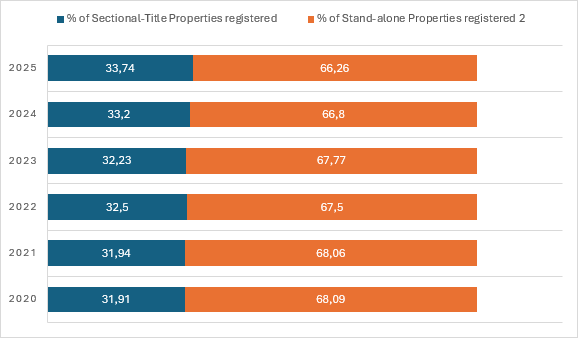
Another change seen in the property market is the resurgence of sectional title properties, even if more homeowners still choose standalone properties.
Although 33.7% of first-time loans granted by Standard Bank were for sectional title properties in 2025, it is still a larger share than the 31.91% in 2020.
65% of first-time loans were for standalone homes in 2025, with the remaining difference directed toward vacant land.
“Sectional title properties attract first-time buyers because of their relative affordability and added security,” said Anderson.
“They are also often closer to economic hubs, with lower maintenance costs and a lock-and-go lifestyle that suits their life stage.
As buyers enter the market at increasingly younger ages, these sectional titles also offer a more accessible entry point.
Another trend seen is the rise of single female buyers in the affordable housing sub-segment of first-time homeowners.
From 2024 to 2025, first-time female buyers recorded a threefold increase, a trend visible both nationally and within major provinces such as Gauteng and the Western Cape.
“This sharp increase reflects rising financial independence and improved access to credit for women,” noted Anderson.
“Seeing so many women enter the property market solo signals a shift in household dynamics and decision‑making power.”


















 Loading ...