

Here’s how much money top board members earn in South Africa


Professional services company PwC has published its report on South African non-executive directors for 2020, highlighting how much top board members are earning in the country right now.
The report focuses primarily on publicly available information, sourced from the JSE, the FTSE 100, the FTSE 250 and seven African stock exchanges.
As directors’ fees rarely follow a standard distribution curve, PwC used quartile/percentage range rather than averages.
The report’s editor, Leila Ebrahimi, said that executive and other remuneration structures play an important role in combating ‘short-terminism’ at companies. This includes a focus on short-term profits, leading to under-investment in innovation and research and development, she said.
“We are, more than ever, in need of strong, effective boards and remuneration committees with diverse experiences and viewpoints comprise of members who are free of fear and favour, and who have the requisite knowledge and experience.”
Chairperson
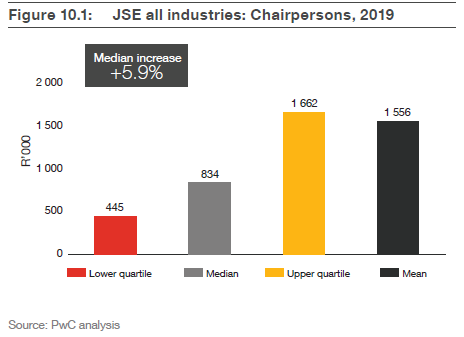
An examination of all fees paid to JSE non-executive directors shows that a 5.9% (2018: 5.1%) increase was awarded to chairpersons at the median level. The median salary was R834,000.
“The role of a chairperson is time-consuming as it includes work carried out between scheduled meetings, representing the organisation externally, and interacting with fellow board members and employees,” PwC said.
Deputy chairperson
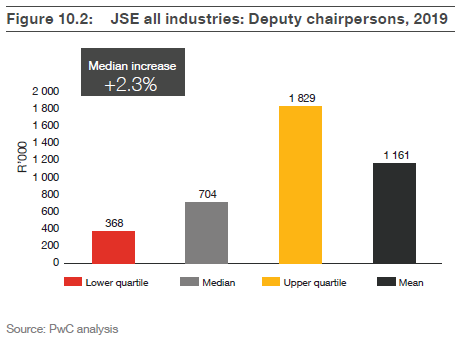
PwC’s data shows that the average deputy chairperson received a lower median increase than that of the chairperson at 2.3% (2018: 5%). The median salary was R704,000.
“Some organisations include a position of deputy chairperson. This person assists the chairperson and fills in if they are unavailable.
“It is essential that the chair and the deputy chair have a good working relationship and understand their roles to ensure that duplication or confused direction does not occur,” PwC said.
Lead independent director
The lead independent director is required to preside at all meetings of the board at which the chairperson is not present or where the chairperson is conflicted.
Their duties include calling meetings of the independent directors, where necessary, and serving as the principal liaison between the independent directors and the chairperson.
Their responsibilities would also include liaising with major shareholders if requested by the board in circumstances in which the chairperson is conflicted.
PwC’s data shows that lead independent directors saw an increase of 2.& at the median level (2018: -1.3%). The median salary was R550,000.

Non-executive director
Non-executive directors are required to make up the majority of a board’s membership and should preferably be independent, PwC said.
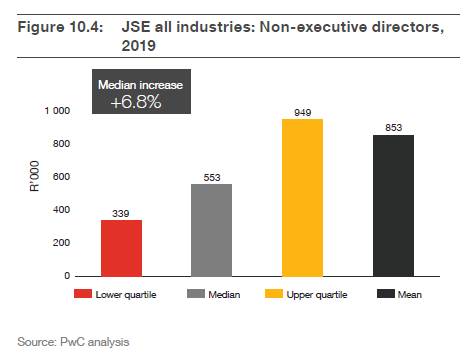
The group’s data shows that the median increase in remuneration was well above inflation at 6.8% (2018: 5.3%). The median salary was R553,000.
Super-caps
While the above data provides an overview of the average salaries across the JSE, board members at ‘super-cap’ companies – making up the top 10 of the JSE – can expect to earn substantially more.
In 2019 these companies included:
- AB InBev;
- Prosus;
- British American Tobacco;
- Naspers;
- Glencore;
- BHP Billiton;
- Richemont;
- Anglo American;
- FirstRand;
- Anglo American Platinum.
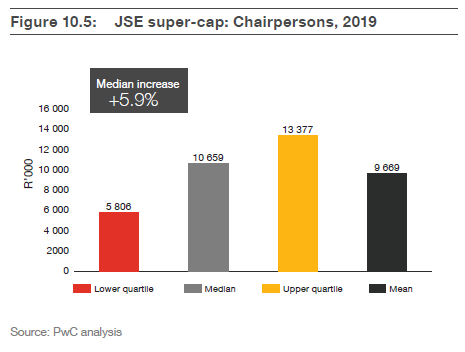
PwC’s data shows that the median salary for a chairperson at one of these super-caps was R10,659,000 in 2019. This is a median increase of 5.9% year-on-year.
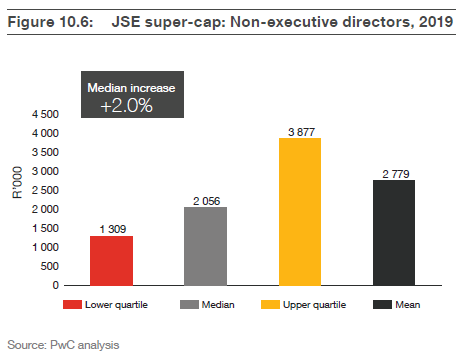
By comparison, the median salary for a non-executive director at one of these super-caps was R2,056,00 in 2019 – an annual increase of 2%.
Read: How much Ramaphosa, ministers and other government officials could earn this year
















 Loading ...