

Eskom hits a $1 billion milestone – and it’s no cause for celebration


South African electricity outages remain at record levels despite the appointment of the electricity minister and the power utility burning through vast quantities of diesel to bolster output.
Eskom said Tuesday that Stage 6 power cuts will be scheduled throughout the week, meaning 6,000 megawatts of capacity will be removed from the grid to prevent a total blackout.
This matches the deepest level of blackouts officially announced by the utility and caused the rand to extend earlier losses.
While President Cyril Ramaphosa and Electricity Minister Kgosientsho Ramokgopa have given repeated assurances that they are tackling the energy crisis, little headway has been made in improving the performance of the coal-fired plants.
These power plans form the backbone of the generation system. Their poor performance had forced Eskom to increasingly use its auxiliary units to boost its output.
Due to Eskom’s struggles with its generation units, Bloomberg reported that the utility’s data shows it generated more energy from its open-cycle gas turbines that run on diesel in the financial year that began on 1 April than in the previous year.
Eskom spent more than $1 billion (R18.9 billion) on fuel in the past year through 31 March, more than double the previous period, and the bill is set to escalate even further, said Bloomberg.
Eskom wasn’t immediately available to comment.
State of load shedding under new electricity minister
Electricity Minister Kgosientsho Ramokgopa and other politicians regularly tell South Africans that Eskom is doing well in fighting load-shedding, but official data tells a different story.
President Cyril Ramaphosa appointed Ramokgopa as Electricity Minister in March 2023 to reduce the intensity of load-shedding and ultimately end it altogether.
Ramokgopa told the South African public multiple times that Eskom is winning the fight against load-shedding, often citing an improvement in the energy availability factor (EAF). At the same time, Deputy President Paul Mashatile was the latest high-profile politician to promise an end to load shedding by 2024.
However, energy expert Chris Yelland slated these comments, saying the government is misleading South Africans, highlighting that Eskom’s EAF is still on a downward trend when considering the year-on-year change.
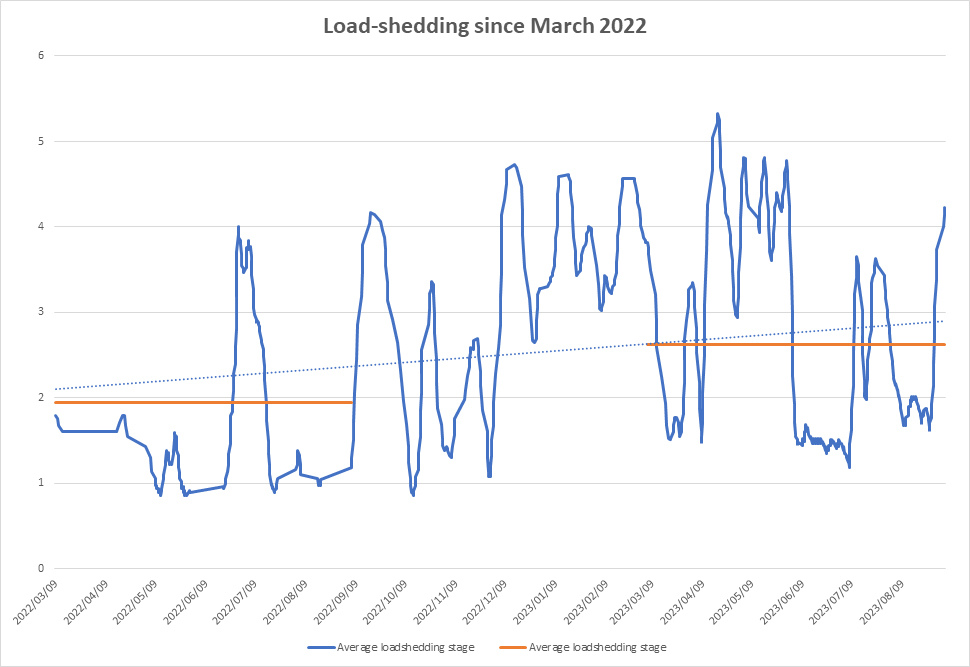
Daily Investor created a moving load-shedding stage average to create a continuous data series to visualise the progression of load-shedding stages.
The data revealed that the severity of the year-on-year load-shedding has increased since Ramokgopa was appointed electricity minister.
The average year-on-year load-shedding stage increased from 1.94 in 2022 to 2.64 in 2023 under Ramokgopa’s leadership.
The moving average chart of load-shedding shows the progress in the severity of load-shedding stages from 2022 to the same period in 2023 under Ramokgopa.
Additionally, Daily Investor showed that unplanned outages and outages due to other constraints from Eskom’s side had also increased under Ramokgopa.
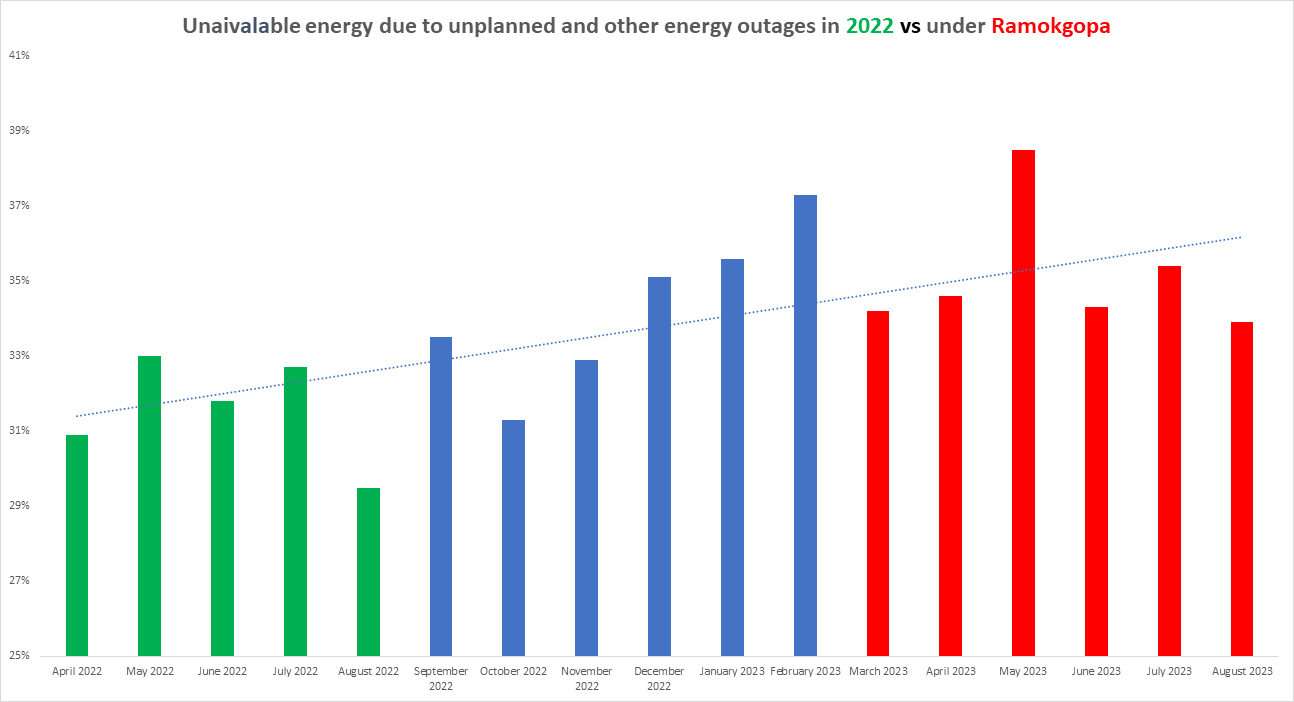
Eskom has three forms of power outages: planned maintenance outages (planned capability loss factor – PCLF), unplanned outages (Unplanned capability loss factor – UCLF), and outages by other constraints from Eskom’s side (Other capability loss factor – OCLF).
Outages are measured as a percentage of total unit capacity unavailable during a specific period. The UCLF and OCLF are the most important indicators of failures on Eskom’s side, said Daily Investor.
Plotting the combined power unavailability due to UCLF and OCLF shows the increased outages under Ramokgopa compared to the same period in 2022.
The average energy unavailability due to these factors has increased from 32% in 2022 to 35% in 2023 under Ramokgopa.
Another critical measurement of Eskom’s performance is energy availability, depicted as the EAF.
The EAF shows the percentage of time the power station was available for use when it was needed. It is a core measure of performance for any power utility.
Daily Investor showed that the EAF has experienced a noticeable deterioration since Ramokgopa was appointed minister. It declined from 60% in 2022 to 55% in 2023 under Ramokgopa.
















 Loading ...