

2026 Local Government Election – the final polls before voting day


Several groups have published their final polls ahead of voting day in the 2026 Local Government Elections, indicating how the vote could go.
While polling is not predictive and needs to be understood in the context of who is running the numbers and the samples used, it does provide insights into the state of the electorate.
They have also historically been very accurate at giving a general view of election outcomes.
In the 2024 National Government Election, for example, the Social Research Foundation’s poll had a total deviation of only 7 percentage points from the actual result.
A deviation of 0 would represent a spot-on call. The larger the deviation, the further away from the final result.
Most polls in 2024 had a deviation over 10, showing how swingy the outcome can be in reality.
Nevertheless, the polling provides a snapshot and strong indicator of voter sentiment.
Polling for Local Government Elections is a much trickier read, as national sentiment can vary wildly from the attitudes and views on a more local level.
Some polls look at the overall national picture and then provide insights at a more granular level, focusing on major municipalities.
The 2026 vote is expected to result in a sharp rise in the number of coalition governments across the country, as the ANC’s grip on major metros gives way to smaller parties.
However, a key focus for many—and for South Africa’s economy as a whole—will be Gauteng’s economic engine, with Johannesburg and Tshwane in particular hotly contested.
Another focus will be eThekwini, with the rise of Jacob Zuma’s uMkhonto we Sizwe Party (MKP) a major disruptor.
Below, we have highlighted the latest polls ahead of election day, from reputable sources such as Ipsos, the SRF/The Common Sense and MarkData/ENCA.
The numbers reflect the latest polling (rather than averages) for these contested metros.
National poll
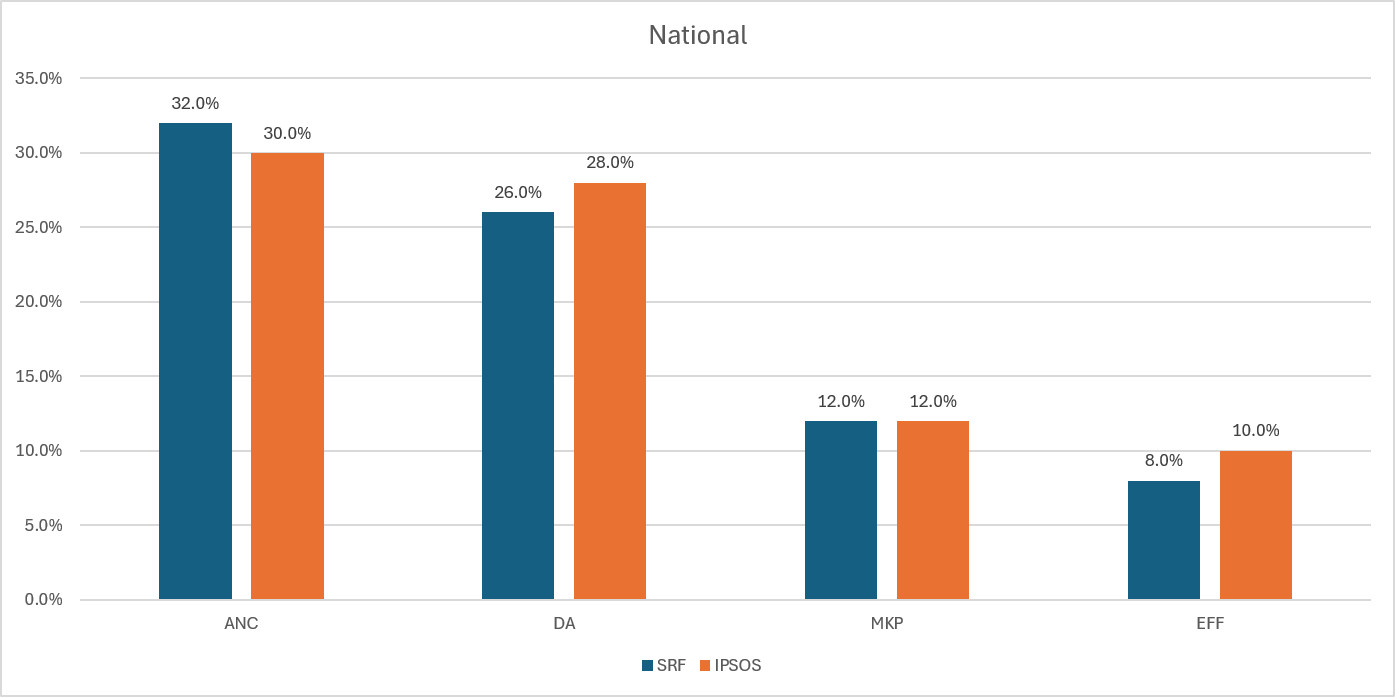
Not all polls look at the national picture of a local government vote. However, Ipsos has gauged national sentiment towards the major political parties in play.
Reflecting the outcome of the 2024 national election, no party commands strong majority support in the country, as the ANC’s dominance wanes, giving rise to smaller parties.
Notably, the poll indicates that the gap between the DA and ANC is narrowing. A similar trend is reflected in the SRF’s data. Broadly, though, the picture hasn’t changed too much since 2024
Ipsos said that coalition politics is likely to remain a defining feature of South Africa’s political landscape in the next two-and-a-half years leading up to the next National Election.
Johannesburg
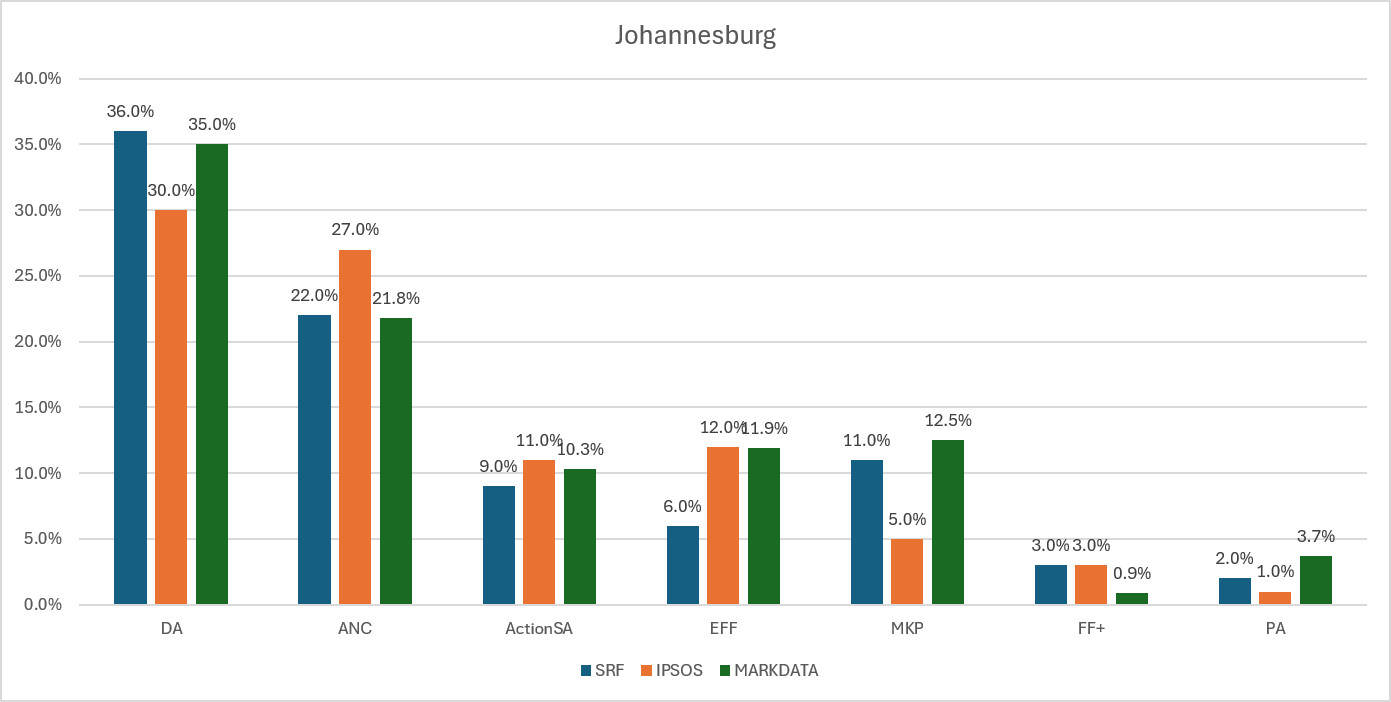
Possibly the most hotly contested metro in the country, the picture for Johannesburg is showing no clear winner.
While all the polls show the DA leading, it is nowhere near the 51% majority the party needs or hopes for.
Instead, with smaller parties still very much in play and dividing the vote, the metro may end up following the same chaotic coalition pattern that has contributed to its rapid collapse over the past five years.
Tshwane
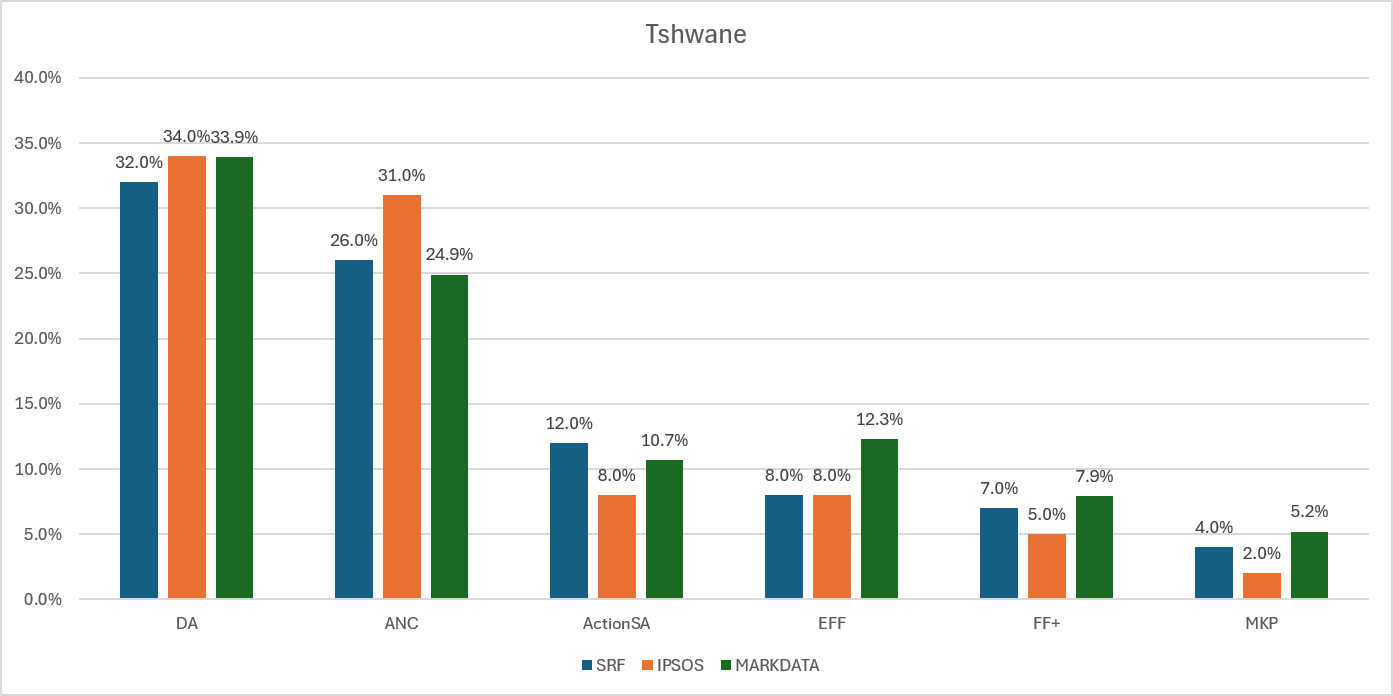
Reflecting a similar position as in Joburg, the DA appears to have the upper hand in the polls, but it is not a clear call.
The Ipsos poll puts the ANC and DA fairly close together, suggesting more coalitions are coming.
This could place the metro at the whims of smaller parties once again, with ActionSA, the EFF and FF+ looking to be key players.
Ethekwini
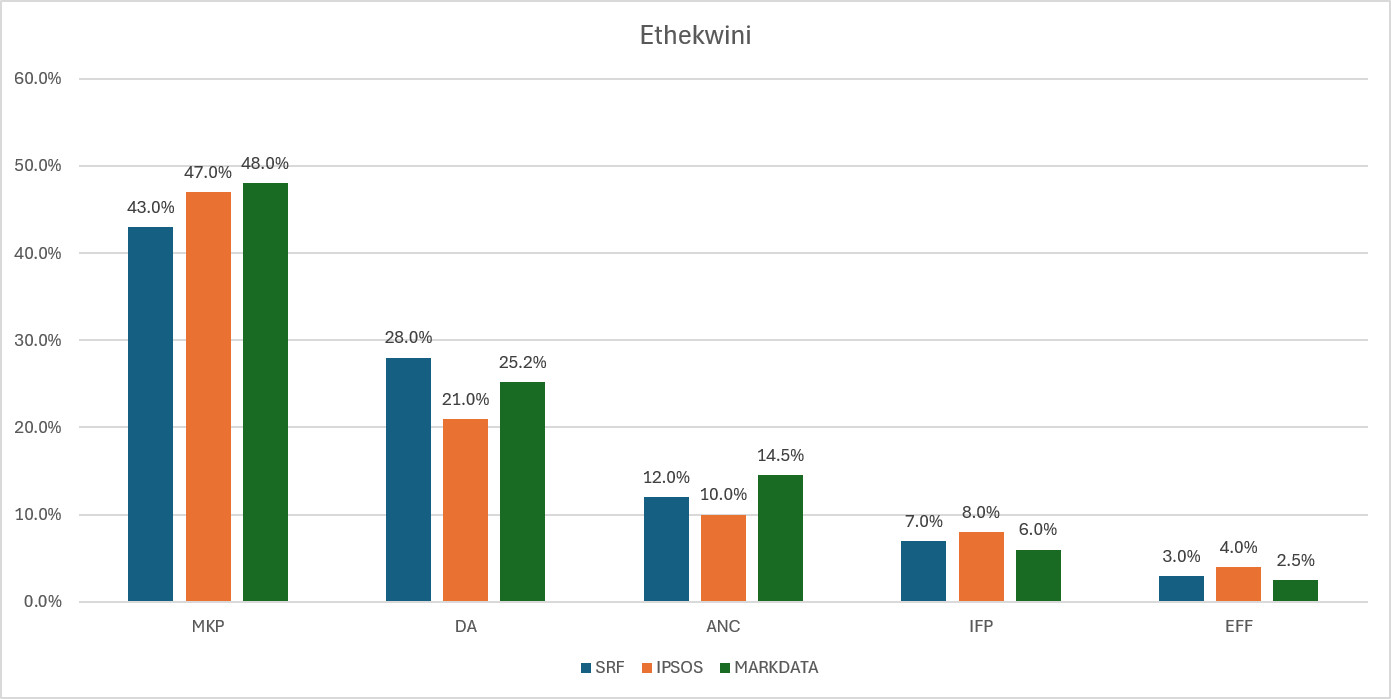
Across the polls, the MK Party is by far the most popular choice, with the DA coming in a distant second.
Notably, much like the 2024 vote, the wave of support for the MK comes at the ANC’s expense, where the party is relegated to third place behind the DA.
The IFP and EFF are the only other notable contenders in all the polls.
Who ran the polls
| Poller | Who | Sample | 2024 National Election accuracy |
|---|---|---|---|
| Ipsos | Ipsos is one of the largest market research and polling companies globally and has been conducting various polls since 1975. It is a publicly traded multinational market research company. | Interviews with 3,600 randomly selected South African adults, conducted between 12 September and 13 October 2026. Registered voters. Those who indicated they would not vote were excluded. | 12.0 point deviation |
| SRF/Common Sense | The SRF is a South African think tank established in 2021 to promote democracy and sound public policy, chaired and led by political and economic analyst Dr Frans Cronje. Cronje is editor and co-director of The Common Sense, a media company. It is privately funded. | Market surveys conducted by SRF/TCS, carried out by Victory Research. The survey was conducted from 18 September to 12 October 2026 among 3,100 respondents. The sample was weighted to reflect the demographic characteristics of the registered voter population. | 7.0 point deviation |
| MarkData/ENCA | MarkData is an independent marketing, insights and consulting firm. It originated as the survey and opinion research centre of the Human Sciences Research Council in 1981 and was re-established as a private company in 1996. ENCA is a 24-hour broadcaster owned by eMedia Holdings. | A MarkData survey of 6,113 voters across six major metros—approximately 1,000 people per metro. Interviews were conducted from 10 August to 14 September 2026. | 10.6 point deviation |















 Loading ...