

Joburg is the second most important financial centre in Africa


London think-tank, Z/Yen, in conjunction with the China Development Institute (CDI), has published its annual Global Financial Centres Index (GFCI 23), detailing the most important financial centres around the world.
The GFCI 23 was compiled using 103 instrumental factors. These quantitative measures are provided by third parties including the World Bank, The Economist Intelligence Unit, the OECD, and the United Nations.
The instrumental factors were combined with 28,599 financial centre assessments provided by respondents to the GFCI online questionnaire.
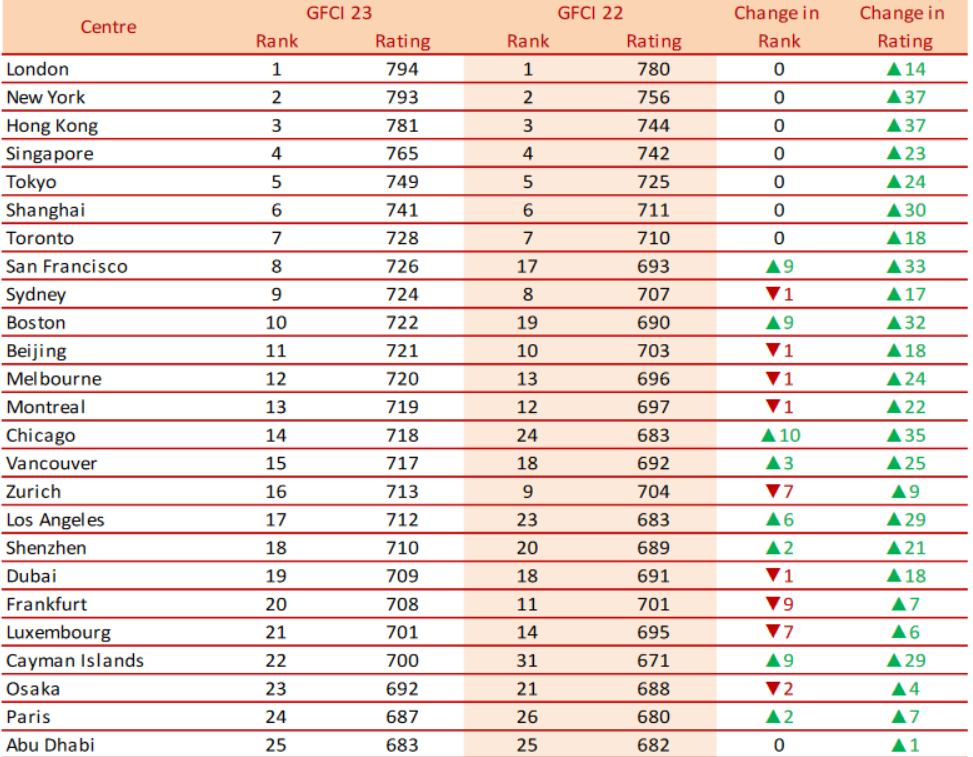
There is an overall increase in confidence for the leading centres, it said. Signs of a bias towards stronger and more established centres are evident with the top 25 centres all rising in the ratings. Ratings fell for all of the lowest 50 centres.
London and New York remain at the top of the rankings and the gap between them in ratings closed to one point on a scale of 1,000. Hong Kong retains third place. London’s rating rose less than the other four top centres. There is now less than 50 points between the top five centres. San Francisco and Shenzhen moved into the top ten, replacing Beijing and Zurich.
Western European financial centres remain volatile. The top five centres rose in the ratings. Most of the lower placed centres lost ground. Hamburg, Munich, Monaco, and Madrid, rose strongly in the ranks, with other improvements for Paris, Jersey, Edinburgh, and Lisbon. Hamburg in particular rose 38 places in the ranks.
In the Asia/Pacific region, the leading centres improved their ratings. There were significant rises in the ranks for Qingdao, Bangkok, Kuala Lumpur, and Busan. Tianjin and New Delhi are new entrants to the GFCI.
North American centres generally achieved improved ratings and improved their ranks accordingly. This was a reversal from GFCI 22. The exception was Washington DC, which dropped 20 places in the rankings. Montreal also dropped by one place – although its rating was 22 higher than in GFCI 22.
All centres in Eastern Europe and Central Asia suffered a fall in their ratings. However, Cyprus, Istanbul, and Moscow rose in the ranks. Tallinn and Riga both fell over 30 places in the ranks. Astana and Baku are new entrants to the GFCI.
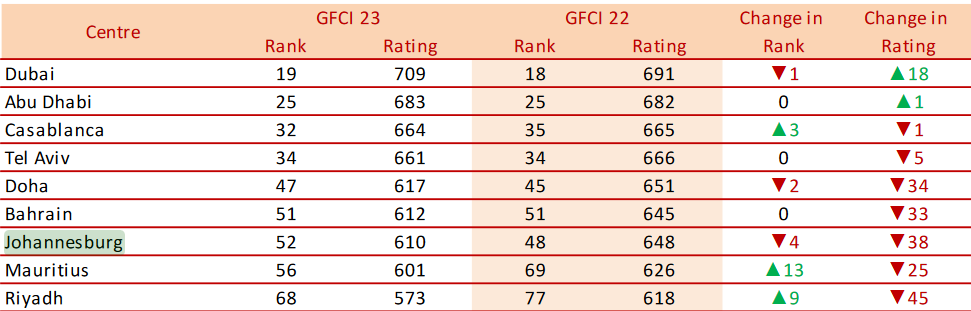
In the Middle East and Africa, only Dubai and Abu Dhabi increased their ratings. Mauritius, Riyadh, and Casablanca improved their ranking despite falls in their ratings.
All centres in Latin America and the Caribbean fell in the GFCI ratings except for the Cayman Islands. Despite the fall in the ratings, six centres rose in the ranks with the Bahamas leading the way rising 22 places. The Cayman Islands are now the leading centre in the region.
“All the top centres have risen in the ratings. London remains on top despite Brexit concerns but rose less than any other centre in the top fifteen,” said Mark Yeandle, director of Z/Yen Partners and the author of the GFCI.
South Africa
Johannesburg is currently the only South African financial centre to feature on the list, ranking at 52.
It is considered to be the second most important financial centre on the African continent, behind Morocco’s Casablanca. Mauritius, and Casablanca improved their rankings despite falls in their ratings.
Joburg is ranked above the likes of Oslo (55), Copenhagen (58), (Milan (61), and Brussels (62), but is below below the likes of Amsterdam (50), Glasgow (49), and Washington DC (48).
Read: The most expensive cities to live in: Joburg vs Cape Town vs Pretoria


















 Loading ...