

Triple-blow for Eskom spells trouble for South Africa


Power utility Eskom has had a rocky start to 2024 with an unexpected early return of load shedding from day one, followed by choppy power supply delivering both outage suspensions and a swift return.
According to electricity minister Kgosientsho Ramokgopa – as well as many energy experts and analysts – South Africans should expect much of the same for the rest of 2024.
Eskom’s generating units are proving unreliable and unpredictable, the minister said this week, and unplanned outages have again started climbing alongside the delayed return of units to service following maintenance.
However, according to independent energy analyst Pieter Jordaan, the swift return to load shedding in 2024 should not have come as a surprise to anyone looking at the data.
Ahead of the return of load shedding from 1 January – after 18 days of zero outages – the ramping up of Eskom’s planned maintenance dispite increasing unit losses made load shedding inevitable at the start of the year.
While the system briefly recovered, delivering some load shedding suspensions again over this past weekend, the return to load shedding on “Trouble Tuesday” was again easily predicted.
“It is noticeable how low the pumped storage reserves were on Sunday, going into a week with an expected up-ramp in demand,” he said.
Eskom was effectively hit from three fronts in the past week, leading to the return of outages:
- Increasing generation losses from breakdowns
- Significantly higher levels of planned maintenance, keeping units offline
- The tanking of energy availability
Analysing the latest data from Eskom on its fleet performance in the first week of the year, this trifecta of blows is evident:
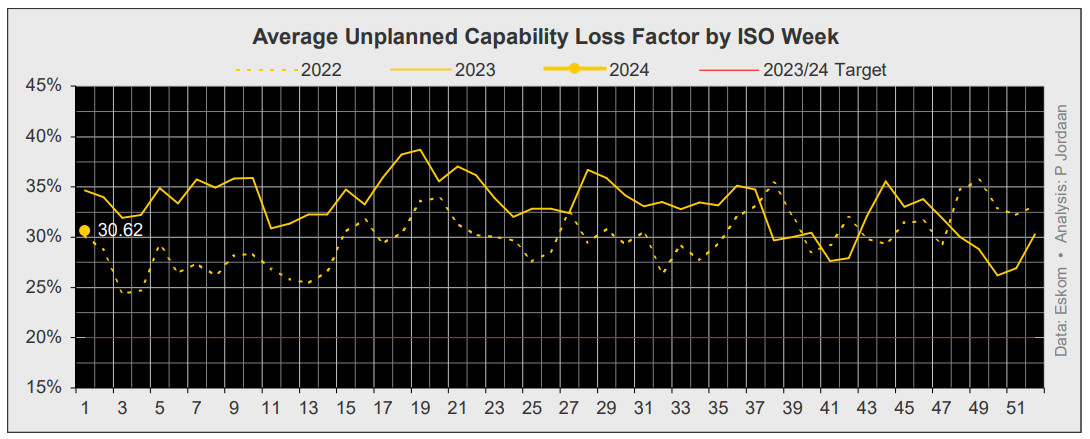
Unplanned outages, while lower than seen during the course of 2023, started creeping higher in the last week of the year, continuing into 2024. A sustained level above 30% makes load shedding all but guaranteed.
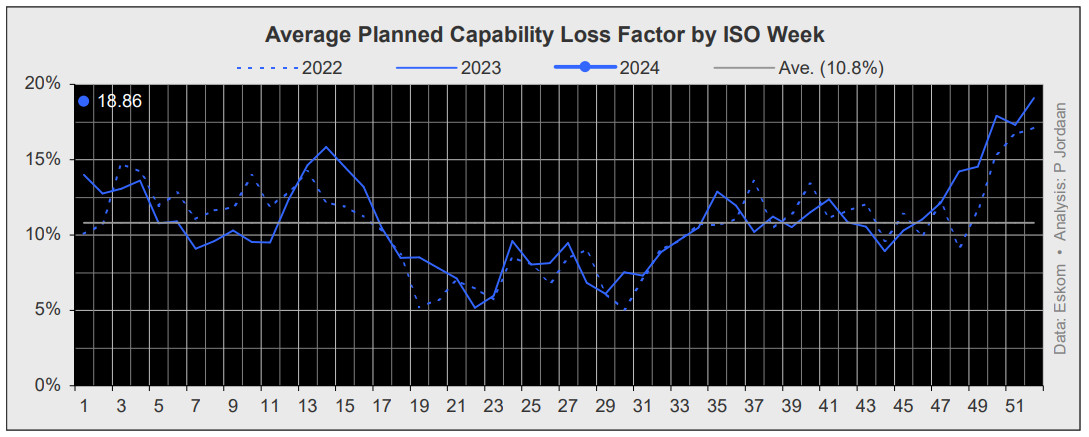
Planned maintenance has shot to record highs as Eskom took advantage of the much lower demand in the holiday period – however, these levels have been sustained in the new year despite demand slowly climbing higher. Meanwhile, delays in returning these units to service tanks energy availability.
The big EAF problem
This scenario ultimately led to the utility’s energy availability factor (EAF) tanking – starting the year below the 50% level.
According to Jordaan, revised data shows that the EAF already dipped below the 50% mark in the prior week (final week of 2023), which is worrying considering the target of 60% EAF was made for March 2023, and 65% is targetted for March 2024.
EAF is nowhere near these level and appears to be getting worse.
Jordaan said that crash in EAF is partly due to the “extraordinary” levels of planned maintenance (PCLF) and a resurgence in breakdowns. In the coming weeks, demand is likely to add even more pressure to the equation.
“The plant unavailability caused blackouts to reappear earlier than hoped, despite ultra-low demand. The data shows that in prior years, week 1 normally posted a much lower PCLF than the previous week.
“The continuation of the lofty PCLF from last week suggests that a substantial portion of the PCLF was, in fact, unplanned as units were simply not returned on time.”
Jordaan said that this scenario creates its own problems as it means that current PCLF levels are inferior to years gone by and are not comparable without a discount.
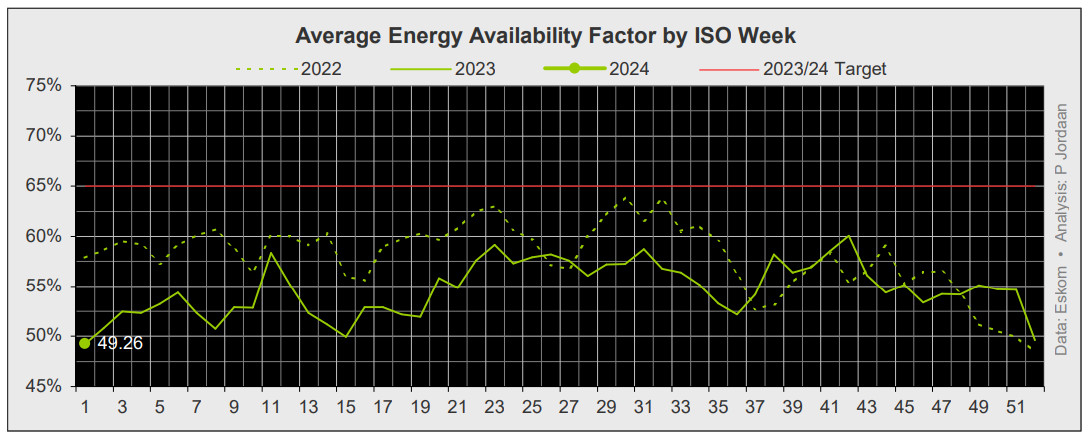
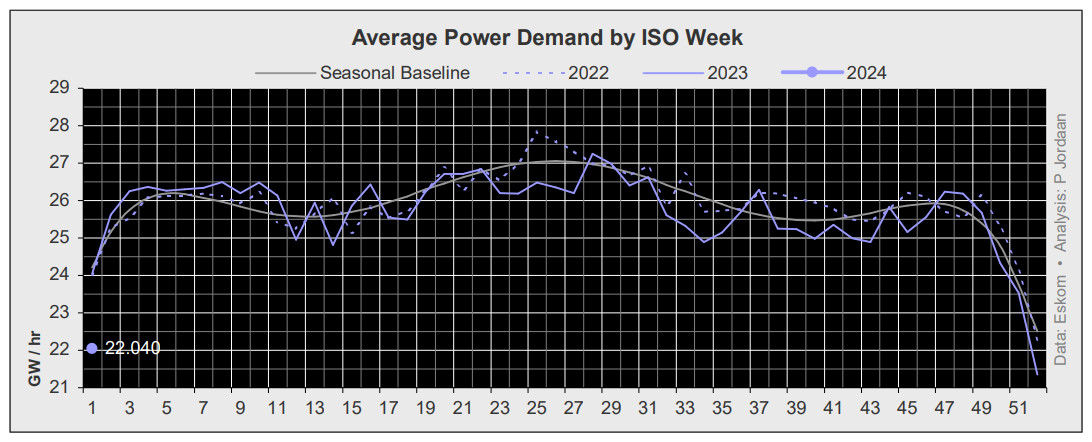
The deterioration in EAF came even though demand was still very low – lower than prior years by some margin.
“The first ISO week of 2024 recorded a seismic shift in demand, dropping 2.2 GW per hour and landing 10% below the seasonal norm of 24.2 GW per hour,” Jordaan said.
“In addition to the effects of the private solar boom, fair weather and holidaymaking also pushed demand lower for longer.”
However, as industries get back to work in the coming weeks, demand is expected to climb rapidly, leaving Eskom with a potentially huge shortfall.
“Supply was also lower than in previous years, despite the return of three and the addition of one, coal-fired units over the past three months. A generation shortfall of 0.8 GW per hour (3.7% of demand) exacted 10.4% in blackout time for the week,” the analyst said.

















 Loading ...