

Here is the expected petrol price for November


Mid-month data from the Central Energy Fund (CEF) show that fuel price recoveries are still deep in the red for petrol and diesel, suggesting likely pain at the pumps next month.
According to the CEF’s data, petrol prices are showing an under-recovery of R2.26 and R2.28 per litre for Petrol 93 and 95, respectively.
Diesel price recoveries are better off, with under-recoveries of R1.37 and R1.46 per litre for 0.05% and 0.005% sulphur, respectively.
At current levels, both petrol and diesel wholesale prices are set to break consecutive record-level pump prices in November following those in October, with the ongoing conflict in the Middle East fuelling disruptions.
Diesel prices first hit their highest-ever level in May 2026, as the impact of the United States’ war against Iran filtered through to global oil markets.
This was followed by petrol prices hitting their worst-ever levels in June 2026.
Before this, both petrol and diesel had hit their worst-ever levels in 2022, after Russia invaded Ukraine—a conflict that is also still ongoing and exacerbating global fuel supplies.
These are the recoveries at mid-month:
- Petrol 93: increase of R2.26 per litre
- Petrol 95: increase of R2.28 per litre
- Diesel 0.05% (wholesale): increase of R1.37 per litre
- Diesel 0.005% (wholesale): increase of R1.46 per litre
- Illuminating paraffin: increase of R3.36 per litre

With half the month still to go, the recovery data can still change. However, at this point in the review period, it is unlikely, especially given the trajectory of the Middle East war.
The path for fuel recoveries relies almost entirely on oil flows, which have only tightened this month.
The oil price remains above $100 a barrel, hitting $106 a barrel on Monday (12 October), and now sits at around $104 a barrel as of 15 October. This is contributing to a R2.50 under-recovery in petrol prices.
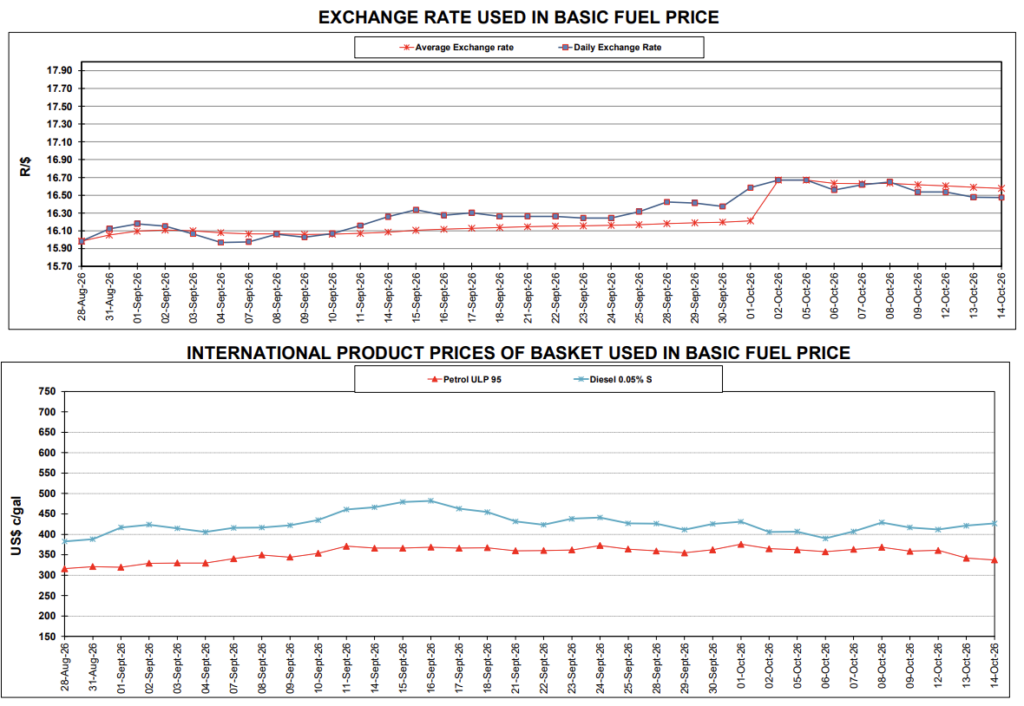
The rand/dollar exchange—which had been offsetting the under-recovery in recent months—is now pushing prices even deeper into the red, adding 50cpl to the negatives.
“The recent rand appreciation has reduced the potential size of the fuel hikes building,” Bishop said.
“However, the gains in the domestic currency against the US dollar over the past week have not been enough to counterbalance elevated international fuel prices.”
Positively, the under-recovery building for November has fallen from R4.60 per litre at the start of the month.
Unfortunately, it has only dropped to around R2 per litre, meaning another significant price hike is still on the way, ready to push prices to yet another record high.
The rand is struggling
The other side of the equation is the rand/dollar exchange rate. The rand has seen a stronger turn in trade at the start of the new week, but it’s nowhere near enough to flip the fortunes in fuel recoveries heading to November.
This is according to Investec Chief Economist, Annabel Bishop, who noted the rand’s recovery against the dollar to around R16.50/$, from R16.70/$ last week.
The issue, she said, is that even though the rand has taken a positive turn, it is still far off from the R16.00/$ levels in early September. It is even further from the R15.70/$ levels it hit before the US-Iran War.
Because of this, the current exchange rate is contributing to a significant under-recovery in fuel prices, compounding the negative balance from global oil prices.
The economist said the logistical constraints in energy markets are expected to persist for some time, with elevated oil and petroleum product prices now expected to last at least into next year.
This will increase import costs for South Africa and constrain its trade balance and growth—all of which will be felt by consumers and the economy at large.
“CPI inflation will likely be above 5.0% y/y when it enters the dry period from the El Nino, and the double whammy (from fuel) could see higher interest rates,” she said.
Bloomberg consensus has revised South Africa’s GDP forecast down for the year, to 1.1% y/y from 1.2% y/y.
There is little room for the government to aid motorists, with Bishop noting that the country’s 2026/27 tax revenue overrun is likely to be smaller than previously expected.
While Parliament is currently processing a bill to aid fuel costs to the tune of R10 billion—with demands from lawmakers that this be in place before December—it is not yet clear where this funding will go.
Finance Minister Enoch Godongwana has made it clear that additional fuel relief would come at a high cost to the budget—something the country can ill afford.
Godongwana is set to deliver his Medium Term Budget Policy Statement on 21 October.
This is how the price changes are expected to reflect at the pumps (Diesel prices reflect wholesale, pump prices will differ):
| Inland | October Official | November Expected |
| 93 Petrol | R29.88 | R32.14 |
| 95 Petrol | R30.25 | R32.53 |
| Diesel 0.05% (wholesale) | R31.95 | R33.32 |
| Diesel 0.005% (wholesale) | R33.29 | R34.75 |
| Illuminating Paraffin | R24.47 | R27.83 |
| Coastal | October Official | November Expected |
| 93 Petrol | R29.09 | R31.35 |
| 95 Petrol | R29.38 | R31.66 |
| Diesel 0.05% (wholesale) | R31.08 | R32.45 |
| Diesel 0.005% (wholesale) | R32.03 | R33.49 |
| Illuminating Paraffin | R23.41 | R26.77 |
Disclaimer: The daily snapshots from the CEF are not entirely predictive of the final fuel price adjustments, and the numbers may change by the end of the month. The Department of Mineral and Petroleum Resources only announces the final price a few days before the implementation date.
The table below outlines the escalating price changes this year.
| Month | Petrol 95 Price | Diesel 0.005% Price (wholesale) |
|---|---|---|
| March 2026 | R20.30 | R18.60 |
| April 2026 | R23.36 | R26.11 |
| May 2026 | R26.63 | R31.88 |
| June 2026 | R28.06 | R29.26 |
| July 2026 | R26.10 | R25.67 |
| August 2026 | R25.58 | R26.90 |
| September 2026 | R26.92 | R30.05 |
| October 2026 | R29.38 (current record) | R33.29 (current record) |
| November 2026 (expected) | R32.53 | R34.75 |


















 Loading ...