

Seacom outage: how business is affected


A number of business ADSL ISPs have responded to queries relating to how the Seacom and Eassy outages have affected their business customers.
Multiple submarine cable systems across Africa, the Middle East and Asia are being affected by cable breaks which are believed to have been caused by a large vessel dragging its anchor across the sea bed off the coast of Egypt.
Two cable systems serving South Africa – Seacom and Eassy – have been hit by the cable breaks in the Mediterranean Sea.
Seacom CEO Mark Simpson said on Saturday (23 March 2013) that the company is continuing to work on restoring transmission and getting restoration services turned on.
“However, this process is proving much more complex and taking longer than we were initially told by our suppliers and would have expected,” Simpson said.

Seacom cable map
Impact on business ADSL
Vox Telecom spokesperson Clayton Timcke said that the ISP is not affected by the Eassy and Seacom’s problems as it has full international redundancy.
Internet Solutions said that there will be a minimal impact on its network for business customers, saying that a rise in latency would be the most obvious effect.
“International DSL traffic has been diverted through the alternative international cable systems, predominantly SAT3 and WACS,” Internet Solutions said.
The small increase in international latency is the extent to which the IS user base has been impacted by the Seacom outage.
“IS will continue to monitor the DSL network to ensure that any negative impact on the user experience is mitigated as far as possible,” it said.
Web Africa said that there was some impact on its international link on Friday when its Seacom capacity failed over to SAT3, “but we have provisioned additional capacity over WACS to alleviate any load on the network,” said Web Africa COO, Rupert Bryant.
Cybersmart CEO Laurie Fialkov said that business customers would see very little difference in their services.
“We were one of the first to take capacity on Seacom and we got hit hard with the original set of outages, since then we have taken steps to mitigate a single cable system failure,” Fialkov said.

Laurie Fialkov
Fialkov explained that the ISP We has taken capacity on both WACS and SAT-3.
“The standard way of doing this is to take 1/3rd on Seacom , 1/3rd on WACS and 1/3rd on SAT-3. Given that we have had more outages on Seacom than the other cable system, we have a weighting of 20% seacom, 40% wacs and 40% sat-3,” he said.
“In summary, we are impacted, but not that severely, we have compensated by reducing p2p and software update throughput during business hours.”
Vodacom said it has been completely unaffected by the Seacom outage.
Mweb Business didn’t return comment by time of publishing, but it was previously reported that the Mweb consumer ISP network was heavily hit by the Seacom downtime.
Mweb ISP Derek Hershaw said that the ISP has capacity on the WACS cable, but with Seacom completely down, this only covers about 45% of the total requirement.
According to a tweet from Mweb, early indications are that it may take up to two weeks to repair the break and restore the cables to full capacity.
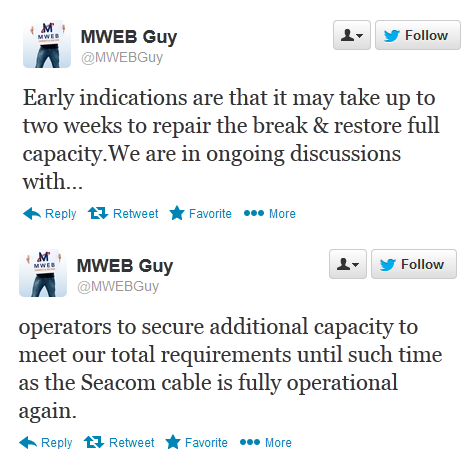
Seacom downtime tweet
Afrihost hadn’t responded to queries by the time of publishing, however Afrihost director Greg Payne said that the Seacom issues are not affecting Afrihost’s network at all (hence its business network included) as they only use Seacom as a backup.
However, Afrihost uses the Eassy cable which forced the ISP to re-route traffic over WACS while the circuit is down.
More Seacom articles
Seacom apologizes for downtime

















 Loading ...