

How much South Africans are paying in rent



The latest PayProp rental index for the third quarter of 2017 paints a pretty bleak picture for high-earning renters in South Africa, who are spending disproportionately more on rent than their lower-earning counterparts.
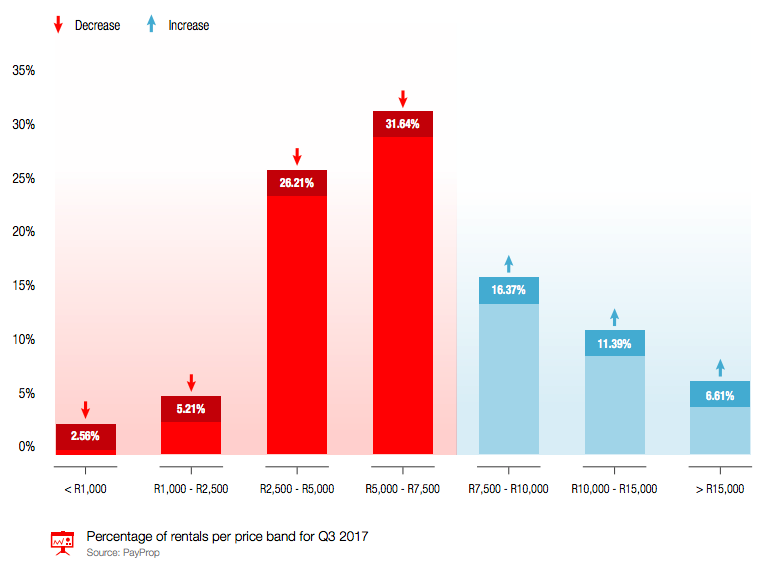
The index shows that the almost a third of tenants rent for between R5,000 and R7,500, which has remained the most ‘popular’ rent bracket for some time.
PayProp noted that the proportion of tenants in the higher brackets (R7,500 and higher) go up over time, while those in the lower rental brackets diminish.
“The question we need to ask is this: is this shift driven by demand from tenants or rising rental prices? To answer this question, we need to look at the kinds of tenants who rent in these bands,” PayProp said.
The common assumption is that tenants who rent more expensive properties have higher incomes and higher levels of financial sophistication, and for the most part, the facts bear this out, the group said.
“When we consider average income per rent bracket, indeed we see that tenants who rent more expensive properties have higher incomes. Average credit measures tell a similar story – tenants who rent for more and have higher incomes also have better credit scores and lower debt-to-income ratios.”
A smaller percentage of these tenants are therefore high-risk clients – “but this doesn’t mean tenants with higher income spend any less – quite the contrary,” PayProp said.
Such tenants tend to have more CPA accounts (day-to-day accounts like retail accounts and cellphone contracts) and higher debt repayments, but their debt as a percentage of income is lower.
“However, one very interesting statistic in all of this: the percentage of income spent on rent tends to increase as income increases. Somehow, high earners spend disproportionately more on rent than lower-income earners,” it said.
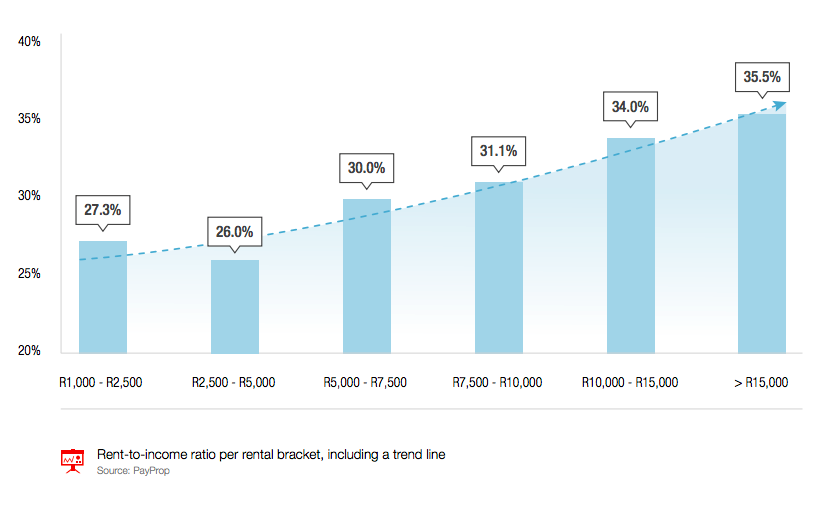
“By all appearances, renters in the higher rental brackets are aspirational – that is, they try to ‘keep up with the Joneses’. The more a tenant earns, the higher the desire to display that fact.”
But higher levels of rent (and more CPA accounts) could mean these tenants are spending more money than necessary.
“From our analysis of the available data, it appears that tenants at the lower end of the more expensive rental bands (properties renting for R7,500 to R10,000) struggle to keep their heads above water.”
“While there was no decrease in credit scores in the past year in any of the upper three rental brackets, there has been a noteworthy increase of almost 16% in the debt-to-income ratio in the R7,500 – R10,000 bracket. This is due to a high increase in debt repayments (13.6%), coupled with a decrease in nominal income over the same period (2.3%),” the group said.
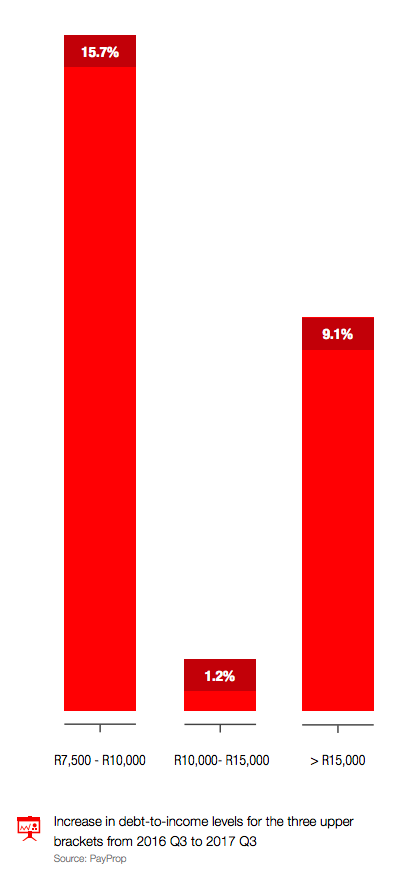
The increase in debt-to-income ratio of the average tenant in this bracket, along with an above-average increase in the percentage of tenants with major delinquencies (up from 33.2% to 36.3% over the past year), indicate that these tenants are under pressure and their credit situation might deteriorate further if left unmanaged, PayProp said.
“It is worth mentioning that the above-R15,000 rental bracket has the lowest percentage of tenants with major delinquencies at 32.3%, but this number is up by almost a quarter from a year ago, when it was at 26.2%. The average debt-to-income ratio in that bracket also increased by 9%.”
“These statistics highlight once again the importance of affordability checks, even for tenants with high income levels and good credit scores. Tough economic times and stagnant income levels put tenants in all rental brackets under pressure,” it said.
















 Loading ...