

Ramaphosa and other officials are meeting to discuss South Africa’s future – here’s what they are talking about


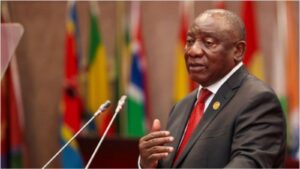
President Cyril Ramaphosa and other top government officials are meeting at a cabinet lekgotla this week, ahead of February’s state of the nation address.
Minister in the presidency, Jackson Mthembu, said that the talks will focus on a number of issues including the establishment of a medium-term strategic framework (MTSF) which will cover government’s plans for the country over the next five years.
“After the elections in 2019, the cabinet literally converted the manifesto of the governing party into its programme of action,” said Mthembu
“As you also know, that manifesto was converted into seven priority areas that will guide the work of government over the next five years.”
The seven priorities are:
- Economic transformation and job creation;
- Education, skills and health;
- Consolidating the social wage through reliable and quality basic services;
- Spatial integration, human settlements and local government;
- Social cohesion and safe communities;
- A capable, ethical and developmental state;
- A better Africa and world.
SAA and Eskom
Besides the MTSF, Mthembu said that the lekgotla will focus on the country’s state-owned enterprises – specifically SAA and Eskom.
Mthembu said that state-owned enterprises are important in ensuring that the country’s economy grows and that government plans to do a lot of work in ‘resuscitating and repurposing them’.
Eskom chief executive officer Andre de Ruyter presented a draft plan to change how the utility operates this week, however the unbundling of the company is likely to happen at a slower pace than envisaged by the government.
In a plan unveiled in October, Public Enterprises Minister Pravin Gordhan set out a series of steps to restore stability to Eskom, including exposing it to greater competition, lowering fuel costs, increasing renewable-energy output and selling non-core assets.
Gordhan also called for the utility to be split into three units — power transmission, generation and distribution — with the first of those divisions to be spun off by March.
This week also saw the start of a rescue for South African Airways, with the embattled airline securing a R3.5 billion loan from the Development Bank.
The company’s business rescue practitioners said that the restructuring of SAA will provide an opportunity to develop a sustainable, competitive and efficient airline with a strategic equity partner remaining the objective of government.
Economy
Mthembu also confirmed that the meeting will receive a presentation by finance minister Tito Mboweni on the state of the economy.
Economic Development Minister Ebrahim Patel will also provide a presentation on what government should be doing to grow the economy.
Mboweni’s February Budget is seen as a key date for South Africa and will likely be a decider as to whether ratings agency Moody’s decides to downgrade the country’s credit rating.
A downgrade will see South Africa without any investment-grade ranking for the first time in 25 years.
That would cause it to fall out of the FTSE World Government Bond Index, which could prompt a selloff and outflows of as much as $15 billion, according to Bank of New York Mellon Corp.
Mboweni’s budget is also likely to include a number of major tax hikes including the possibility of VAT, fuel levy and income tax increases, economists have warned.
Policy changes
While not expressly mentioned by Mthembu, government policy and new legislation will almost certainly be discussed during the meeting.
Chief among these considerations will be the Draft Constitution Eighteenth Amendment Bill allowing for land expropriation without compensation.
The ANC recently indicated that it does not support the idea of courts being the decision-maker on whether or not the state will pay for land it expropriates.
It instead plans to give this power to the minister of land reform who will be the sole arbiter on land expropriation cases in the country.
Other key policy issues that will likely be in the limelight include the nationalisation of the Reserve Bank, an increase in the minimum wage, education reforms, and the introduction of new performance reviews for ministers.
Read: Top government officials will now have their performance reviewed twice a year













 Loading ...